
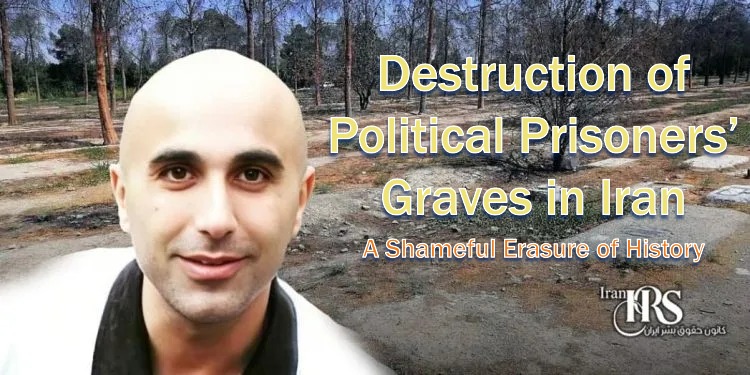
Iran’s regime destroys political prisoners’ graves to erase 1980s massacre evidence, violating human rights.
A Deliberate Assault on Memory
Iran Human Rights Society, Tuesday, August 25, 2025 – Iran’s regime bulldozes political prisoners’ graves, sparking global outrage. Authorities recently demolished a sacred cemetery site, erasing evidence of 1980s mass executions. This act violates human rights and denies families their right to mourn. Hamid Haj Jafar Kashani, a political prisoner, condemns this desecration from Qezel Hesar Prison. This article explores the regime’s actions, their devastating impact, and the urgent need for accountability. The destruction of political prisoners’ graves is not just an attack on stone—it’s an assault on truth, memory, and justice.
Erasing Traces of Atrocities

The destruction of political prisoners’ graves marks a calculated attempt to erase Iran’s dark history. Bulldozers recently flattened a cemetery holding thousands of graves of dissidents executed in the 1980s. Authorities claimed the site was abandoned, converting it into a parking lot. However, this move deliberately eliminates evidence of past atrocities. The regime aims to obscure the truth about mass executions, where countless individuals lost their lives for opposing political and economic oppression. Families, long harassed at these graves, now face further anguish, denied the chance to honor their loved ones. This act deepens their pain and erases a crucial part of Iran’s history.
The regime’s efforts to destroy these graves reflect a broader strategy to rewrite the narrative. By removing physical evidence, they hope to silence the stories of resistance. Yet, the memories of these martyrs endure in the hearts of their families and supporters. The destruction only highlights the regime’s fear of accountability. It also underscores the need for global awareness to preserve the truth.
Hamid Haj Jafar Kashani’s Courageous Stand
From Qezel Hesar Prison, Hamid Haj Jafar Kashani pens a powerful letter. He calls the regime a radical group that thrives on suppressing dissent. Kashani, a former futsal referee arrested for protesting on April 27, 2025, describes the destruction of graves as an attempt to erase a shameful record. He declares that even after death, these fighters face violations. His words reveal the regime’s desperation to erase the martyrs’ legacy. In Qezel Hesar’s Political Ward, Kashani shares a cell with seven others awaiting execution. He describes the solitary cells before execution as “darkrooms,” where prisoners lose their former selves in a harrowing psychological ordeal.
Kashani’s letter is a testament to his resilience. Despite facing execution, he refuses to stay silent. His courage inspires others to speak out against the regime’s actions. Moreover, his vivid descriptions of prison life highlight the ongoing human rights abuses in Iran. His voice, though confined, carries the weight of truth and defiance.
A Life Under Oppression

Kashani reflects on his 43 years living under a regime that hijacked a revolution with false promises of free resources. Instead, they established a brutal dictatorship. The regime imprisoned, tortured, and executed dissenters, creating a climate of fear. Now, by attacking cemeteries, they aim to erase evidence of these crimes. Kashani questions why his cellmates endure such suffering. He emphasizes that destroying graves cannot hide the truth. Instead, it reveals the regime’s desperation to avoid accountability.
The regime’s actions stem from fear. They know the graves symbolize resistance and truth. By destroying them, they hope to erase the memory of those who fought for freedom. However, Kashani’s letter proves that the spirit of resistance lives on. His words challenge the regime’s narrative and inspire others to fight for justice.
Human Rights Violations in Grave Destruction
Destroying political prisoners’ graves violates core human rights principles:
- Article 1 of the Universal Declaration of Human Rights: All human beings are born free and equal in dignity and rights. Destroying graves denies the deceased’s dignity, treating them as lesser beings.
- Article 3 of the Universal Declaration of Human Rights: Everyone has the right to life, liberty, and security of person. Erasing graves undermines families’ psychological security by removing memorials.
- Article 5 of the Universal Declaration of Human Rights: No one shall face torture or cruel, inhuman treatment. Preventing mourning inflicts psychological torture on families.
- Article 7 of the Universal Declaration of Human Rights: All are equal before the law. Targeting only political prisoners’ graves shows clear discrimination.
- Article 12 of the Universal Declaration of Human Rights: No one shall face arbitrary interference with their privacy or attacks on their honor. Destroying graves assaults families’ dignity.
- Article 18 of the Universal Declaration of Human Rights: Everyone has the right to freedom of thought and conscience. Mourning is part of this freedom, which grave destruction violates.
- Article 19 of the Universal Declaration of Human Rights: Everyone has the right to freedom of expression. Graves symbolize resistance; their destruction censors this message.
- Article 22 of the International Covenant on Civil and Political Rights: Everyone has the right to freedom of association. Families gathering at graves is a peaceful act, denied by this destruction.
These violations reflect systemic abuse. The regime disregards global standards, demanding a response to hold perpetrators accountable.
See also the below articles:
- Sheiban Prison: Political Prisoners Face Life-Threatening Conditions
- Tuesdays Against Execution: 83rd Week of Hunger Strikes in 50 Prisons
Follow Iran Human Rights Society on social networks:
Telegram /Twitter /Instagram / YouTube / Facebook
Join Iran Human Rights Society on Twitter




Discussion about this post