
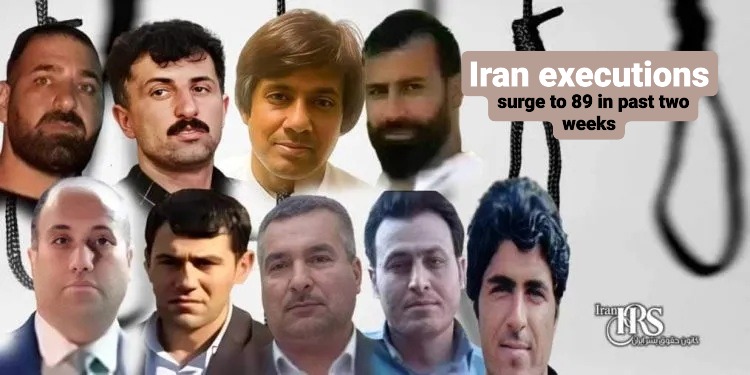
Iran executions surge to 89 in past two weeks, with 15 prisoners executed in Sanandaj, Qezel Hesar, and more

Iran Human Rights Society, Sunday, September 7, 2025 – Iran executions have reached alarming levels, with at least 89 prisoners executed in past two weeks alone. This equates to over four executions daily, or one every six hours. On September 6 and 7, 2025, authorities executed 15 prisoners in prisons across Sanandaj, Qezel Hesar, Arak, Tabriz, Isfahan, Dezful, Zahedan, and Minab. These actions raise serious concerns about human rights violations and Iran’s disregard for international obligations. This article explores the details of these executions and their conflict with global human rights standards.
Executions in Sanandaj Prison: Azad Moradi’s Case
Authorities executed 34-year-old Azad Moradi in Sanandaj Prison on September 7, 2025. Moradi, from Qalyava near Baneh, faced murder charges and received a death sentence after his arrest five years ago. His execution highlights the ongoing use of capital punishment for serious crimes in Iran. However, questions about fair trials persist, as many cases lack transparency.
Qezel Hesar Prison: Dariush Bahrami Garavand Executed
On the same day, Qezel Hesar Prison in Karaj saw the execution of Dariush Bahrami Garavand. The 40-year-old from Kuhdasht, Lorestan, faced drug-related charges. His case reflects Iran’s harsh penalties for drug offenses, often criticized for lacking due process. The rapid pace of executions in Qezel Hesar underscores the prison’s role as a major execution site.
Arak Prison: Two Prisoners Hanged
Arak Prison executed two prisoners, Ahmad Rafiei and Gholamreza, on September 7, 2025, for drug-related offenses. These executions add to the growing tally of drug-related death penalties in Iran. Critics argue that such punishments disproportionately target marginalized groups and fail to address systemic issues like poverty or addiction.
Tabriz Prison: Five Executions on Drug Charges
Tabriz Prison executed five prisoners on September 7, 2025, all charged with drug-related offenses. The prisoners were Keyvan Mamadi from Darik village, Najib Azarm from Kalankani village, Tofigh Nemati and Houshang Henareh from Baradust, and Babak Omrzadeh from a nearby village. These cases highlight the widespread use of the death penalty for non-violent crimes in Iran, raising ethical concerns.
Dezful Prison: Taleb Tavakoli’s Execution
In Dezful Prison, authorities executed 37-year-old Taleb Tavakoli on September 7, 2025. Arrested four years ago on murder charges, Tavakoli’s case mirrors others where lengthy detentions precede executions. The lack of transparent legal processes in such cases fuels criticism of Iran’s judicial system.
Zahedan Prison: Masoud Ghanbarzehi Executed
Masoud Ghanbarzehi, 38, faced execution in Zahedan Prison on September 7, 2025, for murder charges stemming from a 2015 arrest. His case illustrates the targeting of ethnic minorities, as he hailed from the Baluch community. Reports suggest Baluch prisoners face disproportionate executions, often under questionable circumstances.
Minab Prison: Mohammad Mirbaluchzehi’s Death Sentence
Mohammad Mirbaluchzehi, a 46-year-old father of four, was executed in Minab Prison on September 7, 2025, for drug-related charges from a 2015 arrest. His execution further exemplifies Iran’s reliance on capital punishment for drug offenses, despite international calls for reform.
Isfahan’s Dastgerd Prison: Three Prisoners Executed
On September 6, 2025, Dastgerd Prison in Isfahan executed Mohammad Bikar, Taher Rasoulpour, and Moslem Salehkhani. Bikar, 34, faced murder charges, while Rasoulpour and Salehkhani, both convicted of drug offenses, highlight the diverse charges leading to executions. Salehkhani, a father and former car dealership worker, leaves behind a grieving family.
Iran Executions Violate Human Rights Standards
The Universal Declaration of Human Rights, specifically Article 3, guarantees the right to life. Iran executions directly challenge this principle, as the death penalty is irreversible and prone to judicial errors. Some execution methods may also constitute torture, violating human rights norms. Furthermore, Article 6 of the International Covenant on Civil and Political Rights, to which Iran is a signatory, mandates fair trials for death penalty cases. Yet, many Iran executions involve opaque processes, limited legal representation, and courts lacking independence.
Why Iran’s Execution Spree Matters
The surge in Iran executions, with 89 reported in September 2025, signals a deepening human rights crisis. The UN Human Rights Office reported at least 841 executions in 2025 up to August 28, a sharp rise from 901 in all of 2024. These figures suggest an intensifying crackdown on dissent, ethnic minorities, and minor offenses like drug possession. International bodies, including Amnesty International, condemn Iran’s use of the death penalty as a tool to suppress opposition.
See also the below articles:
- Execution of Political Prisoner Mehran Bahramian in Dastgerd Prison, Isfahan
- Omid Fathi’s Courageous Hunger Strike
Follow Iran Human Rights Society on social networks:
Telegram /Twitter /Instagram / YouTube / Facebook
Join Iran Human Rights Society on Twitter






Discussion about this post