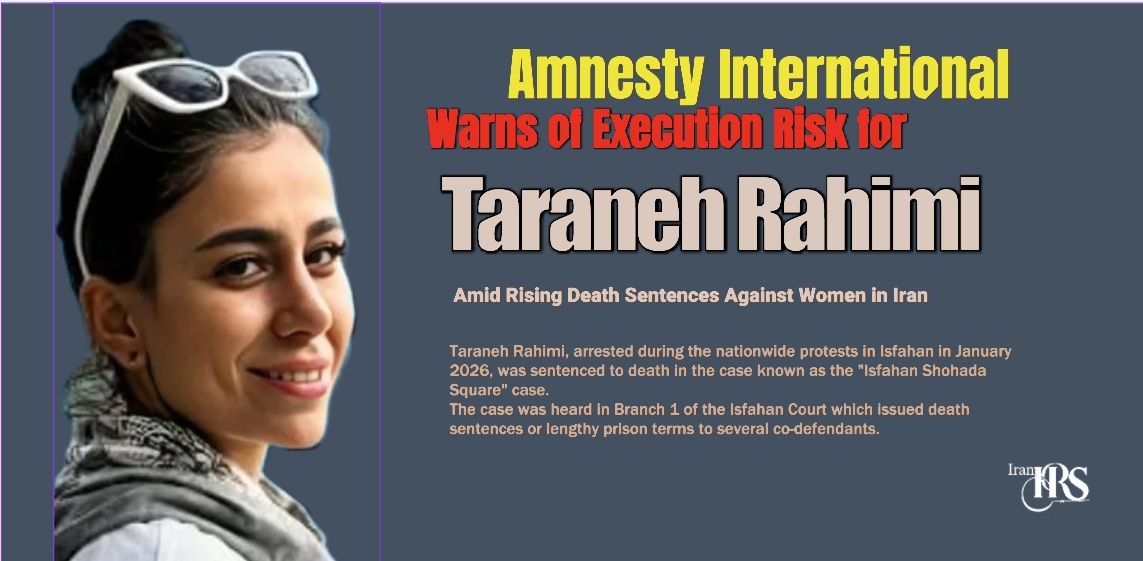
Amnesty International has called for an immediate halt to the execution of Taraneh Rahimi, a young protester detained during the January 2026 demonstrations in Isfahan. This warning comes amid human rights reports pointing to an increase in death sentences handed down against women, the use of torture and forced confessions in security cases, and severe restrictions on defendants’ access to legal counsel.

Iran Human Rights Society, Friday, October 23, 2026 – In a statement on its official X (formerly Twitter) account, Amnesty International demanded an end to the execution of Taraneh Rahimi and urged the international community to pay urgent attention to the plight of women sentenced to death in Iran. The organization warned of the imminent risk of execution in cases marred by political and security charges and reported violations of due process rights.
Amnesty International Calls for a Halt to Taraneh Rahimi’s Execution
Taraneh Rahimi, arrested during the nationwide protests in Isfahan in January 2026, was sentenced to death in the case known as the “Isfahan Shohada Square” case. The case was heard in Branch 1 of the Isfahan Revolutionary Court, which issued death sentences or lengthy prison terms to several co-defendants.
According to human rights organizations, the judicial proceedings were characterized by severe restrictions on defense attorneys’ access to case files and reports of forced confessions extracted under duress.
Reports of Torture and Denial of Medical Treatment
Reports concerning Taraneh Rahimi indicate that she and her twin sister, Romina Rahimi, were subjected to intense physical and psychological pressure following their arrest. Relatives stated that visible signs of beatings and mistreatment were noticeable during family visits.
Furthermore, reports state that Taraneh Rahimi required specialized medical treatment for physical injuries sustained in custody but faced strict obstacles preventing her transfer to a hospital. Romina Rahimi has been sentenced to 25 years in prison under the same case.
Growing Concern Over Death Sentences for Women
Amnesty International’s recent warning extends beyond a single case. Human rights organizations report a rising number of women facing the death penalty on political, security, or protest-related charges.
Among these cases, the sentences passed against Taraneh Rahimi, Leila Abolhasani, Mahboubeh Shabani, and Marzieh Ebrahimi Shamsabadi have drawn significant concern from human rights bodies. The legal status of these women varies, and each case warrants independent examination.
European Parliament’s Response to Death Sentences Against Female Protesters
On October 8, 2026, the European Parliament adopted a resolution regarding the human rights situation in Iran. The resolution passed with 541 votes in favor, 11 opposed, and 25 abstentions.
Condemning the death sentences handed down to Taraneh Rahimi and Leila Abolhasani, Members of the European Parliament demanded the immediate annulment of these sentences, a stop to all executions, and the release of political prisoners. The legislative body also expressed deep concern over the increasing use of the death penalty against women and the reliance on security charges to suppress civic activity and protest.
Warning Over Executions Related to January Protests
Amnesty International previously reported that at least 34 people had been executed in connection with the January 2026 protests following grossly unfair trials.
The organization further warned that the Supreme Court has upheld the death sentences of at least 20 additional individuals whose lives remain at immediate risk. Amnesty International has reiterated its call for an immediate end to executions and urgent international intervention to prevent further killings.
Legal Analysis of Female Executions Under Domestic Law
The legislative framework imposed by Iran’s ruling regime has drawn constant criticism for violating international due process standards and curtailing basic human rights. Examining these cases under domestic laws does not imply endorsement of these statutes, but serves to demonstrate that the regime fails to observe even its own legal requirements.
Procedural Ambiguities
Reports of torture, forced confessions, denial of access to legal representation, and restrictions on examining case files severely undermine the legitimacy and credibility of these judicial proceedings.
Relevant Statutory Articles
Articles 35, 37, and 38 of the Iranian Constitution explicitly protect the right to legal representation, the presumption of innocence, and the absolute prohibition of torture. Furthermore, Article 169 of the Islamic Penal Code invalidates confessions obtained through coercion or physical abuse.
Procedural Violations
Extracting confessions under duress, denying effective legal defense, and ignoring complaints of torture directly contradict the aforementioned legal guarantees.
Analysis from a Human Rights Perspective and Violation of International Standards
Articles 3, 5, 10, and 11 of the Universal Declaration of Human Rights (UDHR) safeguard the right to life, the prohibition of torture, the right to a fair trial, and the presumption of innocence. Articles 6, 7, and 14 of the International Covenant on Civil and Political Rights (ICCPR) guarantee these exact protections.
Issuing a death sentence following a trial lacking fundamental fair-trial guarantees constitutes an arbitrary deprivation of the right to life. Additionally, withholding necessary medical treatment from detainees violates fundamental international human rights standards.
See also the below articles:
- Elya Ben-Rashid Sentenced to Death in Isfahan
- Mai Sato; Guterres Presented Report on Executions and Suppression of Protesters to the General Assembly
Follow Iran Human Rights Society on social networks:
Telegram /Twitter /Instagram / YouTube / Facebook
Join Iran Human Rights Society on Twitter