
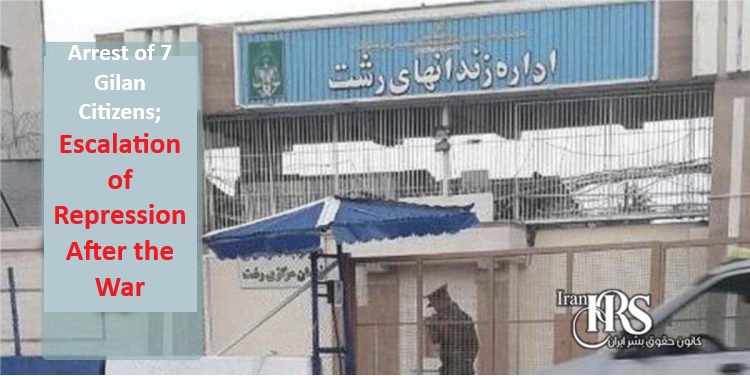
Seven Gilan citizens arrested without warrants, held in Lakan Prison, Rasht. Post-war repression escalates with vague charges, violating human rights.
Iran Human Rights Society, Friday, July 11, 2025 –The arrest of seven Gilan citizens, now detained in Lakan Prison, Rasht, marks a troubling escalation of repression in Iran following the recent 12-day war ceasefire. On July 11, 2025, security forces apprehended these individuals, aged 24 to 55, without judicial warrants, charging them with “collaboration with a hostile government.” This vague accusation, often used to silence dissent, highlights a broader crackdown on activists, journalists, and social media users in Gilan and beyond. As the regime intensifies its security measures, concerns grow over human rights violations, lack of judicial transparency, and the denial of legal access for detainees. This article explores the arrests, the conditions in Lakan Prison, and the broader implications of Iran’s post-war repression tactics.
Heightened Repression in Gilan After the War
Following the ceasefire, Iran’s northern provinces, particularly Gilan, face a tightened security grip. Authorities arrested seven citizens at their homes or workplaces, transferring them to Lakan Prison in Rasht. Reports confirm these arrests occurred without formal judicial warrants, raising alarms among human rights groups. The detainees, ranging in age from 24 to 55, face charges of “collaboration with a hostile government.” However, families report no access to lawyers or in-person visits, and authorities refuse to provide clear information. This lack of transparency fuels fears of a new wave of repression targeting dissenters in the post-war climate.
Vague Charges Fuel Suppression of Dissent
The charge of “collaboration with a hostile government” remains a favored tool for Iran’s security apparatus. Authorities frequently apply this ambiguous accusation to silence critics, including activists, journalists, and social media users. For instance, individuals who give interviews to Persian-language media abroad or post critical content online often face this charge. Without a clear legal definition, the accusation allows subjective interpretations, enabling the regime to prosecute dissenters without substantial evidence. Consequently, this tactic stifles free expression and punishes those who challenge the regime’s narrative, creating an atmosphere of fear.
Basij Forces Intensify Policing in Gilan
As military tensions ease, Iran’s internal security measures grow stricter. Local sources in Gilan report increased Basij patrols and plainclothes agents monitoring public spaces. Furthermore, unofficial reports suggest Basij forces now operate with broad authority to suppress civil activities or protests. This mirrors the repression following the Iran-Iraq War, particularly the mass arrests and executions in 1988. Today, the regime’s heightened policing, coupled with threatening phone calls and activist summons, signals a deliberate effort to curb dissent. These actions aim to prevent public unrest amid growing dissatisfaction with the regime’s policies.
Propaganda Justifies Harsh Crackdowns
Media outlets linked to the Islamic Revolutionary Guard Corps, such as Fars News, have recently intensified their rhetoric. Some articles openly call for a “repeat of the 1988 summer,” glorifying the mass executions of political prisoners as a solution to current crises. Such propaganda not only justifies past atrocities but also emboldens ongoing repression. Meanwhile, families of 1988 victims still lack closure, unaware of their loved ones’ burial sites. This narrative underscores theregime’s reliance on fear and violence to maintain control, further alienating a society grappling with economic and social challenges.
Lakan Prison: A Hub of Human Rights Concerns
Lakan Prison in Rasht, where the seven Gilan citizens are held, has a troubling record. Human rights organizations repeatedly highlight its lack of judicial transparency and frequent denial of legal access. Detainees often endure weeks without contact with families or the outside world. Moreover, reports of torture in the prison’s temporary detention facilities raise serious concerns. The facility’s conditions and practices violate basic human rights standards, making it a focal point for criticism of Iran’s judicial system. For the detained Gilan citizens, these conditions amplify the urgency of addressing their plight.
Preemptive Arrests to Delay Protests
Analysts argue that the regime, weakened by war, inflation, and widespread poverty, anticipates a surge in public protests. Therefore, the recent arrests in Gilan and increased security measures aim to preempt dissent. By targeting activists and ordinary citizens, the regime seeks to intimidate society and delay unrest. Historical patterns support this view, as preemptive arrests often precede significant social or political developments. However, these tactics risk further eroding the regime’s legitimacy, as public frustration grows over economic mismanagement and lack of accountability.
Human Rights Violations in Lakan Prison Transfers
The arbitrary arrests and transfers to Lakan Prison violate several international human rights standards. Specifically:
- Article 9, Universal Declaration of Human Rights: Arbitrary arrests without warrants infringe on the right to liberty and security.
- Article 10, International Covenant on Civil and Political Rights: Denying access to lawyers and fair trials undermines judicial fairness.
- Article 19, Universal Declaration of Human Rights: Punishing free expression through vague charges stifles freedom of speech.
These violations highlight a systemic disregard for global human rights obligations, drawing condemnation from international observers.
A Deepening Divide Between Regime and Society
The arrests of seven Gilan citizens and their detention in Lakan Prison reflect a broader strategy of repression. As the regime tightens its grip post-war, it resorts to familiar tactics: arbitrary arrests, vague charges, and restricted legal access. However, these actions deepen the rift between the government and its people. While citizens demand accountability and reform, the regime chooses suppression, risking further unrest. The situation in Gilan, coupled with propaganda glorifying past violence, signals a troubling path forward. Without meaningful change, the cycle of repression and resistance will likely persist, challenging Iran’s social and political stability.
Follow Iran Human Rights Society on social networks:
Telegram /Twitter /Instagram / YouTube / Facebook
Join Iran Human Rights Society on Twitter







Discussion about this post