
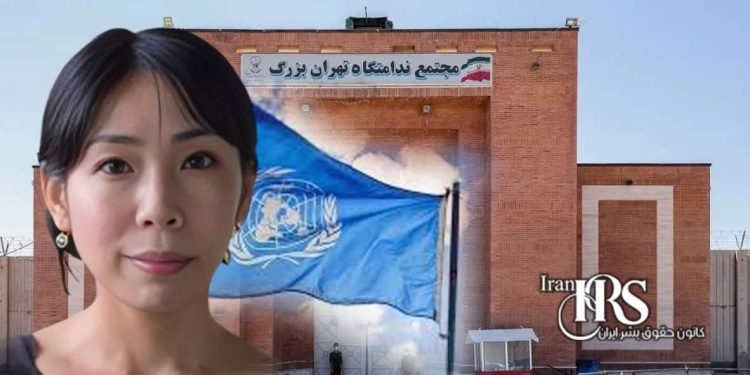
Ms. Mai Sato, the UN Special Rapporteur on Human Rights in Iran, expressed alarm on the social media platform “X” about the concerning conditions of the forced transfer of prisoners from Evin Prison and their detention in Greater Tehran Prison. She specifically highlighted her concern for the situation of Ali Younesi, an elite student and political prisoner.
Wednesday, May 24, 2025, Iran Human Rights Society– Ms. Mai Sato warned about the troubling conditions surrounding the forced transfer of prisoners from Evin Prison to Greater Tehran Prison. She particularly expressed concern about Ali Younesi, describing his case as an example of inhumane treatment and a violation of prisoners’ fundamental rights. She stated on X:
“I have received disturbing reports about the transfer of prisoners from Evin Prison during and after Israel’s attacks. The case of Ali Younesi is particularly alarming. According to reports, he was forcibly transferred from Ward 4 of Evin Prison on June 19, and since then, his family has had no information about his whereabouts.”
Mai Sato’s Concerns Over Arbitrary Detentions and Violations of Due Process
Ms. Sato also pointed to reports of arbitrary detentions, executions of activists, journalists, social media users, and Afghan citizens, describing this trend as indicative of a weakened judicial system and disregard for fair trial principles. She wrote on her X account:
“I am also concerned about reports of arbitrary detentions, executions of activists, journalists, social media users, and Afghan citizens, as well as expedited and flawed trials that violate fair trial principles since the onset of Israel’s attacks. These issues have been raised in a joint statement with the UN Fact-Finding Committee.”
Ali Younesi, a distinguished student at Sharif University of Technology and an astronomy Olympiad medalist, was previously sentenced to 16 years in prison—a ruling that human rights organizations say was issued through a flawed judicial process lacking legal standards. Concerns about his physical and mental well-being have intensified following his forced transfer and disappearance.
Inhumane Conditions in Greater Tehran Prison
According to credible reports, dozens of political prisoners recently transferred from Evin Prison to Greater Tehran Prison are being held in inhumane and shocking conditions. These transfers were conducted without prior notice, without permission to take personal belongings, and under pressure and threats from security forces.
In Greater Tehran Prison, rooms designed for 20 people are now holding up to 50 prisoners. Many are forced to sleep on the floor, which not only violates human dignity but also leads to the spread of skin diseases and physical ailments.
Lack of Access to Medication, Hygiene, and Food
Sick prisoners have no access to medication or healthcare services. The situation is reported to be particularly critical for elderly prisoners and those with pre-existing medical conditions, many of whom suffer from pain and illness without any response from prison authorities.
Food supply in the prison is severely inadequate, with many prisoners suffering from malnutrition and hunger due to insufficient food and the inability to purchase from the prison store. Additionally, the drinking water in Greater Tehran Prison is brackish and undrinkable, and prisoners lack access to cooling facilities during the summer heat.
Responsibility Lies with Evin and Greater Tehran Prison Authorities
Human rights activists and prisoners’ families emphasize that the responsibility for these inhumane conditions lies with the authorities of Evin and Greater Tehran Prisons. The decision to forcibly transfer prisoners, the failure to provide basic facilities, the neglect of medical needs, and the denial of family contact all constitute serious human rights violations.
Gross Violations of Human Rights Under International Standards
The treatment of prisoners in Greater Tehran Prison is a clear violation of international human rights instruments:
Article 5 of the Universal Declaration of Human Rights: “No one shall be subjected to torture or to cruel, inhuman, or degrading treatment or punishment.”
Article 10: “Everyone is entitled to a fair and public hearing by an independent and impartial tribunal.”
Article 7 of the International Covenant on Civil and Political Rights: Inhumane treatment or detention in degrading conditions is strictly prohibited.
Nelson Mandela Rules (UN Standard Minimum Rules for the Treatment of Prisoners): Requirements include separating prisoners based on health and offenses, providing medical services, and ensuring family contact.
International human rights organizations, including the Iran Human Rights Organization, have called for urgent UN intervention, visits by international delegations to Greater Tehran Prison, and the restoration of humane conditions for prisoners. There is also an urgent need for the UN High Commissioner for Human Rights to formally address the issue of prisoners’ disappearances and their dire circumstances.
Follow Iran Human Rights Society on social networks:
Telegram /Twitter /Instagram / YouTube / Facebook
Join Iran Human Rights Society on Twitter







Discussion about this post