
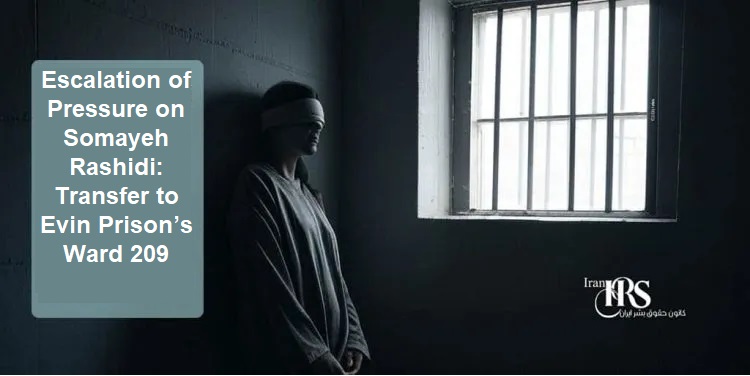
Somayeh Rashidi’s transfer from the women’s ward of Evin Prison to Ward 209 was carried out under the pretext of being taken to a hospital. Security authorities deceived both Somayeh and her family by claiming the transfer was solely for medical treatment, but immediately upon leaving the ward, she was moved to solitary confinement cells in Ward 209, controlled by security agencies.
Iran Human Rights Society, Wednesday, June 11, 2025 – As part of the ongoing systematic suppression and pressure on political prisoners, Somayeh Rashidi, a political prisoner, was transferred to the security Ward 209 of Evin Prison on Monday, June 9, 2025. This transfer occurred while her physical and mental condition has been reported as highly concerning, and her detention in these conditions could clearly constitute psychological and physical torture.
Sudden Transfer to Ward 209
Somayeh Rashidi, a political prisoner, was transferred from the women’s ward of Evin Prison to the notorious Ward 209 on Monday, June 9, 2025, under the pretext of being taken to a hospital for medical treatment. According to reliable sources, security authorities deceived both Somayeh and her family by claiming the transfer was solely for medical purposes. However, immediately upon leaving the women’s ward, she was moved to the solitary confinement cells of Ward 209, which is controlled by security agencies and known for psychological and physical pressure on political prisoners. This transfer has significantly heightened concerns about her health and well-being, as detention in Ward 209 is widely regarded as a form of psychological and physical torture.
Arrest During Protest Activity
Somayeh Rashidi was arrested on April 24, 2025, while engaging in protest graffiti in Tehran’s Javadieh neighborhood. Security forces used extreme violence during her arrest, initially detaining her at the Aghahi 15 Khordad detention center before transferring her to the women’s ward of Evin Prison after two days. She faces the charge of “propaganda against the regime,” but her judicial process has been deliberately kept in limbo, with no court hearings held to address her case.
Violent Treatment During Arrest
Documented reports highlight the brutal behavior of security agents during Somayeh’s arrest. According to credible accounts, agents severely beat her, slamming her head against a wall, sitting on her chest, and striking her face, legs, and abdomen. This violent treatment prompted Somayeh to formally file a complaint against the agents. However, in the highly securitized environment dominated by repressive forces, no effective follow-up on her complaint has been possible.
Deteriorating Physical and Mental Health
Somayeh Rashidi’s physical and mental condition has been reported as severely deteriorated after weeks of pressure and uncertainty. Sources close to her family state that she suffers from severe concentration issues, impaired movement, and episodes of complete immobility and unresponsiveness. She had a pre-existing medical condition before her arrest, and her continued detention without access to proper medical care constitutes a serious violation of her right to health.
Human Rights Violations in Somayeh Rashidi’s Case
The Iran Human Rights Society has called for Somayeh Rashidi’s immediate release, access to medical care, legal representation, and a fair and public trial, urging international bodies to address her case with urgency. Her case exemplifies systematic human rights violations by Iran’s security apparatus, including:
Prohibition of Torture (Article 5, Universal Declaration of Human Rights; Convention Against Torture): The violent treatment during her arrest and transfer to Ward 209, a facility notorious for physical and psychological torture, violates this principle.
Right to Fair Trial (Article 10, Universal Declaration of Human Rights): Somayeh has been denied access to a lawyer and a court hearing, remaining in detention without legal recourse for months.
Right to Family Notification (Article 9, International Covenant on Civil and Political Rights): Her family has been kept uninformed about her status, with no transparency in her case.
Freedom from Arbitrary Detention (Article 9, Universal Declaration of Human Rights): Her arrest for peaceful protest activities, such as graffiti, constitutes arbitrary detention.
Right to Health (Article 12, International Covenant on Economic, Social and Cultural Rights): Denying her access to medical treatment despite her serious health condition poses a direct threat to her life.
These violations underscore the repressive nature of the ruling system and its systematic disregard for international human rights obligations. Somayeh Rashidi’s family and the public are demanding her immediate and unconditional release, as well as accountability for the security and judicial officials responsible for her case.
Follow Iran Human Rights Society on social networks:
Telegram /Twitter /Instagram / YouTube / Facebook
Join Iran Human Rights Society on Twitter





Discussion about this post