Two protesters arrested during the January 2026 protests in Isfahan have been executed; human rights reports highlight physical torture, coerced confessions, restricted access to legal counsel, and procedural flaws
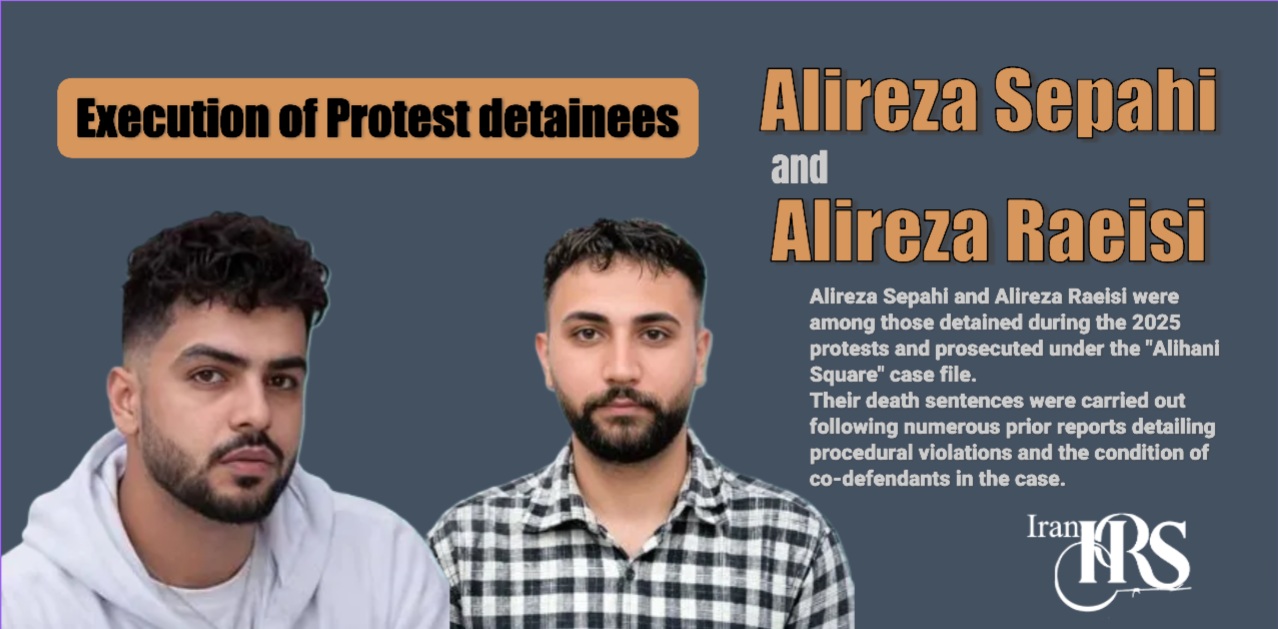
Iran Human Rights Society, Monday, October 5, 2026– Alireza Sepahi and Alireza Raeisi, two protesters arrested during the 2025 nationwide protests and defendants in the case known as “Alihani Square” in Isfahan, were executed at Dastgerd Prison in Isfahan on the morning of Monday, October 5, 2026. These executions coincide with the start of the World Week Against the Death Penalty, despite serious unresolved ambiguities surrounding their interrogation conditions, trial sessions, access to legal representation, and the evaluation of prosecution evidence.

Execution of Alireza Sepahi and Alireza Raeisi in Dastgerd Prison
Alireza Sepahi and Alireza Raeisi were among those detained during the 2025 protests and prosecuted under the “Alihani Square” case file. Their death sentences were carried out following numerous prior reports detailing procedural violations and the condition of co-defendants in the case.
Alireza Sepahi had previously been brought to the brink of execution. He was scheduled to be executed on Tuesday, July 28, alongside Abolfazl Sepahi Badjani and Amirhossein Safari Hosseinabadi, but suffered a heart attack prior to transfer and was rushed to the hospital. Two days later, after receiving medical treatment, he was returned to Dastgerd Prison.
subsequently, a judicial retrial for Alireza Sepahi was granted by the Supreme Court. However, according to his defense counsel, the parallel court branch rejected the retrial request in under 48 hours without holding a formal hearing, a development previously highlighted in reports on the summary rejection of Alireza Sepahi’s retrial.
Ambiguities in Interrogations and Due Process
The “Alihani Square” case file has been fraught with severe ambiguities since its inception. According to published reports, multiple defendants were subjected to intense physical and psychological pressure during interrogations to extract self-incriminating statements or implicate co-defendants.
Reports detail severe beatings, threats, physical abuse, and forced confessions, portions of which were broadcast on state media outlets. Human rights reports indicate that the primary evidentiary grounds for the death sentences relied on confessions obtained under torture—allegations requiring independent and impartial investigation.
Furthermore, transparent information regarding court hearing standards, evidentiary review, effective access to chosen legal representation, and the ability to present a complete defense has been withheld, hindering independent evaluations of the evidence used to justify capital sentences.
In the case of Alireza Sepahi specifically, multiple reports documented torture and coerced confessions, alongside restricted defense attorney access to case records and a failure to evaluate key exculpatory evidence.

Executions of Co-Defendants in the Case
The executions of Alireza Sepahi and Alireza Raeisi mark a continuation of capital executions in the “Alihani Square” case. Previously, Abolfazl Sepahi and Amirhossein Safari were publicly executed in Alihani Square, Isfahan, on July 28. Reports regarding both individuals similarly pointed to physical torture, coerced confessions, and denial of defense rights.
Prior to these executions, reports had drawn attention to the situation of Alireza Sepahi and his family, including coverage of the final visit between the Sepahi family members, which heightened concerns over imminent executions.
Five Executions Within One Week
The execution of Alireza Sepahi and Alireza Raeisi follows the execution of three other protesters linked to the nationwide demonstrations within the past week: Ali Hemmati and Majid Nikandish were executed on September 30 in Mashhad, and Siavash Jamshidi Kheirabadi was executed on October 3 in Shahrekord.
Reports on the cases of Ali Hemmati and Majid Nikandish also stressed that independent details regarding judicial procedures and state allegations remained strictly limited.
Executions and Deterrence Concerns
The ongoing execution of individuals detained during the January protests, occurring alongside concerns over potential renewed public demonstrations, raises questions regarding whether these capital sentences function purely as judicial decisions or serve a broader social deterrence function.
Human rights organizations and observers assess the acceleration of protester executions as an attempt to instill public fear and prevent new waves of protests. While this represents an assessment of state motivation, the execution of multiple protesters within a condensed timeframe has heightened international concern regarding the use of capital punishment as an instrument of social intimidation.
Information Box | Case Information at a Glance
| Subject | Details |
| Defendants | Alireza Sepahi & Alireza Raeisi |
| Case Designation | “Alihani Square” Case (Isfahan) |
| Arrest Context | 2025 Nationwide Protests (January 2026 Protests) |
| Execution Date & Location | October 5, 2026 — Dastgerd Prison, Isfahan |
| Prior Co-Defendants Executed | Abolfazl Sepahi & Amirhossein Safari (Publicly executed on July 28, 2026) |
| Primary Documented Abuses | Torture for forced confessions, broadcast of coerced statements, summary rejection of retrial in under 48 hours without a hearing, denial of effective counsel |
Legal Review of the Case Based on Domestic Laws
Analyzing these judicial proceedings under domestic statutes does not constitute an endorsement of the existing legal framework, but demonstrates that even internal statutory mandates are being systematically bypassed.
Relevant Statutory Provisions
- Article 32 of the Constitution: Mandates strictly legal procedures for arrest and notification of charges.
- Article 35 of the Constitution: Upholds the right of all defendants to access legal representation across all trial stages.
- Article 37 of the Constitution: Establishes the presumption of innocence until guilt is proven in a competent court.
- Article 38 of the Constitution: Expressly prohibits all forms of physical and psychological torture to extract confessions and nullifies coerced statements.
Procedural Violations
The extraction of confessions under torture, broadcast of coerced statements on state media, denial of defense access to case files, and rejection of a Supreme Court-prescribed retrial in under 48 hours without a court session represent direct violations of statutory protections codified under domestic law.
Human Rights Violations in the Executions
The execution of Alireza Sepahi and Alireza Raeisi following flawed judicial proceedings directly conflicts with fundamental international human rights standards:
- Article 3 of the Universal Declaration of Human Rights (UDHR): Guarantees the right to life, liberty, and security of person.
- Article 5 of the Universal Declaration of Human Rights (UDHR): Strictly prohibits torture or cruel, inhuman, or degrading treatment.
- Article 10 of the Universal Declaration of Human Rights (UDHR): Entitles everyone to a fair and public hearing by an independent and impartial tribunal.
Executing individuals based on confessions extracted under torture without fair trial guarantees constitutes an arbitrary deprivation of life, underscoring the vital need for independent international scrutiny and legal accountability.
See also the below articles:
- Execution of Siavash Jamshidi Kheirabadi Amid Severe Due Process Violations
- UN Special Rapporteur Mai Sato Welcomes 46-Nation Joint Statement Condemning Executions in Iran
Follow Iran Human Rights Society on social networks:
Telegram /Twitter /Instagram / YouTube / Facebook
Join Iran Human Rights Society on Twitter