
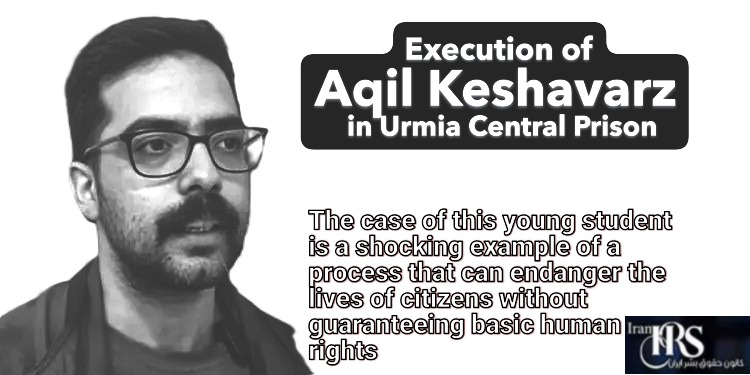
Aqil Keshavarz, a 27-year-old student, faced execution in Urmia Prison on espionage charges.
Iran Human Rights Society, Saturday, December 20, 2025 – Early Saturday morning, 29 Azar 1404, the Mizan news agency reported the execution of Aqil Keshavarz in Urmia Central Prison; a 27-year-old young man, architecture student at Shahroud University, and native of Isfahan, whose arrest, trial, and execution were accompanied by a wave of human rights concerns and reactions.
Arrest Amid Heightened Security
Revolutionary Guards arrested Aqil Keshavarz in June 2025. He traveled to Urmia when Israel attacked Iran. Intelligence forces detained him without clear reasons. Therefore, they moved him to their detention center in Urmia. The atmosphere remained highly securitized, especially in border areas.

Intense Interrogations and Forced Confessions
Interrogators held Aqil Keshavarz for one week. They applied severe psychological and physical pressure. Their goal focused on extracting a confession for espionage for Israel. However, sources report he endured torture-like conditions. This led to forced statements against him.
Transfers and Unfair Death Sentence
Officials transferred Aqil Keshavarz to Evin Prison next. He stayed there during Israel’s bombing. Then, they moved him again. Finally, he arrived at Urmia Central Prison.
In late summer 2025, the Revolutionary Court sentenced him to death. Judge Sajjad Dousti presided over Branch One. The trial restricted lawyer access. Moreover, it ignored fair trial standards completely.
Final Days and Execution
Authorities confirmed the death sentence recently. On December 16, 2025, they placed him in solitary confinement. His family visited him that day. The meeting occurred in a tense atmosphere.
Early on December 19, 2025, officials carried out the execution. Mizan news agency reported it. This event again spotlights Iran’s frequent death penalties in political cases.
Human Rights Violations in Aqil Keshavarz Execution
The execution of Aqil Keshavarz shows systematic abuses. Authorities relied on forced confessions. They denied basic rights throughout the process. Human rights activists condemn these actions strongly.
Key Violated International Standards
- § Article 3 of the Universal Declaration of Human Rights – Right to life; executing a death sentence without fair trial is arbitrary deprivation of human life.
- § Article 5 of the Universal Declaration of Human Rights – Prohibition of torture; obtaining confession under physical and psychological pressure is a clear violation of this principle.
- § Article 9 of the Universal Declaration of Human Rights – Prohibition of arbitrary arrest; the arrest was carried out without clear charges and legal process.
- § Article 10 of the Universal Declaration of Human Rights – Right to fair trial; the court lacked independence, publicity, and legal guarantees.
- § Article 14 of the International Covenant on Civil and Political Rights – Right to defense and access to lawyer; this fundamental right was violated in the proceedings.
See also the below articles:
- Political Prisoners Hakimeh Honarmandi and Rouhollah Eskandari Endure One-Year Limbo in Iran
- Mohammad Javad Vafaei Thani Execution Risk Escalates Amid Solitary Confinement and Retrial Rejection
Follow Iran Human Rights Society on social networks:
Telegram /Twitter /Instagram / YouTube / Facebook
Join Iran Human Rights Society on Twitter






Discussion about this post