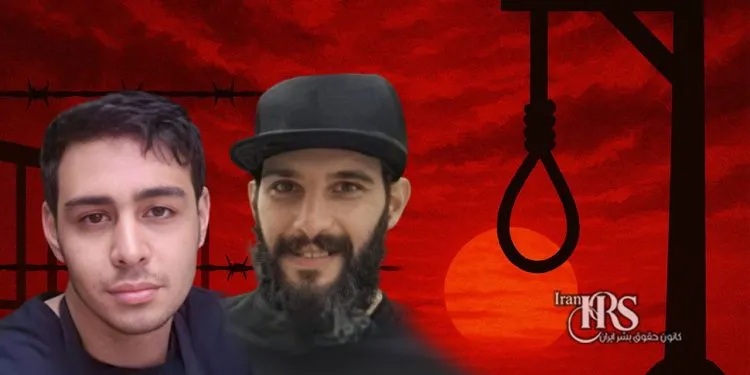
With the execution of Mohammad Amin Biglari and Shahin Vahedparast, the number of executed political prisoners in recent days has increased; a case that, according to legal sources, has been accompanied by serious ambiguities.
Iran Human Rights Society, Sunday 5 April 2026 – Two political prisoners named Mohammad Amin Biglari and Shahin Vahedparast, who had been arrested during the nationwide protests of 2025, were executed this morning. These executions took place while the two prisoners had been transferred to solitary confinement cells in Qezelhesar Prison a few days earlier; a transfer that is usually recognized as one of the signs of the imminent implementation of the execution sentence.
Transfer to Solitary Confinement; Sign of Execution Implementation
At dawn on Tuesday 1 April 2026, Mohammad Amin Biglari, Shahin Vahedparast, Abolfazl Salehi Siavashani, Amir Hossein Hatami and Ali Fahim, five political prisoners sentenced to death, were transferred to solitary confinement cells in Unit Three of Ward 35 of Qezelhesar Prison in Karaj. This transfer was carried out in conditions where, in the days before it, several other political prisoners had also been executed after being transferred to solitary confinement.
According to received reports, the transfer of prisoners sentenced to death to solitary confinement is usually considered one of the stages prior to the implementation of the execution sentence. This very issue had increased the concerns of the families of these prisoners, because in previous cases as well, prisoners had been executed in a short time after being transferred to solitary confinement.
The execution of Mohammad Amin Biglari and Shahin Vahedparast was also carried out after this transfer to solitary confinement; an issue that has increased concerns about the situation of the other prisoners transferred to solitary confinement.

Mohammad Amin Biglari; 19-Year-Old Young Man
Mohammad Amin Biglari was 19 years old and, according to his lawyer, after receiving his diploma, he was working in two jobs simultaneously to provide for his family’s livelihood. According to sources close to the family, his father was unable to follow up on the case due to poor physical condition, and his uncle, along with the lawyers of the case, had been pursuing his situation.
Mohammad Amin Biglari’s family had been in the dark about his situation for weeks. According to people close to the family, the father of this prisoner, despite his illness and poor physical condition, had repeatedly gone to Kahrizak and searched among the bodies transferred to this place for any sign of his son.
Transfer to Solitary Confinement; Sign of Execution Implementation
The charge against these two prisoners has been stated as “setting fire to the Basij base and seizing weapons and military equipment.” This charge relates to the incident of the arson of Basij Base 185 in eastern Tehran on the evening of 8 January 2026. After this incident, seven people were arrested in connection with it and the death sentence was issued for all of them on the charge of “enmity against God (moharebeh).”
However, the films that exist of this incident and have been examined by the lawyers of the case show a different narrative of the event. In these films, it is seen that people in civilian clothes push people into the building and close the door, and after that the building is set on fire.
In these films, the voices of people shouting “Don’t push” are heard, and also a mother is seen shouting “Open the door.” The people who had been pushed into the building managed to save themselves by breaking the windows from the upper floor, but after the fire was extinguished by the fire department, those same people were immediately arrested.
These narratives have caused the case of these prisoners to be accompanied by serious ambiguities, and some legal sources have stated that a precise examination of this case and the role of different individuals in this incident has never been carried out transparently.

Continuation of the Wave of Executions
The execution of Mohammad Amin Biglari and Shahin Vahedparast has taken place while in less than one week, several other political prisoners have also been executed. In the past days, Babak Alipour, Vahid Bani Amelian, Mohammad Taghavi, Pouya Ghobadi, Akbar Daneshvar Kar, Abolhassan Montazer and Amir Hossein Hatami have also been executed.
The implementation of these executions in a short time interval has created widespread concerns about the situation of other political prisoners and the process of handling their cases.
Violation of Human Rights in the Handling of the Case of These Two Political Prisoners
In the handling of the case of these two political prisoners, numerous articles of human rights laws have been violated, including:
- Violation of the right to a fair trial – Article 10 of the Universal Declaration of Human Rights: Handling cases that are accompanied by the death penalty, without complete examination of ambiguities, without effective access to a lawyer and without independent examination of documents, is considered a violation of the right to a fair trial.
- Violation of the principle of presumption of innocence – Article 11 of the Universal Declaration of Human Rights: Issuing a death sentence in cases where there are different narratives and serious ambiguities, without definitive proof of the crime in an impartial court, is a violation of the principle of presumption of innocence.
- Violation of the right to life – Article 3 of the Universal Declaration of Human Rights: Implementation of the death sentence in highly ambiguous cases, without transparent and fair handling, is considered a violation of the fundamental right to life.
Increase in Concerns About the Fate of Other Prisoners
Given the transfer of several other political prisoners to solitary confinement in Qezelhesar Prison, concerns about the possibility of implementing death sentences for them have increased. The families of these prisoners have announced that they are unaware of their situation and have not received any clear response from the officials.
In conditions where the case of these prisoners is accompanied by serious ambiguities, the continuation of the implementation of execution sentences has created widespread concerns among families and human rights institutions. Many observers believe that the handling of cases that are accompanied by the death penalty should be carried out with precision, transparency and full respect for the rights of the accused; an issue that in these cases has been a subject of serious discussion and disagreement.
See also the below articles:
- Execution of Vahid Bani Amrian and Abolhassan Montazer: Wave of Executions Demands Global Action
- Execution of Amirhossein Hatami after a hasty and entirely ambiguous trial
Follow Iran Human Rights Society on social networks:
Telegram /Twitter /Instagram / YouTube / Facebook
Join Iran Human Rights Society on Twitter