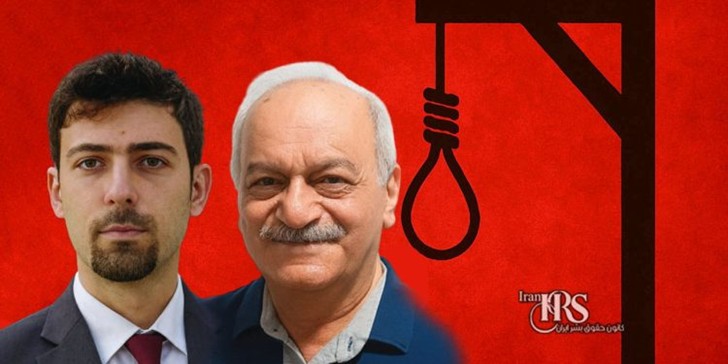
With the execution of Vahid Bani Amrian and Abolhassan Montazer in Qezel Hesar Prison, the number of executions of political prisoners in this case reached six people; human rights institutions have called for an immediate reaction from the global community to these executions.
Iran Human Rights Society, Saturday, April 4, 2026 – At dawn on Saturday, April 4, 2026, two political prisoners, Vahid Bani Amrian and Abolhassan Montazer, were executed in Qezel Hesar Prison. The execution of Vahid Bani Amrian and Abolhassan Montazer took place following the execution of four other political prisoners Mohammad Taghavi, Akbar Daneshvar Kar, Babak Alipour and Pouya Ghobadi in the same case; executions that have created widespread concerns about the situation of political prisoners and the process of handling their cases and have once again raised the discussion on the necessity of the global community’s reaction to these executions.

Execution of Vahid Bani Amrian and Abolhassan Montazer
According to published reports, at dawn on Saturday, April 4, 2026, the execution sentence of Vahid Bani Amrian and Abolhassan Montazer was carried out in Qezel Hesar Prison in Karaj. The execution of Vahid Bani Amrian and Abolhassan Montazer took place while previously four other political prisoners in the same case, including Mohammad Taghavi, Akbar Daneshvar Kar, Pouya Ghobadi and Babak Alipour, had been executed on March 30 and 31, 2026.
The execution of Vahid Bani Amrian and Abolhassan Montazer in continuation of this trend shows the implementation of execution sentences for the defendants of a joint case in a short time interval; an issue that has increased concerns about the judicial process and the possibility of repeating such executions.
Transfer to Solitary Confinement Before Execution
Prior to the implementation of the execution sentence of Vahid Bani Amrian and Abolhassan Montazer, reports had been published about the transfer of 22 political prisoners from Unit 4 of Qezel Hesar Prison to an unknown location. Among these prisoners, there were also prisoners sentenced to execution.
After a period of no news, it became clear that Vahid Bani Amrian and Abolhassan Montazer had been transferred to solitary cells. Transfer to solitary cell is usually carried out in many cases before the implementation of the execution sentence and this very issue had increased concerns about the fate of these two prisoners.
Only hours after the transfer of the prisoners from Unit 4, the execution sentence of Akbar Daneshvar Kar and Mohammad Taghavi was carried out and the next day Babak Alipour and Pouya Ghobadi were also executed. Finally, a few days later, the execution sentence of Vahid Bani Amrian and Abolhassan Montazer was also carried out.
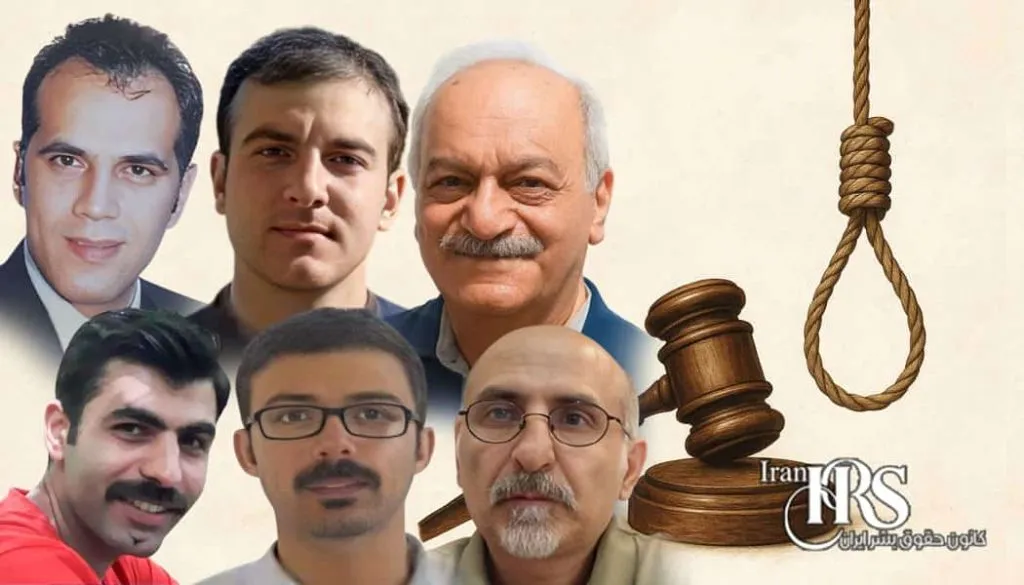
Six Political Prisoners Supporters of the Mujahedin-e Khalq Awaiting Execution Joint Case and Judicial Process
Vahid Bani Amrian and Abolhassan Montazer were arrested in Dey 1402 (December 2023 / January 2024) in Tehran. They were initially kept in Evin Prison and then transferred to Qezel Hesar Prison. The execution sentence of these two prisoners along with four other defendants had been issued on the charge of “baghy” (rebellion).
However, this sentence was overturned by the Supreme Court in Tir of last year (July 2025) and the case was referred to a parallel branch for re-examination. But these individuals were retried again in Branch 26 of the Tehran Revolutionary Court under the presidency of Judge Iman Afshari and finally on 16 Azar of the same year (December 7, 2025) the execution sentence was issued for them.
The execution of Vahid Bani Amrian and Abolhassan Montazer took place while previously their sentence had been overturned by the Supreme Court and the case had been sent for re-examination.
About Abolhassan Montazer
Abolhassan Montazer was an old political prisoner who had a history of arrest in the pre-revolution period as well as the 1980s decade. He was arrested in 1356 (1977) in Mashhad and was imprisoned for some time in Vakil Abad Prison. Also in 1360 (1981) he was arrested again and spent more than four years in prison.
In his last arrest in Dey 1402 (December 2023 / January 2024), Abolhassan Montazer was arrested by security agents and transferred to Ward 209 of Evin Prison. He was later charged with “baghy” and connection with the Mujahedin Organization and finally sentenced to execution.
About Vahid Bani Amrian
Vahid Bani Amrian, born in 1371 (1992) and from Sonqor, a graduate of Khajeh Nasir Toosi University of Technology and holding a master’s degree in management. Vahid Bani Amrian was arrested in Dey 1402 (December 2023 / January 2024) and transferred to Ward 209 of Evin Prison.
Reports indicate that Vahid Bani Amrian had been subjected to interrogation and torture during his detention. After a few months he was transferred from Ward 209 to the general ward. The intensity of the tortures was such that upon transfer to the general ward a letter was taken from him in which it was written that the tortures had been carried out before entering the general ward.
The trial of Vahid Bani Amrian along with five other political prisoners who are supporters of the Mujahedin-e Khalq was held in Branch 26 of the Tehran Revolutionary Court and finally the execution sentence was issued for him.
Necessity of Reaction from the Global Community
The execution of Vahid Bani Amrian and Abolhassan Montazer took place in continuation of the wave of executions of political prisoners while many human rights institutions had expressed concern about the process of handling the cases of these prisoners and the implementation of execution sentences.
Human rights activists believe that the global community should show reaction to the execution of Vahid Bani Amrian and Abolhassan Montazer and other political prisoners, because the continuation of this trend can lead to the increase of executions and the intensification of repression.
According to observers, the silence of the global community in the face of the execution of political prisoners can pave the way for the repetition of these executions and for this reason, requests for reaction by international institutions have increased.
- Violation of Human Rights in the Execution of Political Prisoners Violation of the Right to Life – Article 3 of the Universal Declaration of Human Rights: Execution as a punishment is considered a violation of the right to life by many human rights institutions.
- Violation of the Prohibition of Torture – Article 5 of the Universal Declaration of Human Rights: Reports of torture and pressure to obtain confessions are considered a violation of the principle of prohibition of torture.
- Violation of Fair Trial – Article 10 of the Universal Declaration of Human Rights: The overturning of the sentence in the Supreme Court and the re-issuance of the execution sentence have increased concerns about the fairness of the trial process.
- Violation of the Right to Access to a Lawyer – Article 14 of the International Covenant on Civil and Political Rights: Deprivation of full access to a lawyer in the stages of interrogation and detention is considered one of the cases of violation of the rights of the accused.
The execution of Vahid Bani Amrian and Abolhassan Montazer in continuation of the execution of four other political prisoners in this case has once again turned the issue of execution of political prisoners into one of the important human rights topics. Many observers believe that the global community should react to these executions, because the continuation of this trend can lead to an increase in executions and intensification of repression.
See also the below articles:
- Execution of Amirhossein Hatami after a hasty and entirely ambiguous trial
- War on the Thirty-Second Day in the Shadow of Ambiguity in Negotiations
Follow Iran Human Rights Society on social networks:
Telegram /Twitter /Instagram / YouTube / Facebook
Join Iran Human Rights Society on Twitter