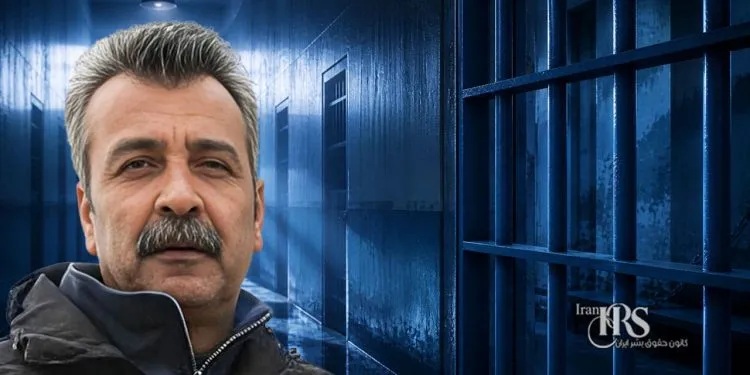
Mohammad Reza Tabari, one of the detainees of the protests of January 2026, was sentenced to execution by Branch 26 of the Tehran Revolutionary Court; a ruling issued based on forced confessions and without the presentation of independent evidence.
Iran Human Rights Society, Friday 1 May 2026- Mohammad Reza Tabari, a detainee of the protests of January 2026 and resident of Eslamshahr, was sentenced to execution by Branch 26 of the Tehran Revolutionary Court presided over by Iman Afshari on the charge of “muharibah”. Reports indicate that the execution sentence for Mohammad Reza Tabari has been issued in a situation where no substantiated and independent evidence except for confessions obtained under pressure and torture has been presented in his case.
How was Mohammad Reza Tabari sentenced to execution?

Mohammad Reza Tabari, originally from Bojnourd and resident of Eslamshahr, was arrested during the protests of January 2026. He is the owner of a carpentry workshop in the Orin area of Eslamshahr. The ruling judiciary has sentenced him to execution on the charge of “muharibah” through the use of a firearm and “operational action in favor of groups opposed to the ruling authority”. This ruling has been issued while Mohammad Reza Tabari has been deprived of access to a lawyer of his choice in all stages of interrogation and judicial proceedings and has not enjoyed the right to a fair trial.
On what basis are the charges raised against Mohammad Reza Tabari?
In the issued indictment, Mohammad Reza Tabari has been charged with “drawing a firearm towards people and security forces” and “operational action”. However, no independent and verifiable document has been presented to prove these charges and all claims have been formulated based on the narrative of security institutions. State media have claimed that he injured one of the security forces. This claim is made while no independent authority has had the possibility to examine its accuracy.
Forced confessions and psychological pressure in the process of handling the case
Parts of Mohammad Reza Tabari’s court session on 7 February 2026 were broadcast by state media. In the published images, signs of severe mental and psychological pressure on this prisoner were observable. Reports indicate that the confessions cited in the case were obtained under severe physical and psychological pressures. Human rights observers believe that in such cases, forced confessions are the main tool for consolidating pre-written security scenarios.
Arrest of family; use of hostage-taking to impose confession
Reports related to Mohammad Reza Tabari’s case point to concerns about the use of arresting family members as a means of pressure. According to these reports, interrogators in cases related to protests force detainees to accept the desired confessions by arresting or threatening their close relatives. Arresting the family as hostages is considered one of the common methods to break the resistance of prisoners in security cases.
Increase in the execution of protesters in the shadow of fear of the escalation of protests
The issuance of an execution sentence for Mohammad Reza Tabari has taken place simultaneously with the increase in the issuance and implementation of execution sentences against political prisoners and detainees of protests. This trend indicates the intensification of the ruling authority’s use of the death penalty to intimidate society and contain public discontent. Observers believe that the increase in the execution of protesters and political prisoners in the current situation stems from the ruling structure’s fear of the renewed escalation of nationwide protests.
Current situation of Mohammad Reza Tabari in prison
Mohammad Reza Tabari has been transferred to Qezel Hesar Prison in Karaj since 10 January 2026 and is currently being held in this prison. With the issuance of the execution sentence, concerns about the possibility of carrying out this sentence in the near future have increased.
Condemnation to the Execution of Mohammad Reza Tabari; Issuance of Ruling Based on Forced Confessions and Violation of Fair Trial
The conviction of Mohammad Reza Tabari to execution has been issued in a situation where reports indicate the absence of independent evidence, the use of forced confessions, pressure on the family, and deprivation of a fair trial. This case is an example of the simultaneous violation of several fundamental principles of human rights in dealing with detainees of protests.
Violated articles:
Violation of the right to life – Article 3 of the Universal Declaration of Human Rights: Everyone has the right to life, liberty and security of person.
Violation of the right to a fair trial – Article 10 of the Universal Declaration of Human Rights: Everyone is entitled in full equality to a fair and public hearing by an independent and impartial tribunal, in the determination of his rights and obligations and of any criminal charge against him.
Violation of the prohibition of torture and forced confession – Article 5 of the Universal Declaration of Human Rights: No one shall be subjected to torture or to cruel, inhuman or degrading treatment or punishment.
Violation of the right to family security and prohibition of hostage-taking – Fundamental principles of human rights and customary international law: The use of arresting relatives to pressure the accused is an instance of violating individual and family security.
See also the below articles:
- Urmia Prison Transfers Spark Fears of Secret Executions in Iran
- Iran Issues Death Sentences for Shiraz Protesters Amid Torture Claims
Follow Iran Human Rights Society on social networks:
Telegram /Twitter /Instagram / YouTube / Facebook
Join Iran Human Rights Society on Twitter