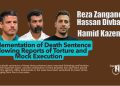
The Special Rapporteur and the Fact-Finding Mission reported the execution of at least 34 people in connection with protests, mass arrests, torture, and the risk of execution facing more than 100 individuals; several nations called for an immediate halt to executions and accountability for perpetrators.

Iran Human Rights Society, Thursday, October 29, 2026 – Mai Sato, the UN Special Rapporteur on the situation of human rights in Iran, warned at a meeting of the United Nations General Assembly’s Third Committee that the ruling regime has weaponized war and sanctions to justify and intensify internal repression. Pointing to ongoing executions, arbitrary arrests, torture, enforced disappearances, and pressure on defense lawyers, she stated that at least 34 individuals have been executed in connection with the January 2026 protests. Simultaneously, a representative of the Independent International Fact-Finding Mission reported the killing of at least 221 children, the detention of tens of thousands of people, and more than 100 individuals—including women and children—currently under sentence of death.
These statements were delivered on Wednesday, October 28, 2026, during the examination of Iran’s human rights situation in the Third Committee. Representatives from several countries also took strong positions regarding executions, the crackdown on protesters, communications blackouts, and transnational threats against journalists.
Mai Sato: The Scale of Human Rights Violations During My Mandate Is Unprecedented
Opening her address, Mai Sato emphasized that what she was reporting to the committee was unprecedented in the two years she has held this mandate. She described the plight of a populace facing military attacks while simultaneously being threatened, arrested, tortured, forcibly disappeared, and executed by ruling authorities.
According to Sato, the regime has exploited the backdrop of war and sanctions to justify its crackdown, framing protesters as agents of hostile foreign powers. Within this framework, peaceful protest and expression of dissent are met with grave national security charges.
Mai Sato highlighted that external attacks and internal repression have compounded the suffering of a single population—a population exploited by various parties while bearing the main burden of the damage itself. She assessed that war has not reduced security pressures, but rather intensified them.
Executions Did Not Stop During Wartime
A key focal point of the Special Rapporteur’s remarks was the continued execution of protest-related detainees. Mai Sato announced that at least 34 individuals have been executed in connection with the January protests, emphasizing that these executions did not pause during military conflict.
To illustrate the nature of judicial proceedings, she cited a case in which 34 adults were tried in just five days. In that single proceeding, 12 people were sentenced to death, and 7 have already been executed.
These figures specifically pertain to protest-related cases and do not represent the total executions carried out in the country this year. Highlighting the simultaneous number of defendants, brief trial durations, and capital sentences underscores severe concerns regarding due process and the lack of individualized judicial review.
Mai Sato also highlighted the continuation of arbitrary detentions, enforced disappearances, and retaliatory measures against defense lawyers—tactics that directly target the ability to provide legal defense and pursue judicial remedies.
Internet Blackouts and Witness Intimidation: Obstacles to Uncovering the Truth

The Special Rapporteur warned that the information presented at the session represents only a fraction of actual occurrences. She noted that internet shutdowns, witness intimidation, and restrictions on transmitting information have made it exceptionally difficult to construct a complete picture of human rights violations.
She pointed to legislation regarding espionage under which sharing information with foreign media can carry the death penalty. Sato added that several witnesses withdrew their testimonies out of extreme fear.
The combination of witness intimidation, communication restrictions, and capital punishment threats for information sharing poses severe barriers to independent documentation. Under these conditions, a reduction in reported data cannot be interpreted as a decrease in human rights abuses.
Sato further noted that communication blackouts even disrupted the dissemination of military attack warnings. Beyond restricting information flow, internet shutdowns have devastated the livelihoods of millions, with disproportionately adverse effects on women.
Special Rapporteur’s Call: An End to Repression and Placing Human Rights at the Center
Concluding her address, Mai Sato stressed that war has brought neither security, rights, nor freedom to the people. She spoke of ongoing executions, rising detentions, and pervasive fear among a populace whose communications remain severed and whose voices are silenced.
The Special Rapporteur called for an end to internal repression and an end to hostilities through diplomacy. She emphasized that human rights must be placed at the center of any agreement, ensuring that an end to military conflict does not come at the expense of ignoring the plight of the public, prisoners, and victims of state repression.
Fact-Finding Mission: Suppression of Protests Marked by Unprecedented Violence
Viviana Krsticevic, a member of the Independent International Fact-Finding Mission, stated in her presentation that the nationwide protests that began in December 2025 were met with unprecedented state violence.

She reported that under the cover of an internet blackout lasting nearly five months, the number of protest fatalities and detentions reached the highest levels ever recorded. While official state lists acknowledge over 3,000 deaths, the Fact-Finding Mission believes the true death toll is significantly higher.
Krsticevic disclosed the killing of at least 221 children, with the youngest victim being just four months old—findings that illustrate the severe toll inflicted on civilians and children during the crackdown.
Tens of Thousands Detained and Over 100 Facing Execution
The representative of the Fact-Finding Mission reported that tens of thousands of people were detained during and after the January protests, adding that detainees have been subjected to torture and ill-treatment.
Krsticevic also warned of the sharp escalation in the use of the death penalty in 2026. While referencing the execution of 34 individuals tied to the protests, she revealed that more than 100 people—including women and children—are currently under sentence of death.
The Fact-Finding Mission held the ruling regime responsible for gross human rights violations, many of which amount to crimes against humanity. (This assessment represents the investigative findings of the panel and should not be equated with a formal verdict handed down by an international criminal court.)
Ongoing Discrimination Against Women and Persecution of Minorities
Krsticevic emphasized that women and girls continue to face institutionalized, structural discrimination. She also highlighted the ongoing persecution and harassment targeting ethnic and religious minorities.
Her presentation linked the violent suppression of protests with enduring systemic discrimination, demonstrating that evaluating human rights goes beyond counting arrests and executions to examining underlying discriminatory structures and policies.
In another part of her speech, she condemned U.S. and Israeli military strikes and the resulting damage to civilian infrastructure, calling for accountability, civilian protection, and immediate diplomatic action to cease hostilities.
Canada, France, and the Czech Republic: Stressing Accountability
The representative of Canada called for the abolition of the death penalty and the immediate release of arbitrarily detained individuals, emphasizing that continued international monitoring and evidence preservation are essential to ending impunity.
The representative of France condemned the lethal violence against protesters and urged the ruling regime to cooperate with UN human rights mechanisms.
Positions of the United Kingdom, Australia, the European Union, and the Netherlands
According to media coverage of the session, the representative of the United Kingdom condemned the killing of children, the torture of detainees, violence against peaceful protesters, and internet blackouts.
Australia criticized the use of lethal force, mass arrests, and nationwide communications blackouts designed to silence protests and isolate the population from the outside world.
The European Union demanded an immediate end to executions, condemning the use of capital punishment and torture to suppress dissent. The delegation also warned against retaliatory actions targeting critics, including those residing abroad.
The Netherlands highlighted the dramatic increase in lethal force and mass detentions. Canada further expressed grave concern over proposed legislation criminalizing contact with foreign organizations, civil society groups, and diplomatic missions.
Reaction from the Regime Representative
The representative of the ruling regime characterized the two UN human rights mechanisms as politically motivated, rejected all allegations brought against state officials, and called for the termination of their mandates.
In response, the common position among the Special Rapporteurs and multiple delegations reaffirmed the necessity of continued independent monitoring, evidence preservation, a halt to executions, and accountability for killings and torture. (The matters raised in this session reflect the statements of rapporteurs and state representatives and do not constitute the adoption of a formal new resolution at that specific meeting.)
Legal Analysis of Protest Suppression Under Domestic Frameworks
The legislative framework imposed by the ruling dictatorship faces continuous international criticism for restricting fundamental human rights. Examining these issues under domestic law does not imply endorsement of these statutes; rather, it demonstrates that the regime fails to adhere even to its own legal codes.
Articles 32, 35, and 37 of the Iranian Constitution mandate strict procedures for arrest, the right to legal counsel, and the presumption of innocence. Articles 38 and 39 strictly prohibit coerced confessions and the mistreatment of detainees. The arbitrary arrests, torture, and harassment of defense attorneys reported during the session directly contradict these statutory guarantees. Furthermore, hasty mass trials resulting in death sentences highlight the total absence of individualized defense opportunities.
Human Rights Assessment
The reported killings of protesters, arbitrary arrests, torture, and enforced disappearances directly violate the fundamental rights to life, liberty, personal security, and human dignity. Issuing and executing capital sentences in trials devoid of fair-trial guarantees carries the grave risk of arbitrary deprivation of life.
Threats against witnesses and defense lawyers, restrictions on information flow, and the harassment of journalists severely undermine victims’ access to justice and independent documentation efforts. The Fact-Finding Mission’s determination that many of these violations amount to crimes against humanity underscores the urgent imperative to preserve evidence and establish accountability for perpetrators and officials.
See also the below articles:
- Amin Pardal Sentenced to Death in Zahedan Prison
- Mai Sato Issues Call for Submissions on Human Rights Violations in Iran
Follow Iran Human Rights Society on social networks:
Telegram /Twitter /Instagram / YouTube / Facebook
Join Iran Human Rights Society on Twitter