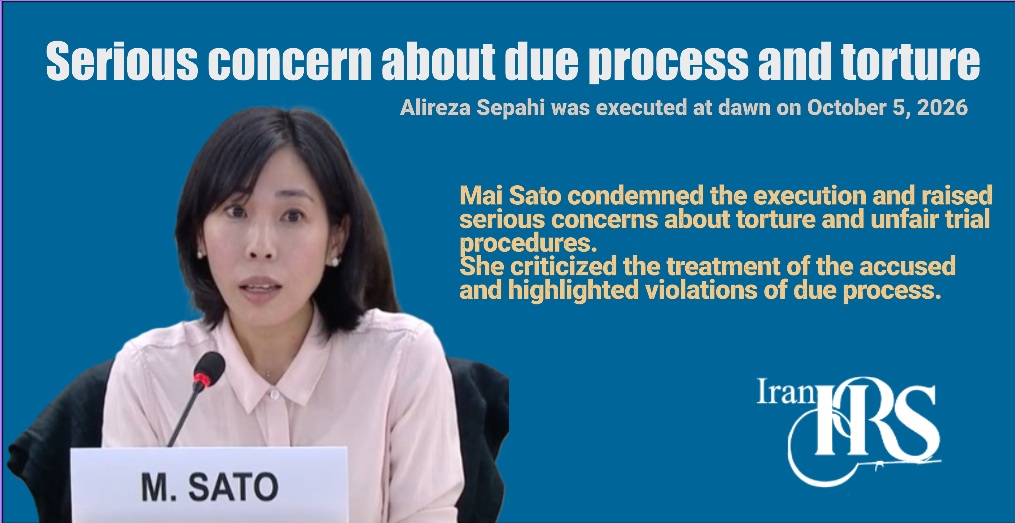
Alireza Sepahi, one of those arrested during the nationwide protests of 2025 in Isfahan, was executed at dawn on Monday, October 5, 2026. Mai Sato, the UN Special Rapporteur on the situation of human rights in Iran, reacting to the implementation of this sentence, condemned the execution and expressed serious concern about the treatment of the accused, torture, and the lack of fair trial standards in his case.
Mai Sato: Alireza Sepahi was awaiting a review of his case
Iran Human Rights Society, Monday, October 5, 2026 – On Monday, October 5, after the news of the execution of Alireza Sepahi was published, Mai Sato commented on the process of his case on her official account on the social network X.

She referred to the large gathering of the people of Isfahan on the night of July 27, 2026, to prevent the execution of three protesters in the case known as “Ali Khani Square,” saying that people stayed in the square until dawn to stop the implementation of the sentences. According to Sato, security forces used violence and lethal force to disperse the crowd.
Mai Sato emphasized that the gathering of people to demand the preservation of a human life should not be considered a crime, and that public executions are in contradiction with international human rights standards.
The execution of Alireza Sepahi after a temporary halt
Alireza Sepahi was supposed to be executed at dawn on July 27, 2026, along with Abolfazl Sepahi Badjani and Amirhossein Safari Hosseinabadi. However, during his transfer to the execution site, he suffered a heart attack and was taken to the hospital.
After receiving medical treatment, he was returned to Dastgerd Prison in Isfahan, and the implementation of his sentence was postponed for a period. The two other convicts in the same case were executed in Ali Khani Square.
But this temporary halt did not mean the salvation of Alireza Sepahi. Mai Sato, referring to this point, emphasized that he was ultimately executed at dawn on October 5, 2026.
Concern about torture and the treatment of the accused
One of the most important parts of Mai Sato’s position was her reference to reports of torture of Alireza Sepahi and members of his family.
The UN Special Rapporteur announced that Sepahi’s case was accompanied by serious concerns regarding the treatment of the accused and adherence to fair trial principles. These reports mention the torture and beating of Alireza Sepahi and his cousin in front of family members, as well as the torture of his mother in front of him.
If proven, these cases could constitute serious violations of the prohibition of torture and fundamental principles of fair trial—especially in a case that ultimately led to the issuance and implementation of a death sentence.
The death sentence was carried out while the request for review had been accepted
Mai Sato also referred to the judicial process of Alireza Sepahi’s case and said that his request for case review had been accepted on September 2, 2026, and the case had been referred for reconsideration.
However, according to the explanation provided by the Special Rapporteur, the Isfahan Revolutionary Court rejected the request without reconsideration, and the death sentence was carried out while Sepahi’s lawyer was still attempting to have the case reviewed.
This issue is one of the main points of human rights criticism regarding the implementation of the sentence; because carrying out the death penalty while judicial processes related to case review were still under dispute raises serious questions about the right to effective legal proceedings and the possibility of using legal avenues of appeal.
The “Ali Khani Square” case and the execution of protesters
Alireza Sepahi was one of the accused in the case known as Ali Khani Square in Isfahan; a case formed in connection with the nationwide protests of 2025.
Judicial authorities have raised heavy charges against the defendants in this case, accusing them of involvement in the killing of security forces and other violent acts during the protests. In contrast, human rights organizations have expressed concern about the trial process, the use of forced confessions, and restrictions on the defendants’ access to independent lawyers.
The two other defendants in this case, Abolfazl Sepahi and Amirhossein Safari, were executed on July 28, 2026, in Ali Khani Square in Isfahan. Before the implementation of the sentence, families and citizens of Isfahan had gathered at the site to prevent the executions.
Execution in public; explicit condemnation by Mai Sato
In her reaction, Mai Sato did not consider public execution merely a judicial punishment, but described it as an act that exposes society to state violence.
She described public execution as a form of cruel, inhuman, and degrading treatment and emphasized that no one should face such punishment and no society should be forced to witness it.
This position comes at a time when the implementation of death sentences for protesters arrested during the nationwide protests of 2025 has become one of the serious concerns of human rights organizations.
A case that still leaves many questions
The execution of Alireza Sepahi was carried out while serious questions remain regarding the manner of his arrest, the interrogation process, reports of torture, adherence to fair trial standards, and the status of his request for case review.
On the other hand, Mai Sato has announced that the communications of the UN Special Rapporteur’s mandate regarding the case of Alireza Sepahi have not yet been published and are to be made available in the future.
From this perspective, the execution of Alireza Sepahi is not merely the implementation of a judicial sentence; this case has now become one of the matters under the attention of UN human rights mechanisms. Mai Sato’s position also shows that concern about the handling of this case has not ended even after the implementation of the sentence.
Legal review of Alireza Sepahi’s case based on domestic laws
According to fair trial principles in domestic law, the accused must have the right to defense, access to a lawyer, and the ability to appeal the verdict. Article 38 of the Constitution also prohibits torture for obtaining confessions. Therefore, reports of torture and the implementation of the sentence while the request for case review had been accepted are matters requiring serious and independent investigation.
Review of the case from a human rights perspective
From a human rights perspective, the right to life, the prohibition of torture, and the right to a fair trial are among the most fundamental international standards. Article 3 of the Universal Declaration of Human Rights emphasizes the right to life, and Article 5 prohibits torture and cruel, inhuman, or degrading treatment. Article 10 also recognizes the right to a fair and independent trial.
In the case of Alireza Sepahi, reports of torture, concern about fair trial standards, and the implementation of the death sentence place a set of human rights issues before public opinion and international bodies.
See also the below articles:
- Mehdi Pourmorad; Political Prisoner Sentenced to 18 Years in Prison Denied Furlough
- Mohammad Amin Mandani Sentenced to Death and 20 Years Imprisonment
Follow Iran Human Rights Society on social networks:
Telegram /Twitter /Instagram / YouTube / Facebook
Join Iran Human Rights Society on Twitter