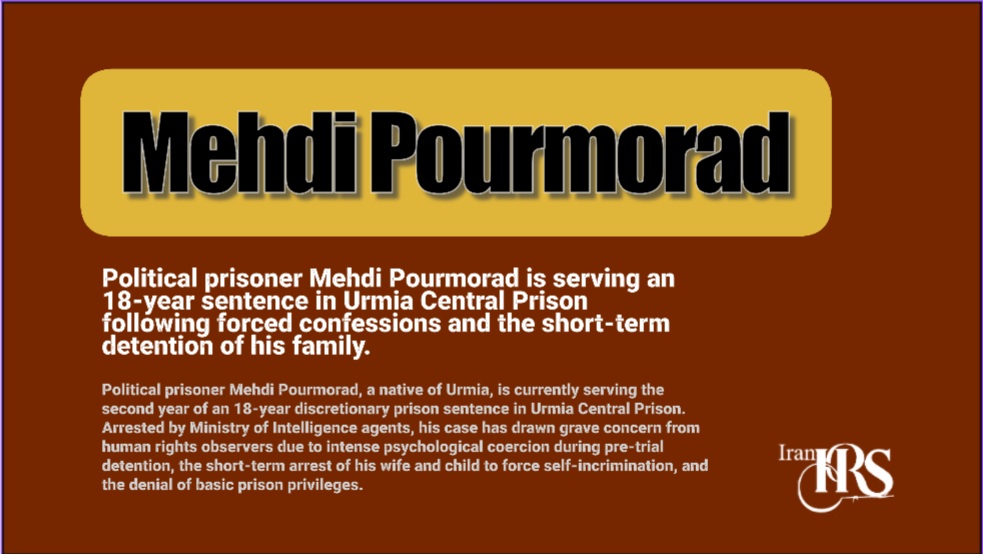
Mehdi Pourmorad, a political prisoner from Urmia, is serving the second year of his 18-year sentence in Urmia Central Prison and, according to relatives, has been denied furlough and other prison privileges due to opposition from the Ministry of Intelligence
Iran Human Rights Society, Saturday, October 3, 2026– Mehdi Pourmorad, a political prisoner from Urmia, is serving the second year of his 18-year sentence in Urmia Central Prison. Arrested in April/May 2025 by Ministry of Intelligence agents, he was transferred to prison after being held for two months in the intelligence agency’s detention center. During his arrest and interrogation, his wife and child were also detained for several days; according to available reports, this action was taken to exert pressure on him to extract forced confessions. Pourmorad was subsequently sentenced to a total of 18 years in prison in a court hearing held via video link, under conditions where he was denied access to a lawyer of his choice.
Arrest of Mehdi Pourmorad in Urmia
Mehdi Pourmorad, born in 1978 in Urmia, is married and a father of two children. He resided in the village of “Kacheh Bash” in the Urmia region.
Ministry of Intelligence agents arrested him in this village on April 27, 2025, and transferred him to the security agency’s detention facility in Urmia.
Pourmorad was held in the Ministry of Intelligence detention center for approximately two months before being transferred to Urmia Central Prison. According to available reports, his detention period was accompanied by security and psychological pressure—a situation that subsequently impacted the progression of his case and the circumstances of his family.
Detention of Wife and Child to Exert Pressure
One of the most significant issues raised regarding the arrest process of Mehdi Pourmorad is the detention of his family members.
During the arrest and interrogation phases, security forces also detained his wife and child for several days. According to the report, the purpose of this measure was to exert pressure on Pourmorad and force him to provide coerced confessions.
The detention of a prisoner’s family members to place him under pressure, in addition to directly affecting the mental and psychological state of the detainee, subjects the family to security pressure as well.
These same pressures have led Mehdi Pourmorad’s family to refrain from widespread public media reporting regarding his arrest and the status of his case until now.
Trial and Denial of Legal Representation of Choice
A few months after Mehdi Pourmorad was transferred to Urmia Central Prison, his case was processed in Branch 1 of the Revolutionary Court of Urmia.
The court session was conducted via video link, and according to the available report, Mehdi Pourmorad was denied the right of access to a lawyer of his choice during the proceedings.
This issue carries particular importance in a case involving heavy charges and a lengthy sentence; access to effective legal representation and adequate legal defense are considered among the most fundamental guarantees of a fair trial.
Issuance of an 18-Year Prison Sentence
Branch 1 of the Revolutionary Court of Urmia convicted Mehdi Pourmorad on three charge counts.
According to the issued verdict, he was sentenced to 15 years of discretionary imprisonment on the charge of “membership in opposition groups” through membership in the People’s Mojahedin Organization (MEK).
Additionally, he received two separate 18-month discretionary prison sentences on the charge of “insulting the Supreme Leader.”
In total, these sentences amount to 18 years of discretionary imprisonment.
Mehdi Pourmorad is currently serving the second year of this heavy sentence in Urmia Central Prison.
Ministry of Intelligence Opposition to Furlough
After the verdict became final, Mehdi Pourmorad submitted a request for prison furlough; however, this request was met with opposition.
According to available reports, prison officials informed him that the Ministry of Intelligence opposed granting him furlough, resulting in his denial of leave and other prison privileges.
This situation continues even as Pourmorad has served a notable portion of his sentence and remains deprived of access to privileges designated for prisoners.
Security Pressure on Mehdi Pourmorad’s Family
Security pressure has not been limited solely to Mehdi Pourmorad.
The detention of his wife and child during the interrogation period, along with the family’s apprehension regarding the consequences of sharing information about the case, resulted in details about his condition remaining unpublished for a prolonged period.
Consequently, a significant portion of the details surrounding the case file, the interrogation process, and his condition during detention were not released in the public domain.
This situation also makes an independent review of the case file and evaluation of the judicial proceedings difficult.
Concerns Regarding Due Process and Legal Status
The case of Mehdi Pourmorad raises human rights concerns on several fronts, including reports of psychological pressure during interrogations, the detention of family members, denial of access to a lawyer of his choice during proceedings, and the issuance of a lengthy prison sentence.
Article 10 of the Universal Declaration of Human Rights emphasizes the right of everyone to a fair and public hearing by an independent and impartial tribunal. Article 9 of the declaration prohibits arbitrary arrest.
Furthermore, Article 14 of the International Covenant on Civil and Political Rights emphasizes the right of an accused person to fair trial guarantees and the opportunity for defense.
In the case of Mehdi Pourmorad, the reported denial of a chosen lawyer and allegations of pressure during interrogations highlight the necessity of a thorough review of the judicial proceedings.
Mehdi Pourmorad Remains in Urmia Prison
Mehdi Pourmorad is currently serving the second year of his 18-year sentence in Urmia Central Prison. His request for furlough was met with opposition from the Ministry of Intelligence, and according to the report, he remains deprived of other prison privileges as well.
In addition to the severity of the sentence, the case of this political prisoner involves a range of issues tied to security detention, pressure on family members, interrogation methods, access to legal counsel, and denial of furlough—issues that keep his legal and human status at the center of ongoing concern.
See also the below articles:
- Mohammad Amin Mandani Sentenced to Death and 20 Years Imprisonment
- Execution of Alireza Sepahi and Alireza Raeisi; Ambiguities in Due Process and Forced Confessions
Follow Iran Human Rights Society on social networks:
Telegram /Twitter /Instagram / YouTube / Facebook
Join Iran Human Rights Society on Twitter