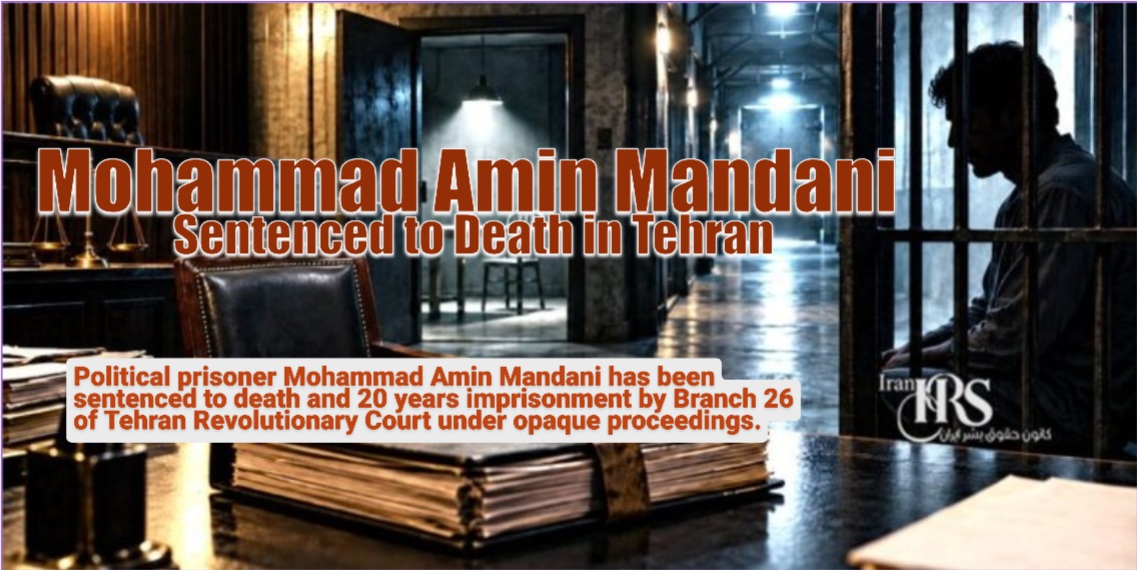
Mohammad Amin Mandani, a political prisoner currently incarcerated in Greater Tehran Prison, has been sentenced to death and 20 years in prison by Branch 26 of the Tehran Revolutionary Court; details regarding his defense arguments, interrogation procedures, and defense counsel’s access to case files remain undisclosed
Mohammad Amin Mandani, a political prisoner detained in Greater Tehran Prison, has been sentenced to death and a total of 20 years in prison by Branch 26 of the Tehran Revolutionary Court, presided over by Judge Iman Afshari. This judgment was issued amid a significant lack of transparent information regarding his interrogation conditions, the evidence cited by the court, the defense arguments presented by Mandani, and the extent to which his defense counsel was granted access to case materials and supporting documentation.
Death Sentence and 20-Year Prison Term Issued for Mohammad Amin Mandani
According to received information, Mohammad Amin Mandani was sentenced to death on charges related to “cooperation with hostile states.” Additionally, Branch 26 of the Tehran Revolutionary Court sentenced him to a combined total of 20 years in prison on charges including “assembly and collusion against national security.”

In the prosecution documents, “transmitting location coordinates of certain sites” was cited as a primary factual basis for bringing the charge of “cooperation with hostile states” against him.
The issued court ruling was officially communicated to Mohammad Amin Mandani’s defense attorney on Tuesday, September 29, 2026.
Ambiguities Regarding Defense Arguments and Case File Access
Despite the formal notification of the verdict, published reports lack clear details regarding Mandani’s substantive defense arguments against the charges, the specific evidentiary grounds relied upon by the court to justify a capital sentence, and how this evidence was presented during trial proceedings.
Furthermore, details remain unavailable regarding the degree of access granted to Mandani’s defense attorney concerning the prosecution files, underlying evidence, and the ability to conduct a comprehensive legal review. It remains unclear at what procedural stage, and under what constraints, defense counsel was permitted to draft and submit defense filings.
Additionally, details surrounding the conditions of Mandani’s interrogation and judicial processing have been withheld. It is unknown under what conditions his interrogations took place, what evidence was gathered during preliminary investigations, and how those materials were utilized in court.
Arrest of Mohammad Amin Mandani
Mohammad Amin Mandani was arrested by security forces in April 2026, coinciding with security developments related to wartime conditions. Following initial interrogation stages, he was transferred to Greater Tehran Prison, where he is currently serving his sentence.
The imposition of a death sentence against Mohammad Amin Mandani occurs under conditions where available information regarding judicial proceedings, defense statements, and evidentiary records remains severely restricted, with no detailed reports published regarding his court hearings.
Legal Review of the Case Based on Domestic Laws
Reviewing these judicial actions under domestic statutes does not constitute an endorsement of the existing legal framework, but illustrates that even internal statutory mandates are being systematically bypassed.
Relevant Statutory Provisions
- Article 32 of the Constitution: Mandates strictly lawful procedures for arrest and prompt written notification of charges.
- Article 35 of the Constitution: Guarantees the fundamental right of all defendants to retain defense counsel across all stages of judicial proceedings.
- Article 37 of the Constitution: Establishes the presumption of innocence until guilt is proven in a competent judicial court.
- Article 38 of the Constitution: Expressly prohibits all forms of physical and psychological torture to extract confessions or gather information, declaring coerced statements legally void.
Procedural Violations
Restricting defense attorney access to prosecution evidence, failing to provide transparent trial proceedings, and withholding details regarding pre-trial detention and interrogation conditions represent direct violations of statutory protections codified under domestic law.
Human Rights Violations Regarding the Death Sentence
The capital ruling and opaque judicial process against Mohammad Amin Mandani directly conflict with established international human rights standards:
- Article 9 of the Universal Declaration of Human Rights (UDHR): Strictly prohibits arbitrary arrest, detention, or exile.
- Article 10 of the Universal Declaration of Human Rights (UDHR): Entitles everyone to a fair and public hearing by an independent and impartial tribunal in the determination of any criminal charge.
- Article 11 of the Universal Declaration of Human Rights (UDHR): Guarantees the presumption of innocence and all necessary defense guarantees for anyone charged with a penal offense.
Imposing an irrevocable death sentence through opaque judicial proceedings without full evidentiary transparency and complete defense guarantees constitutes an arbitrary deprivation of life, highlighting the vital need for independent legal review and international human rights oversight.
See also the below articles:
- Execution of Alireza Sepahi and Alireza Raeisi; Ambiguities in Due Process and Forced Confessions
- Execution of Siavash Jamshidi Kheirabadi Amid Severe Due Process Violations
Follow Iran Human Rights Society on social networks:
Telegram /Twitter /Instagram / YouTube / Facebook
Join Iran Human Rights Society on Twitter