Mohsen Babaeian and Borzou Rezaei, two prisoners held in Greater Tehran Central Penitentiary who were arrested during the 2025–2026 nationwide protests, have been sentenced to death by Tehran Revolutionary Courts.
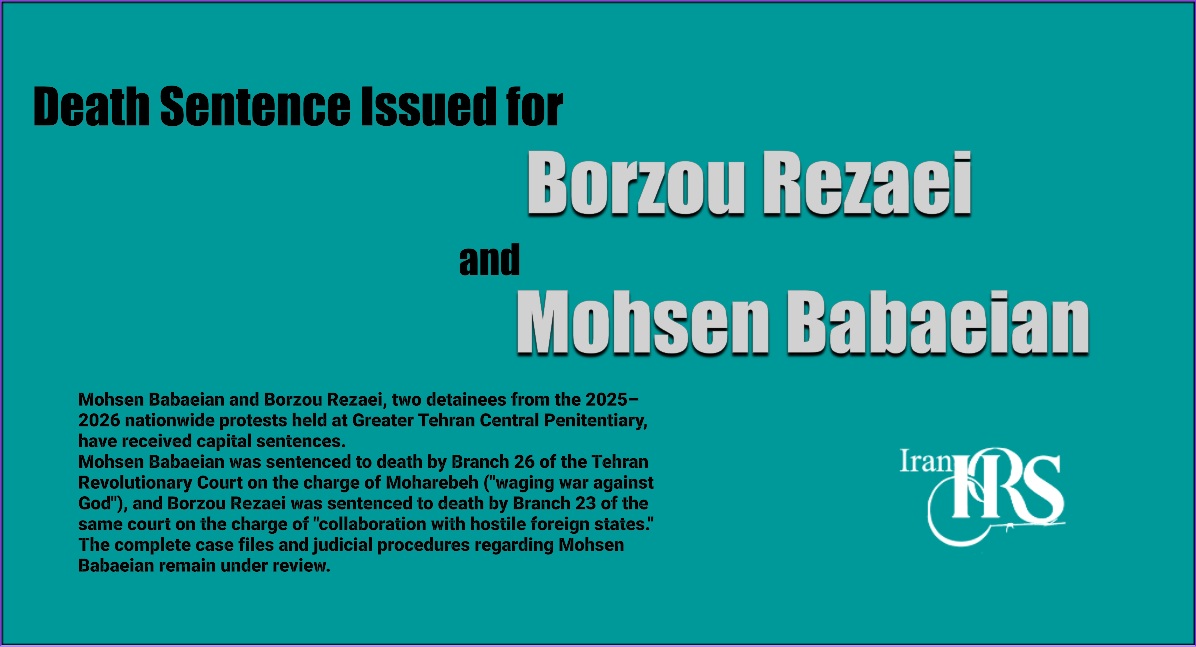
Iran Human Rights Society, Tuesday, October 6, 2026 – Mohsen Babaeian and Borzou Rezaei, two detainees from the 2025–2026 nationwide protests held at Greater Tehran Central Penitentiary, have received capital sentences. Mohsen Babaeian was sentenced to death by Branch 26 of the Tehran Revolutionary Court on the charge of Moharebeh (“waging war against God”), and Borzou Rezaei was sentenced to death by Branch 23 of the same court on the charge of “collaboration with hostile foreign states.” The complete case files and judicial procedures regarding Mohsen Babaeian remain under review.
Death Sentence Issued for Mohsen Babaeian
Mohsen Babaeian, currently held in Greater Tehran Central Penitentiary and among those arrested during the 2025–2026 nationwide protests, was sentenced to capital punishment by Branch 26 of the Tehran Revolutionary Court, presided over by Judge Iman Afshari.
The verdict was officially communicated to Mohsen Babaeian recently. Available documentation indicates that the charge resulting in the death penalty is Moharebeh.
Detailed information regarding the exact date of his arrest, supplementary charges, evidentiary materials, and procedural due process remains unavailable and subject to ongoing investigation. It is established only that he was arrested in connection with the 2025–2026 nationwide demonstrations and is currently detained in Greater Tehran Central Penitentiary.
The imposition of a capital sentence on a protest detainee occurs under circumstances where transparency concerning interrogations, evidence gathering, access to legal representation, and courtroom standards is essential to evaluating judicial integrity.
Borzou Rezaei: Sentenced to Death in Branch 23 of the Revolutionary Court
Borzou Rezaei, a resident of Kermanshah and fellow detainee at Greater Tehran Central Penitentiary, has likewise been sentenced to death.
According to available reports, Branch 23 of the Tehran Revolutionary Court issued the capital sentence against Borzou Rezaei on the charge of “collaboration with hostile foreign states.” The ruling was recently communicated to his defense counsel.
The trial hearing for Borzou Rezaei took place approximately two months ago before Branch 23 of the Tehran Revolutionary Court. He was initially arrested in February–March 2026 in connection with the 2025–2026 protests and subsequently transferred to Greater Tehran Central Penitentiary.
The information made public regarding Borzou Rezaei’s case lacks substantive detail concerning the evidence relied upon by the court, as well as the conditions of his interrogation and trial. Clarification on these points is vital to determine whether his rights to a fair defense were upheld.
Concerns Over Due Process Standards
The capital convictions of Mohsen Babaeian and Borzou Rezaei occur against a backdrop of severely limited information regarding each stage of their judicial proceedings. The lack of clarity surrounding evidence, interrogation methodologies, effective access to legal counsel, and the defense presented at trial severely impedes independent assessment of the legal validity of these proceedings.
In cases involving capital punishment, strict adherence to fair trial guarantees and independent judicial scrutiny of evidence are of paramount importance, as the enforcement of such verdicts results in the irreversible deprivation of life.
Legal Review Under Domestic Law
The authoritarian legal framework governing Iran has faced ongoing criticism for contravening international fair trial standards and restricting defendants’ fundamental rights. Reviewing this case under domestic statutes does not constitute endorsement of these laws, but rather highlights the requirement to respect even existing domestic legal safeguards.
Article 35 of the Constitution recognizes the right to legal representation, while Article 37 affirms the presumption of innocence. Furthermore, Article 38 strictly prohibits torture for the purpose of extracting confessions or information. Consequently, establishing transparency regarding interrogation methods and the admissibility of evidence is imperative in capital cases.
Human Rights Perspective
Article 3 of the Universal Declaration of Human Rights affirms the fundamental right to life, while Article 5 prohibits torture and cruel, inhuman, or degrading treatment. Furthermore, Article 10 guarantees the right to a fair and public hearing by an independent and impartial tribunal. Imposing the death penalty when trial procedures and evidence remain opaque underscores the urgent necessity of an independent review of judicial safeguards.
Would you like this formatted and delivered as a downloadable Microsoft Word document (.docx) with the exact font sizes and justified margins applied?
See also the below articles:
- Mai Sato Condemns the Execution of Alireza Sepahi
- Mehdi Pourmorad; Political Prisoner Sentenced to 18 Years in Prison Denied Furlough
Follow Iran Human Rights Society on social networks:
Telegram /Twitter /Instagram / YouTube / Facebook
Join Iran Human Rights Society on Twitter