
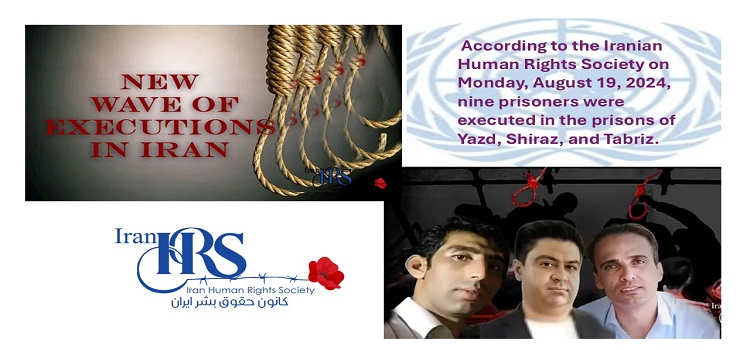
According to the Iranian Human Rights Society on Monday, August 19, 2024, nine prisoners executed in the prisons of Yazd, Shiraz, and Tabriz.
The judicial system in Iran is fundamentally flawed, operating contrary to international law by prioritizing executions and imprisonment to instill fear and suppress society.
According to the Iranian Human Rights Center, on Monday, August 19, 2024, nine prisoners executed in the prisons of Yazd, Shiraz, and Tabriz. Reports from Halwash indicate that at dawn on August 10, 2024, five prisoners executed in Yazd Prison. Among them were three Baloch prisoners and two Afghan nationals. The identities of two executed Baloch prisoners are Abdulrahman Damani (Gorgij), 34 years old, married with two children, and Abdulraouf Shah-Bakhsh (Dehmordeh), 33 years old, also married with two children. Both were from Zahedan and had been sentenced to death in a joint case related to drug charges. Despite Abdulrahman Damani’s sentence being reduced, prison officials transferred him to solitary confinement and executed him this morning. The identities of the other three executed prisoners are unknown.
**Execution of a Prisoner in Tabriz Prison**
A prisoner named Abbas Alaei Aghbolagh executed in Tabriz Prison at dawn on Sunday, August 18, 2024. He arrested three years ago on drug-related charges and sentenced to death. This execution not reported in domestic media or judiciary-related websites.
**Execution of Three Prisoners in Adelabad Prison, Shiraz**
At dawn on Saturday, August 17, 2024, three prisoners were executed in Adelabad Prison, Shiraz. Their identities are Youssef Kazemzadeh, Ali Salimi, and Heydar Arab. Youssef Kazemzadeh and Ali Salimi arrested and sentenced to death on drug-related charges. While Heydar Arab sentenced to death for murder in a group fight. News of these executions has also not been reported by domestic media or judiciary-related websites.
**Secret Execution of 6 Prisoners, Including 2 Women, in Qazvin Central Prison**
According to reports from inside sources, at least 9 prisoners were executed in Qazvin Central Prison in August 2024. Over the past year and a half, at least 31 prisoners have been secretly executed in Qazvin Central Prison (Choobindar). Only a few of their names reported by domestic media, and none of these executions have been covered by government-affiliated media outlets.
A reliable source has revealed the names of 4 prisoners executed in August 2024, whose executions not yet publicly reported:
– Vahid Ebrahimzadeh and Vahid Soltanabadi, who were arrested and sentenced to death on drug-related charges.
– Amir Hossein Bagherieh and Hamid Behmazi, who were arrested and sentenced to death for murder.
– Additionally, two female prisoners, whose charges remain unknown, also executed during this period.
These 6 individuals executed secretly in Qazvin Central Prison (Choobindar) in August 2024. The Iranian Human Rights Center has also reported on the execution of three other prisoners in this prison.
The judicial system in Iran is fundamentally flawed
The judicial system in Iran is fundamentally flawed, operating in stark contrast to international law by prioritizing executions and imprisonment to instill fear and suppress society. This defective system is characterized by the lack of judicial impartiality due to pressure from security forces, the denial of access to chosen legal representation, the use of torture and forced confessions, and the absence of proportionality between crime and punishment.
The focus on punishment rather than addressing the root causes of crime, coupled with a lack of necessary expertise in investigation, prosecution, and judicial proceedings, has led to many defendants being unfairly sentenced to death. The issuance of death sentences for first-time offenders who are unfamiliar with the investigative and judicial processes further highlights the human rights violations in Iran.
Moreover, the failure to address the underlying causes of murder in judicial proceedings has undermined the credibility of Iran’s courts on the international stage. According to international law, it is essential to explore the root causes of homicide. Simply focusing on punishing the perpetrators without examining the contributing factors does not solve the issue of murders; rather, it perpetuates human rights violations and fosters ongoing violence in society.
Contradiction of the death sentence with the Universal Charter of Human Rights
Universal Declaration of Human Rights (UDHR), a cornerstone international document, guarantees fundamental rights of all individuals. Regardless of race, color, gender, language, religion, political or other opinions, national or social origin. And also, property, birth, or any other status.

Article 3 of the UDHR explicitly states: “Everyone has the right to life, liberty, and security of person.” This right is inviolable and cannot be deprived except by lawful judgment after a fair trial for a crime defined by law.
The death penalty, as the ultimate punishment, directly contradicts this article of the UDHR for several reasons:
1. **Right to Life: ** The right to life is a fundamental and inalienable right. The death penalty strips individuals of this right.
2. **Irreversibility: ** Once the death penalty carried out, there is no possibility to correct a judicial error. So, leading to irreversible consequences.
3. **Torture and Inhumane Treatment: ** Some methods of executing the death penalty considered forms of torture and inhumane treatment. Which is in direct violation of the principles enshrined in the UDHR.
Thus, the imposition of the death penalty is fundamentally at odds with the core values and principles established by the Universal Declaration of Human Rights.
Follow Iran Human Rights society on social networks:
Telegram / Twitter / Instagram / YouTube / Facebook
Follow the Iranian Human Rights Society on social networks:
Join Iran Human Rights Society on Twitter






Discussion about this post