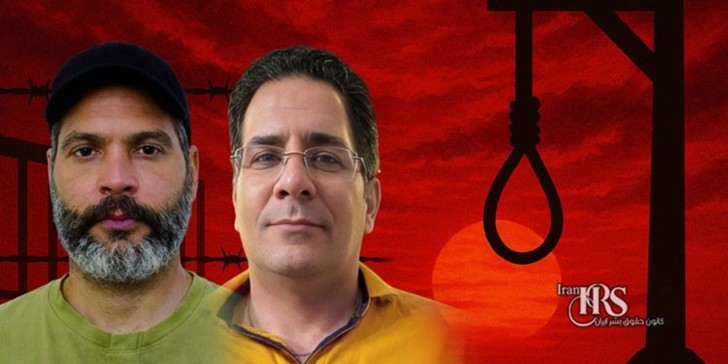
Two political prisoners Hamed Validi and Nima Shahi were executed without informing their families and lawyers; reports indicate an increase in executions with security charges and without following the legal process
Iran Human Rights Society, Monday, April 20, 2026 – At dawn today, Hamed Validi and Nima Shahi, two political prisoners sentenced to death, were executed secretly and without informing their families and lawyers. These two political prisoners were members of the Mujahedin-e Khalq. Their execution comes while reports indicate the hasty nature of the execution of sentences and the increase in executions in a security and war atmosphere.

What were the details of the execution of Hamed Validi and Nima Shahi?
According to the published report, these two political prisoners were executed at dawn today, but the location of the execution of the sentence has not been announced. These executions took place in conditions where previously, on Sunday, April 19, 2026, these two individuals had been transferred from Karaj Central Prison to an unknown location.
This transfer at that time had increased concerns about the imminent execution of the death sentence. However, the execution of the sentence was carried out without prior notification to their families and lawyers; an issue that has been raised as one of the cases of serious violation of the rights of the accused.
Why are these executions described as hasty and outside the legal process?
Reports show that the execution of Hamed Validi and Nima Shahi was carried out without completing all legal stages and in ambiguous conditions. Human rights sources emphasize that the legal rail in this case was not observed and the execution of the sentence was carried out hastily.
Also, failure to inform the family and lawyer before the execution of the sentence is among the cases that have added to concerns about the process of handling this case. This type of execution of sentences seriously questions transparency and accountability.
What are the details of the case of these two political prisoners?
Hamed Validi, born in 1359 from Kermanshah and resident of Isfahan, was a civil engineer and had one daughter. Nima Shahi was also born in 1366, from Tehran and resident of Karaj, and worked as a technical worker.
These two individuals were sentenced to death in early October 2025 by Branch 3 of the Karaj Revolutionary Court on charges including “enmity against God (muharibah)”, “membership in a criminal group” and “propaganda against the regime”. In official reports, connection with the Mujahedin-e Khalq Organization has been mentioned as one of the axes of the charges.
According to available information, these two prisoners were subjected to pressure and torture during their detention to obtain forced confessions; an issue that has added to the ambiguities of the case.
Has the pattern of executions changed in war conditions?
Reports indicate that after the start of war conditions, the approach towards protesters and political opponents has changed. While previously charges such as “disrupting public order” were raised, now individuals face charges such as “espionage” and “connection with Israel”.
This change in the language of charges, according to observers, has prepared the ground for issuing and executing heavier sentences, including execution. In this framework, the war atmosphere has been used as a factor to intensify security measures.
Increase in the number of executions and concerns about the continuation of this trend
According to reports, from the beginning of April 2026 until now, at least 12 political prisoners have been executed. This significant increase has heightened concerns about the continuation of this trend.
Observers believe that these executions are taking place in conditions where the ruling authority fears the possible restart of nationwide protests. In such an atmosphere, the use of heavy punishments can be used as a tool for control and creating deterrence.
Are the executions part of a broader suppression policy?
Analysts believe that the increase in executions, especially in war conditions, can be part of a broader policy to suppress opponents. In this framework, the use of security charges and the quick execution of sentences acts as a tool to create an atmosphere of fear in society.
At the same time, the focus of public opinion on war developments can divert attention from these actions. This situation, according to observers, has made it possible to implement stricter policies.
Widespread violation of the rights of the accused in hasty executions
The execution of Hamed Validi and Nima Shahi in conditions where it was carried out without informing the families and lawyers and without completing the full legal process indicates a serious violation of the fundamental principles of human rights.
Violated articles:
- Violation of the right to life – Article 3 of the Universal Declaration of Human Rights: Executing the death sentence in ambiguous conditions and without observing the principles of fair trial violates the fundamental right to life.
- Violation of the prohibition of torture – Article 5 of the Universal Declaration of Human Rights: Reports indicate the application of torture to obtain forced confessions, which is an example of inhuman treatment.
- Violation of the right to fair trial – Article 10 of the Universal Declaration of Human Rights: Failure to inform the family and lawyer and the hasty execution of the sentence distorts the fair trial process.
- Violation of human dignity – Article 1 of the Universal Declaration of Human Rights: Secret execution of sentences and non-transparent treatment of the accused seriously questions their human dignity.
See also the below articles:
- Qazalhasar Prison Transfer: Political Prisoners Moved from Evin in Secrecy
- Danger of Execution of Farzad Moradi in Iran
Follow Iran Human Rights Society on social networks:
Telegram /Twitter /Instagram / YouTube / Facebook
Join Iran Human Rights Society on Twitter