
Story of a Hopeful Heart of a Young Man and Pellet Guns on Mahsa Amini’s 40th Memorial
This is not a story or a tale; it is a glimpse into the life of a young man who stepped out of his home during the nationwide uprisings of 2022 to attend the 40th-day memorial of Mahsa Amini. At this gathering, he was shot with pellet bullets, sustaining severe injuries to his leg.
This young man, who identified himself to the Human Rights Center under the name “Azad,” wrote:
“This is a saga born of an uprising that erupted in the cold autumn of 2022 in the soil of Saqqez—a rebellion ignited by the name Mahsa Amini. It echoed from the brave hearts of Kurdish men and women to every corner of Iran. As one of the injured in this uprising, I share my story—a story of Mahsa’s 40th day, a day when people flocked to Saqqez from all directions to honor her memory and to ensure that the brutality inflicted upon her would not be forgotten.”
How did the story begin?
“That day, October 29, 2022, the sky over Saqqez was heavy, but our hearts were filled with hope and determination. From every corner, men and women, young and old, gathered—even little children, just beginning their journey in life, cradled in their mothers’ arms, were among us. The crowd was vast and vibrant, with a fire in their eyes that no force could extinguish. Elderly women bore the lines of history on their faces, while young girls, walking with steady steps, envisioned a brighter future.”
After the ceremony ended, security forces sealed off the city’s entrances. When people realized the exits were blocked, they erupted like a volcano. Stones were hurled at the forces, who responded with a relentless downpour of tear gas and bullets. Expecting such brutality, I had stocked my pockets with cigarettes to neutralize the tear gas, which I distributed among the crowd.
But the ordeal was far from over. Suddenly, a group of motorcyclists armed with shotguns stormed in, spreading injury, pain, and death. I sought refuge in a fountain, where I saw three young girls with tear-filled eyes, staring at me in terror. They feared falling into the hands of these men, afraid that what happened to Mahsa Amini might happen to them. I tried to calm them with reassuring words, promising they would be safe.
What the oppressors did to me.
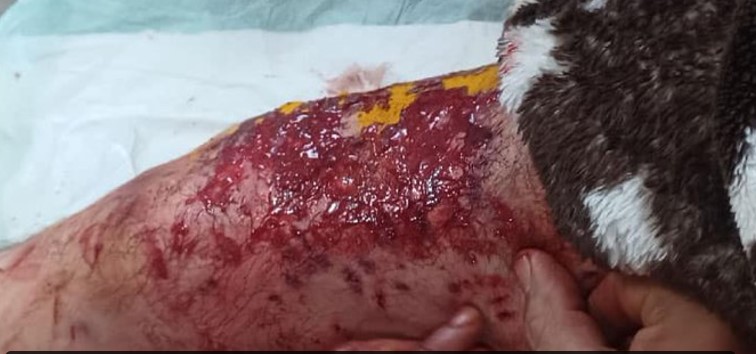
At that moment, I turned my head and saw one of the motorcyclists aiming his shotgun at me. I tried to move out of his line of fire, but it was too late. He fired, and the pellets hit my right knee. The pain was indescribable—like thousands of blades piercing my body at once. The three girls ran away, and I collapsed to the ground. Despite the excruciating pain, I felt a sense of relief that they had escaped the clutches of these brutal agents.
As I writhed on the ground in agony, security forces approached me. One of them repeatedly struck me with a baton, while I transformed every ounce of my pain into shouts of defiance and curses. Then, one of them, pretending to play the “good cop,” said they would send an ambulance to take me to the hospital. I knew it was a trap—this wasn’t my first encounter with their tactics. I had seen this playbook before, back in August 2005, when I first experienced their savagery.
In the midst of this clash, a guardian angel in the form of an elderly woman appeared. Crying and shouting, she begged the police to let me go, claiming I was her son, that I had only come for the 40th-day ceremony and had committed no crime. Her maternal instincts and compassion for me—stronger than even a real mother’s—were evident as she pleaded for my release.
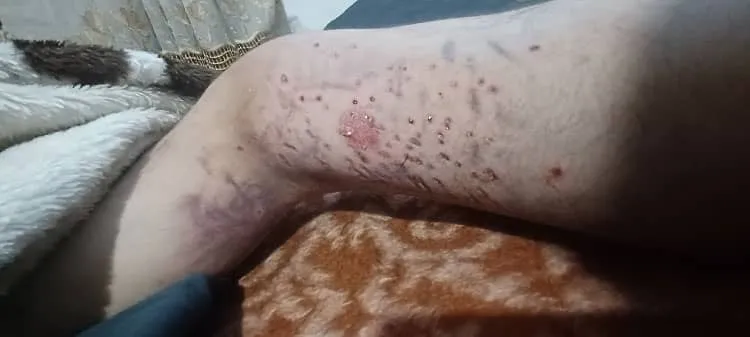
When she noticed the blood pouring from my wounded leg, her urgency intensified. With the help of other townspeople, this courageous woman pulled me away from the scene. The pain was savage, consuming my entire being, but my mind was occupied with worry. If I went home, how would my parents—who had given everything for me—react when they saw my injuries? How could I bear breaking their hearts with the sight of my wounds?
Taken to a Military Base: A Battle with Pain and Resilience.
What happened to me in the end?
They took me to an army base, presumably to treat me in their hospital, but there were no facilities—no bandages, no medicine, nothing to soothe the physical and emotional wounds I bore. Only the excruciating pain, searing deep into my bones, remained. Once I regained some composure, I called my brothers, asking them to come and take me home. When they arrived, their faces etched with worry, they carried me home while my wounds still bled profusely.
The pellets remained lodged in my leg, each one a cruel thorn clawing at my nerves and psyche. A family friend with some medical knowledge came to our aid, attempting to remove the pellets without any anesthesia. With every pellet he extracted, the pain was unbearable, a fiery agony that felt like it reached the depths of my soul. But with each shard of metal that left my body, I reminded myself that this pain was part of the price for Iran’s freedom. Far from breaking my spirit, it strengthened my resolve, making me feel braver and more determined than ever.
Yet, not all the pellets could be removed. My brother’s friend explained that some were dangerously close to vital nerves, and attempting to extract them could risk paralysis. Those pellets have since become a part of me, embedded in my tissue, causing numbness in my leg to this day.
The motorcyclist with the shotgun who shattered my knee didn’t just target my body; he stole my future. I was a construction worker, relying on my physical strength to earn a living. But from that day onward, I could no longer return to my job.
The Wounds Couldn’t Break Me.
These wounds didn’t stop me. Though the brutal enforcer targeted my body, my spirit burned brighter than ever. Even in my injured state, I continued to participate in the uprising, refusing to give up or be silenced.
And finally, the last word.
One day, we will avenge the blood of our loved ones—Navid Afkari, Mohammad Hassan-Zadeh, Shahriar Mohammadi, Danial Pabandi, Seyed Mohammad Hosseini, Esmail Dezvar, Fereydoun Mahmoudi, and thousands of other unnamed young souls. We are alive, and until that day—until victory—we will not stop fighting.
This story isn’t just mine; it’s our story. It’s the story of a generation that has fearlessly stood against oppression for the sake of justice and freedom. Some are no longer with us, and some, like me, live on with scars but with the unyielding resolve to see the dreams of our fallen comrades realized for a free Iran.
I am grateful to have the opportunity to share my story with other young people. Together, we keep the flame of hope alive and work towards a future where justice prevails, and freedom becomes a reality for all.
Follow Iran Human Rights society on social networks:
Telegram /Twitter /Instagram / YouTube / Facebook
Join Iran Human Rights Society on Twitter

Discussion about this post