
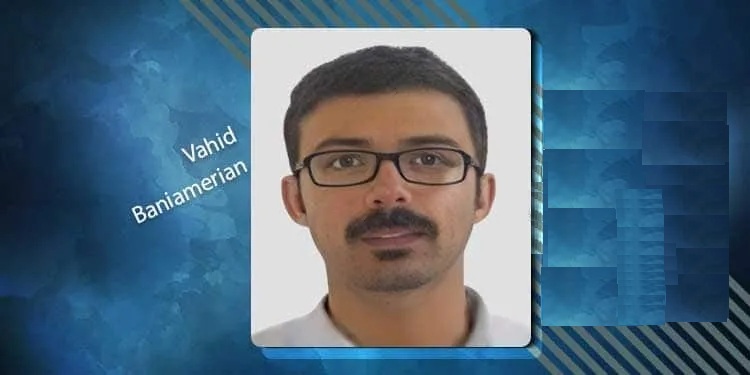
Vahid Bani Amerian, a political prisoner in Iran, faces a death sentence after severe torture and unfair trials. Learn about his case and human rights concerns.

Vahid Bani Amerian, a political prisoner born in 1992 in Sanandaj, Iran, faces a death sentence following a grossly unfair trial in 2024. Arrested on December 22, 2023, he endured severe torture in Evin Prison’s Ward 209. Furthermore, his case highlights Iran’s ongoing human rights violations. This article explores his background, charges, and the urgent need for justice.
Who is the political prisoner Vahid Bani Amerian?
Vahid Bani Amerian, a 33-year-old from Sanandaj, holds a Master’s degree in Management from Khajeh Nasir Toosi University of Technology in Tehran. Authorities arrested him on December 22, 2023, and transferred him to Ward 209 of Evin Prison. There, he faced brutal torture and interrogation for four months. After his transfer to the general ward, prison officials forced him to sign a letter claiming the torture occurred before his move. This pattern of coercion underscores the systemic abuse political prisoners endure in Iran.
Charges and Death Sentence
On October 6, 2024, Branch 26 of the Tehran Revolutionary Court, led by Judge Iman Afshari, tried Vahid alongside five other political prisoners: Seyyed Mohammad Taghavi, Babak Alipour, Pouya Qobadi, Shahrokh Daneshvar Kar, and Abolhassan Montazer. The court charged them with rebellion (baghi), assembly, and collusion against national security, as well as membership in the Mujahedin-e Khalq. Consequently, on December 1, 2024, the court sentenced Vahid and his co-defendants to death, imprisonment, and exile. These charges often serve as tools to suppress dissent, raising global concerns about Iran’s judicial fairness.
History of Arrests and Imprisonment

Vahid’s history of arrests dates back to 2017 and 2018. In January 2019, authorities sentenced him to five years in prison for “propaganda against the regime” and “insulting the leadership.” Later, in March 2021, they arrested him again. In September 2020, Judge Moghiseh at Branch 28 of the Tehran Revolutionary Court imposed a 10-year sentence and two years of exile. The charges included “acting against national security through membership in the Mujahedin-e Khalq,” “propaganda against the regime,” and “destruction of government property.” Vahid served time in Evin and Gohardasht prisons before his release in March 2023. However, authorities exiled him to Bashagard, further punishing his activism.
Health Concerns and Lack of Medical Care

Vahid suffers from irritable bowel syndrome, a weakened immune system, and severe respiratory infections. Despite these conditions, prison authorities deny him adequate medical care. This neglect exacerbates his suffering and highlights the inhumane treatment of political prisoners in Iran. Access to proper healthcare remains a critical issue for detainees like Vahid, who face both physical and psychological torment.
Amnesty International’s Call for Action
Amnesty International issued a powerful statement condemning the death sentences of Vahid and his co-defendants. The organization declared, “The six political prisoners—Seyyed Abolhassan Montazer, Akbar (Shahrokh) Daneshvar Kar, Babak Alipour, Mohammad Taghavi Sangdehi, Pouya Qobadi, and Vahid Bani Amerian—face execution following grossly unfair trials.” Amnesty highlighted the charge of “armed rebellion against the state” (baghi) as baseless. They urged Iran to halt the executions, quash the sentences, and release the prisoners due to violations of their right to a fair trial. This statement amplifies the global outcry against Iran’s treatment of political dissidents.
Follow Iran Human Rights Society on social networks:
Telegram /Twitter /Instagram / YouTube / Facebook
Join Iran Human Rights Society on Twitter








Discussion about this post