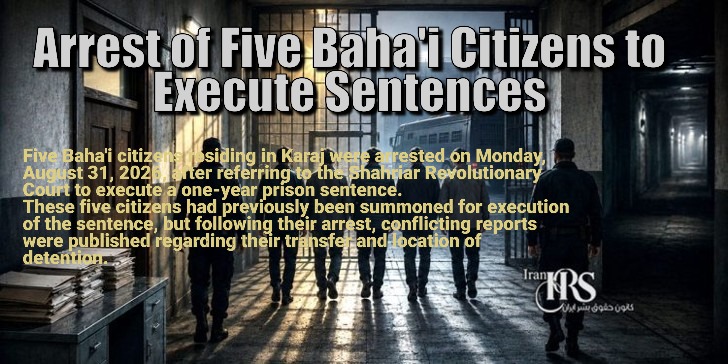
Babak Zeinali, Sahba Taef, Foad Taefi, Shervin Shebrokh, and Ali Bagherkashi were arrested after referring to the Shahriar Revolutionary Court; their final location of detention remains unknown
Iran Human Rights Society, Wednesday, September 2, 2026 – Five Baha’i citizens residing in Karaj were arrested on Monday, August 31, 2026, after referring to the Shahriar Revolutionary Court to execute a one-year prison sentence. These five citizens had previously been summoned for execution of the sentence, but following their arrest, conflicting reports were published regarding their transfer and location of detention.
Arrest After Referring to Shahriar Revolutionary Court
Babak Zeinali, Sahba Taef, Foad Taefi, Shervin Shebrokh, and Ali Bagherkashi referred to the Shahriar Revolutionary Court following the receipt of a summons to execute their sentence. They were arrested upon presence at this judicial authority to begin serving their one-year prison term.
The arrest of these five Baha’i citizens occurred under conditions where their families lack clear information regarding their confirmed location of detention and status. The publication of precise information regarding prison location, communication access, and health status are basic demands of families following prison transfers.
Ambiguity Regarding Transfer to Ghezel Hesar Prison
Initially, it was announced that these five individuals would be transferred to Greater Tehran Prison. However, they were held for a period in the Shahriar detention facility, after which reports were published regarding their transfer to Ghezel Hesar Prison.
Until the time of compiling this report, the final location holding these citizens has not been precisely determined. This ambiguity makes family access to information and legal pursuit of the case difficult. Judicial officials and prison authorities have not provided clear explanations regarding their transfer procedure and holding ward.
Initial Arrest of Five Baha’i Citizens in Mehrshahr, Karaj
The case of these citizens dates back to their arrest on November 7, 2023. Security forces arrested all five individuals while present at Babak Zeinali’s home in the Mehrshahr area of Karaj.
Following case formation, charges including “propaganda against the system” and “deviant educational and propaganda activity contrary to or disturbing to the holy sharia of Islam” were raised against them. Details regarding specific charge instances, trial proceedings, defendant defenses, and quality of access to independent legal representation have not been fully published.
Conviction Citing Article 500 Bis
Adjudication of these five Baha’i citizens’ case was conducted citing Article 500 Bis of the Islamic Penal Code, ultimately sentencing each to one year in prison. This article has been cited by courts in recent years in a number of cases related to religious, educational, and propaganda activities.
Babak Zeinali also has a prior history of arrest and judicial conviction before this case. His re-arrest alongside four other citizens increases concerns regarding ongoing judicial and security pressures on Baha’is.
Information Box | Case Information at a Glance
| Subject | Information |
| Names of Detainees | Babak Zeinali, Sahba Taef, Foad Taefi, Shervin Shebrokh, Ali Bagherkashi |
| Belief / Identity | Baha’i citizens residing in Karaj |
| Initial Arrest Date | November 7, 2023 |
| Initial Arrest Location | Mehrshahr, Karaj (At Babak Zeinali’s home) |
| Sentence Execution Date | August 31, 2026 |
| Summoning Authority | Shahriar Revolutionary Court |
| Issued Sentence | 1 year in prison each |
| Legal Basis of Conviction | Article 500 Bis of the Islamic Penal Code |
| Stated Charges | Propaganda against the system; Deviant educational/propaganda activity |
| Current Detention Status | Unspecified location (Reports indicate potential transfer to Ghezel Hesar) |
Legal Review of the Five Baha’i Citizens’ Case Based on Domestic Laws
The laws governing Iran are criticized due to restricting citizens’ rights. This review does not constitute confirmation of these laws; the goal is to highlight instances where even these regulations were not observed by the judiciary.
Legal Ambiguities of the Case
- Article 23 of the Constitution: Explicitly prohibits the investigation of beliefs and taking action against individuals based on their opinions.
- Article 2 of the Islamic Penal Code: Conditionalizes crime and punishment on the existence of explicit legal text.
- Principle of Legality of Crime: If the conviction basis relies on peaceful religious or educational activities, using vague charge titles conflicts with the principle of legality and belief protections.
- Lack of Transparency: Keeping the exact location of detention unspecified violates family notification rights and hinders legal pursuit.
Reviewing the Case from the Perspective of Human Rights and Violation of International Standards
Imprisonment based on religious belief or peaceful activity directly violates freedom of religion, freedom of expression, and equality before the law.
Human Rights Ambiguities of the Case
If their conviction relies on peaceful religious and educational practices, imprisonment constitutes arbitrary detention and religious discrimination. Concealing or keeping their detention location ambiguous threatens personal security, family communication, and due legal process.
Related International Documents
- Articles 18 & 19 of the Universal Declaration of Human Rights: Guarantees freedom of thought, conscience, religion, and expression.
- Articles 18, 19 & 26 of the International Covenant on Civil and Political Rights: Emphasizes freedom of religion and expression while strictly prohibiting discrimination.
See also the below articles:
- Hamidreza Kouhkan and Three Baloch Citizens Sentenced to Combined 17 Years
- Supreme Court Confirms Death Sentence for Ali-Asghar Peyghambari
Follow Iran Human Rights Society on social networks:
Telegram /Twitter /Instagram / YouTube / Facebook
Join Iran Human Rights Society on Twitter