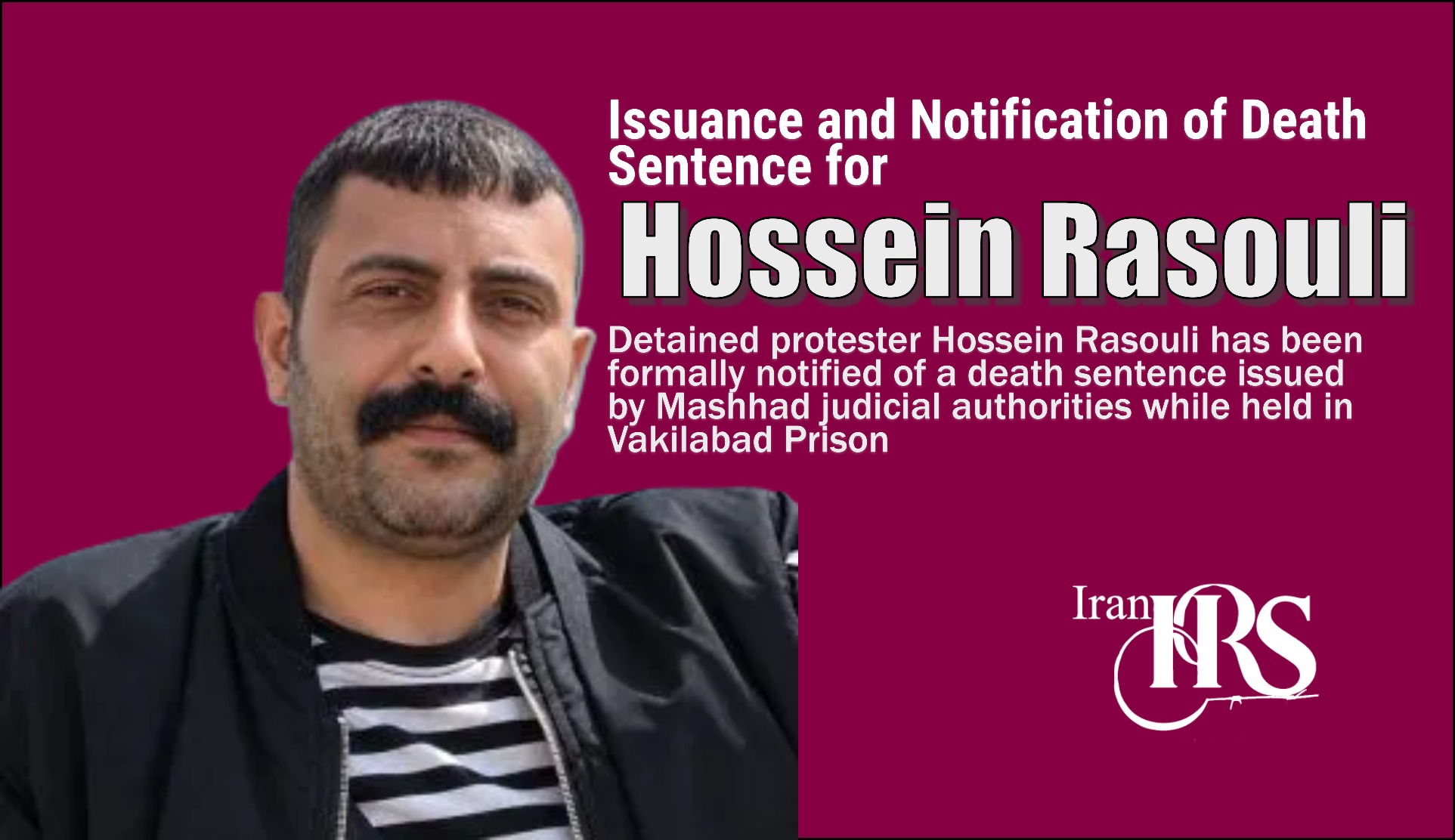
Hossein Rasouli, detained during the 2026 nationwide protests in Mashhad, is held in Vakilabad Prison where a death sentence has been issued and formally notified to him
Iran Human Rights Society, Saturday, September 12, 2026 – Hossein Rasouli, detained during the 2026 nationwide protests in Mashhad, remains imprisoned in the city’s Vakilabad Prison under deeply concerning judicial circumstances. According to received information, a death sentence has been issued for this detained protester and formally communicated to him. Hossein Rasouli’s case
was previously referred to the Revolutionary Court and Criminal Court 2 of Mashhad, and with the issuance of the death penalty, his file has entered a critical stage.
Issuance and Notification of the Death Sentence
Based on received information, Hossein Rasouli—who was arrested during the 2026 nationwide protests in Mashhad—has been sentenced to death, and this verdict has been formally served to him.
Following his arrest, Rasouli was transferred to Vakilabad Prison in Mashhad, where he has been held ever since. Full details of the formal charges raised against him and the documentation cited by the court are not specified in available reports.
The issuance of a death sentence for a detained protester elevates the case to a critical phase, heightening concerns regarding his fate.
Hossein Rasouli’s Case in Mashhad Courts
According to available information, the legal files of Hossein Rasouli and several other individuals arrested during the 2026 nationwide protests in Mashhad were referred to the Revolutionary Court and Criminal Court 2 of Mashhad.
Hossein Rasouli’s name has also been cited in human rights reports related to cases of individuals arrested during the nationwide protests in Shandiz and Mashhad.
Given the issuance of the death penalty, the judicial proceedings, the specific charges leading to this verdict, and the availability of appeal mechanisms carry crucial importance.
Concerns Regarding the Fate of Hossein Rasouli
The death sentence for Hossein Rasouli comes while he remains incarcerated in Vakilabad Prison in Mashhad since his arrest. His family and relatives face profound anxiety over the fate of this detained protester.
Available details regarding the precise judgment, the issuing branch, and evidentiary documentation remain limited, and the full text of the ruling is not publicly accessible. Consequently, a comprehensive review of the charges and trial process requires access to official court documents.
Nevertheless, the formal notification of the death sentence to Hossein Rasouli underscores the urgent need to monitor his judicial status, particularly given that his case stems from the 2026 nationwide protests in Mashhad.
Information Box | Case Information at a Glance
| Subject | Information |
| Name | Hossein Rasouli |
| Context of Arrest | 2026 Nationwide Protests (Mashhad / Shandiz) |
| Detention Location | Vakilabad Prison, Mashhad |
| Judicial Bodies Involved | Revolutionary Court & Criminal Court 2 of Mashhad |
| Current Sentence | Death penalty (Issued and formally notified) |
| Case Status | Critical / Sentenced (Awaiting appeal/next judicial steps) |
| Reported Violations | Lack of trial transparency, potential denial of full defense rights |
Legal Review of Hossein Rasouli’s Case Based on Domestic Laws
The laws of the dictatorship ruling Iran have consistently been criticized due to conflicting with fair trial standards and restricting citizens’ rights. Reviewing this case based on domestic laws does not mean confirmation of these laws; rather, it serves to evaluate whether even these internal regulations were observed.
Legal Ambiguities of the Case
- Article 32 of the Constitution: Mandates the legality of arrest and immediate written notification of charges.
- Articles 35 & 37 of the Constitution: Explicitly guarantee the right to legal counsel and uphold the presumption of innocence.
- Capital Case Standards: In cases resulting in the death penalty, strict adherence to procedural formalities, due process, and defense rights is legally mandatory under statutory regulations.
Reviewing the Case from the Perspective of Human Rights and Violation of International Standards
Imposing the death penalty on an individual arrested in connection with public protests, amidst procedural non-transparency, raises grave violations regarding the right to life and fair trial standards.
Human Rights Ambiguities of the Case
Executing capital punishment against political protesters strips individuals of fundamental protections, turning judicial proceedings into a arbitrary tool of repression.
Related International Documents
- Articles 3, 9, 10 & 11 of the Universal Declaration of Human Rights: Protect the right to life, ban arbitrary detention, and guarantee due process and fair trials.
- Articles 6, 9, 14 & 15 of the International Covenant on Civil and Political Rights: Protect the right to life, guarantee personal liberty and security, and prohibit arbitrary capital punishment without fair judicial procedures.
See also the below articles:
- Sudden Transfer of Parisa Kamali to Bandar Abbas Prison Without Prior Notice
- Arrest of At Least 10 Sunni Citizens in Ahvaz
Follow Iran Human Rights Society on social networks:
Telegram /Twitter /Instagram / YouTube / Facebook
Join Iran Human Rights Society on Twitter