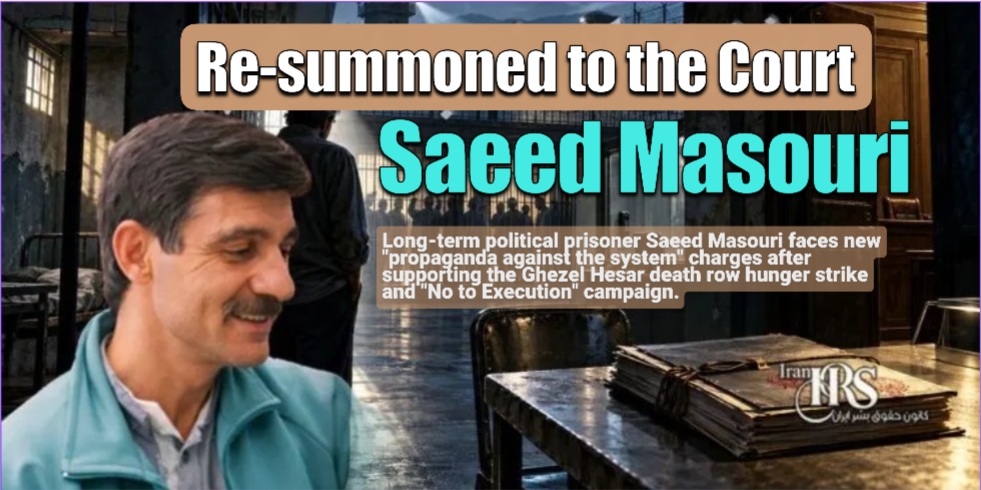
Political prisoner Saeed Masouri, after serving 26 years in prison, has once again been summoned to Branch 2 of the Karaj Revolutionary Court on charges of “propaganda against the system”; those close to him state that his support for the hunger strike of death row prisoners in Ghezel Hesar is the primary reason for re-opening this case
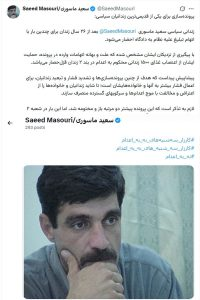
Iran Human Rights Society, Saturday, September 26, 2026– Saeed Masouri, a political prisoner who has spent over 26 years of his life behind bars, has been summoned to court once again on charges of “propaganda against the system.” According to information received from those close to him, the primary cause and context of this new legal case stems from his support for the hunger strike of approximately 1,500 death row prisoners in Ward 2 of Ghezel Hesar Prison and his opposition to the issuance and execution of death sentences. This case had previously been opened and closed twice, but is now being re-examined in Branch 2 of the Karaj Revolutionary Court.
Saeed Masouri Summoned Again to Court
Based on published information, Saeed Masouri faces a new judicial case after more than two decades of imprisonment. The official charge leveled against him is cited as “propaganda against the system,” with proceedings taking place in Branch 2 of the Karaj Revolutionary Court.
According to relatives of the political prisoner, the primary catalyst for bringing charges against him once again was his active support for death row prisoners in Ghezel Hesar Prison and their collective hunger strike.
This case had previously been opened and subsequently closed on two separate occasions, but has now been placed back on the judicial agenda for processing.
Support for the Hunger Strike of Death Row Prisoners
Saeed Masouri had previously published an open letter in support of prisoners protesting the implementation of execution sentences in Ghezel Hesar. Iran Human Rights Society reported in October 2025 that on the seventh day of the Ghezel Hesar prisoners’ hunger strike, Masouri declared his support for their action and took a firm stance regarding the “No to Execution” campaign.
That report noted that Masouri expressed solidarity with inmates who launched a hunger strike in protest against the issuance and execution of death sentences. According to sources close to him, this public stance is now being cited as key evidence in the new judicial case.
Consequently, the connection between Saeed Masouri’s advocacy, the “No to Execution Tuesdays” campaign, and the broader prison protest against capital punishment constitutes a central pillar of the new charges against him.
“No to Execution” and Increasing Pressure on Detainees
Saeed Masouri’s support for the anti-death penalty movement comes at a time when prisoner protests against executions have become a central issue inside Iranian facilities over recent years.
In his letter regarding the Ghezel Hesar hunger strike, Masouri explicitly linked the “No to Execution” stance to the fundamental right to life and spoke out in defense of death row inmates.
Prior to this, numerous reports regarding severe punitive measures against Saeed Masouri had been documented, including reports detailing his forced transfer from Ghezel Hesar to Zahedan Prison. HRANA news agency previously reported that after Zahedan Prison authorities refused to admit him, Masouri was returned to Ghezel Hesar and held in solitary confinement for a period of time.
Long History of Imprisonment and Security Pressures
Saeed Masouri has been continuously incarcerated since the year 2000 (1379 SH), and throughout this period, he has been held in various facilities, including Ahvaz, Evin, Rajai Shahr, and Ghezel Hesar prisons. Human rights sources previously documented attempts to forcibly relocate him to Zahedan Prison and the severe impact this transfer had on his family’s ability to maintain contact and visitation.
In July/August 2025 (Mordad 1404 SH), reports again emerged regarding his transfer to Zahedan; however, following the facility’s refusal to accept him, he was returned to Ghezel Hesar.
A Case Re-Opened for the Third Time
According to current information, the “propaganda against the system” case against Saeed Masouri had previously been closed twice before being revived in Branch 2 of the Karaj Revolutionary Court.
His relatives maintain that his support for death row hunger strikers and his vocal opposition to the surge in executions are the true causes behind the case’s re-opening and his renewed summons. However, precise details of the formal indictment and official court documentation remain unreleased to the public.
Information Box | Case Information at a Glance
| Subject | Details |
| Name | Saeed Masouri |
| Incarceration Background | In prison continuously since 2000 (Over 26 years of total detention) |
| Current Facility | Ghezel Hesar Prison (Previously held in Evin, Rajai Shahr, Ahvaz) |
| New Formal Charge | “Propaganda against the system” (Summoned to Branch 2 of Karaj Revolutionary Court) |
| Primary Basis of Case | Public support for ~1,500 Ghezel Hesar death row hunger strikers and “No to Execution” statements |
| Procedural History | New charge previously opened and closed twice before current revival |
| Additional Pressures | Failed forced transfers to Zahedan Prison; periods in solitary confinement |
Legal Review of Saeed Masouri’s Case Based on Domestic Laws
The laws applied in such proceedings have been subject to continuous criticism due to provisions that infringe upon fair trial standards and restrict defendants’ defense rights. Reviewing this case under domestic statutes serves to examine whether authorities are adhering even to their own statutory mandates.
Legal Ambiguities of the Case
- Article 24 of the Constitution: Guarantees freedom of expression and freedom of the press, prohibiting prosecution for peacefully voicing opinions.
- Article 35 of the Constitution: Mandates the right to select legal counsel in all courts and judicial proceedings.
- Article 37 of the Constitution: Formally codifies the presumption of innocence until proven guilty in a competent court.
- Procedural Violations: Re-opening a closed case without new criminal evidence solely based on a prisoner exercising peaceful expression against execution sentences violates statutory protections under internal law.
Reviewing the Case from the Perspective of Human Rights and International Standards
International human rights frameworks explicitly protect freedom of thought and expression, prohibiting arbitrary prosecution for peaceful opposition to capital punishment.
Human Rights Ambiguities of the Case
Prosecuting a long-term political prisoner for voicing support for death row inmates and taking a peaceful stance against executions constitutes a direct violation of international human rights guarantees.
Related International Documents
- Article 19 of the Universal Declaration of Human Rights (UDHR): Guarantees the right to freedom of opinion and expression, including the freedom to hold opinions without interference and to seek, receive, and impart information and ideas through any media.
- Article 9 of the International Covenant on Civil and Political Rights (ICCPR): Protects against arbitrary arrest or detention and ensures security of person.
- Article 19 of the International Covenant on Civil and Political Rights (ICCPR): Upholds the right to freedom of expression, strictly limiting restrictions on peaceful discourse or advocacy against rights violations.
Up to the time of drafting this report, no further details regarding the full indictment or trial schedule for political prisoner Saeed Masouri have been made public.
See also the below articles:
- Indefinite Detention and Medical Neglect of Dr. Ahmad Rahimi
- Ward 7 of Evin Prison: Severe Overcrowding, Unsanitary Conditions, and Medical Neglect
Follow Iran Human Rights Society on social networks:
Telegram /Twitter /Instagram / YouTube / Facebook
Join Iran Human Rights Society on Twitter