
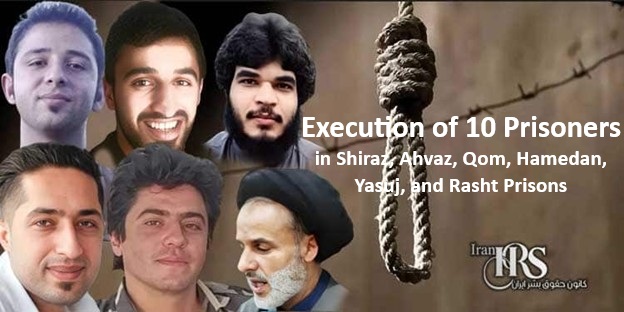
Total reaches 120 in past three weeks, averaging 5 daily. Human rights violations persist amid rising death penalty use.

The Iran Human Rights Society , Sunday, September 14, 2025- Authorities executed at least 10 prisoners on Sunday, September 14, 2025, across prisons in Shiraz, Ahvaz, Qom, Hamedan, Yasuj, and Rasht. This pushes the past three weeks total to at least 120. Furthermore, it means about five people face death each day, or one every five hours.
On that same morning, nine more prisoners moved to solitary confinement in Qezel Hesar Prison for impending executions. Such actions highlight ongoing human rights concerns in executions in Iran.
Recent Executions in Iran Prisons
Iran’s prisons continue to witness frequent executions. Reports confirm 10 cases on September 14, 2025. However, the pace shows no sign of slowing. Therefore, activists urge international attention. The death penalty remains a tool for control. Let’s examine the details.
Executions of 2 Prisoners in Shiraz’s Adelabad Prison
Authorities executed two prisoners in Adelabad Prison, Shiraz, on the morning of September 14, 2025. Ghavam Najafi and Amir Hossein Pouramini lost their lives. Najafi hailed from Kovar. Pouramini came from Shahr-e Babak. Police arrested them in separate murder cases. Courts sentenced both to death. These executions add to the grim tally in executions in Iran.
Execution of Javad Mortazavi in Ahvaz’s Sepidar Prison
Javad Mortazavi faced execution in Sepidar Prison, Ahvaz, on September 14, 2025 morning. Officials arrested him in April 2023 for murder. The court imposed a death sentence. Before arrest, he served as a cleric. He also managed a marriage registry office. This case underscores how professionals fall victim to Iran’s strict laws. Furthermore, it raises questions about fair trials.
Execution of Rasoul Paydari in Qom Prison
Rasoul Paydari died by execution in Qom Prison on September 14, 2025 morning. His charges involved drug offenses. Such cases often lack transparency. Therefore, human rights groups criticize the process. Executions in Iran for drugs continue despite global calls for reform.
Executions of 2 Prisoners in Hamedan Prison
Two men met their end at dawn on September 14, 2025, in Hamedan Prison. Mazyar Karami, aged 30 from Arak, faced drug charges. Arrest happened three years prior. He worked in his father’s blacksmith shop before capture. Peyman Ajami, from Hamedan, endured four years in custody for similar drug offenses. Courts handed down death sentences to both. However, families argue the punishments seem excessive.
Execution of Ali Mozaffari in Yasuj Prison
Ali Mozaffari, 29 years old, suffered execution in Yasuj Prison on September 14, 2025 morning. Police arrested him five years ago for murder. The sentence came swiftly after trial. This incident fits the pattern of executions in Iran. Moreover, it highlights youth among the condemned.
Execution of Amer Parki (Balochzehi) in Zahedan Prison
Amer Parki, known as Balochzehi, faced hanging in Zahedan Prison on September 14, 2025 morning. At 28, he was son of Mohammad Shamsuddin. He married and had one child. He originated from Bom Posht and lived in Saravan. Arrest occurred in 2021 for murder. The death sentence followed. Ethnic minorities like Baloch often bear the brunt. Therefore, advocates call for protections.
Executions of Hafez Ghoidast and Kazem Mousavi in Rasht’s Lakan Prison
Hafez Ghoidast Talekoui died on the morning of September 13, 2025, in Lakan Prison, Rasht. Son of Ahmad, he remained single. He resided in Talekouh village, Manjil. Prior arrest stemmed from murder charges. The court issued a death penalty. Earlier, on September 3, 2025 dawn, Kazem Mousavi lost his life in the same prison. Drug charges led to his arrest and sentence. These back-to-back events amplify fears of more executions in Iran.
Transfer of 9 Prisoners to Solitary in Qezel Hesar Prison
Nine prisoners shifted to solitary confinement in Qezel Hesar Prison on September 14, 2025 morning. Officials prepare them for execution. Families receive little notice. This practice fuels outrage. Furthermore, it violates due process norms. Human rights monitors track such moves closely.
Why the Death Penalty Clashes with Universal Human Rights
The Universal Declaration of Human Rights, Article 3, declares: “Everyone has the right to life.” Courts can deprive it only for serious crimes via fair verdicts. Yet, the death penalty contradicts this. It strips away the fundamental right to life. Once carried out, no reversal exists for errors. Some methods inflict torture and cruelty. Therefore, they breach human dignity. Executions in Iran ignore these principles daily.
Breaches of International Human Rights on Executions in Iran
Iran signed the International Covenant on Civil and Political Rights, Article 6. It allows death penalties only for gravest crimes with fair trials. However, many cases lack transparency. Defendants face restricted legal aid. Courts often show bias. Thus, verdicts violate core rights.
See also the below articles:
- New case against political prisoner Mohammad Ashtiani violates human rights
- Zinab Jalalian: Eighteenth Year in Prison, Deprived of Treatment
Follow Iran Human Rights Society on social networks:
Telegram /Twitter /Instagram / YouTube / Facebook
Join Iran Human Rights Society on Twitter






Discussion about this post