
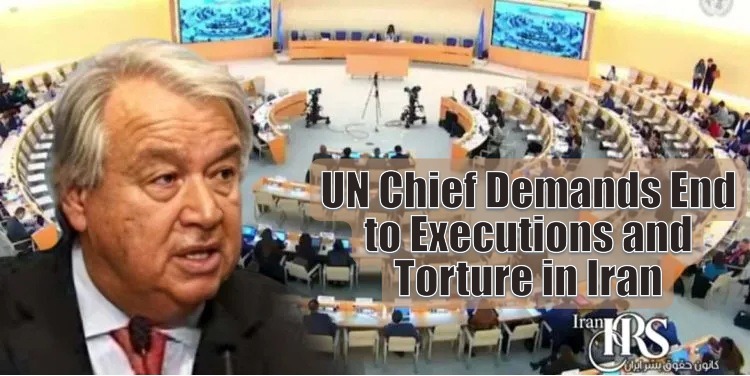
UN Secretary-General Antonio Guterres urges Iran to halt executions, end torture, and uphold human rights, addressing widespread violations.
Iran Human Rights Society, Wednesday, October 22, 2025 – The United Nations Secretary-General, Antonio Guterres, calls for urgent action to stop human rights violations in Iran. On October 21, 2025, his report to the General Assembly raised alarms about escalating executions, torture, and suppression. Guterres demands an immediate halt to executions, the release of political prisoners, and an end to inhumane treatment. Furthermore, he urges Iran’s leaders to cooperate with international human rights bodies. This article explores the critical situation and the UN’s push for change.
Surge in Executions Sparks Global Concern
October 2025 saw a sharp rise in executions in Iran, targeting political prisoners and those charged with drug offenses or vague crimes like “corruption on earth.” Guterres’ report highlights that authorities often rely on forced confessions obtained through torture. Trials lack transparency, deny legal representation, and violate international standards. Public executions of protesters, in particular, intensify fears, as they breach Iran’s global human rights obligations. Consequently, Guterres insists on halting these acts to protect the right to life.
Torture and Inhumane Treatment in Prisons
Torture remains rampant in Iran’s detention centers. The UN report details solitary confinement, restricted family contact, and coerced confessions as common practices. These actions violate the International Convention Against Torture, which Guterres urges Iran to adopt. Moreover, the UN Fact-Finding Mission confirms widespread mistreatment, including humiliation and physical abuse. Ending these practices is critical to restoring dignity and upholding international law.
Suppression of Minorities and Civil Liberties
Iran’s ruling authorities systematically suppress ethnic and religious minorities, curbing their rights to expression and assembly. Peaceful protests face criminalization, while journalists and activists endure arrests on baseless charges. Guterres’ report underscores that fabricated cases against political prisoners stifle civic engagement. Therefore, he calls for lifting restrictions to ensure freedom of expression and peaceful assembly for all.
Women’s Rights Under Attack
Discriminatory laws, including mandatory hijab enforcement, undermine women’s rights in Iran. Guterres emphasizes abolishing these laws to promote equality. Additionally, he advocates decriminalizing political and social activism to empower women and civil society. The UN report stresses that Iran must align with international standards to protect women’s civil liberties and ensure equal treatment.
Key Human Rights Violations in Iran
Here’s a breakdown of the major violations outlined in Guterres’ report:
- Right to Life: Frequent executions, especially in October 2025, lack fair trials, violating the right to life.
- Prohibition of Torture: Forced confessions, solitary confinement, and inhumane prison conditions breach global anti-torture laws.
- Freedom of Expression: Suppressing protests and jailing activists curtail free speech and assembly.
- Women’s Rights: Mandatory hijab laws and discriminatory policies restrict women’s equality.
- Fair Trial: Fabricated charges and lack of legal access deny justice to political prisoners.
Urgent Call for International Action
Guterres’ report paints a grim picture of human rights violations in Iran. He presses for immediate action to stop executions and release political prisoners. Additionally, he calls for ending torture, discrimination, and restrictions on freedoms. This urgent situation demands global attention. Practical steps, such as supporting political prisoners and preventing unlawful executions, are vital.
See also the below articles:
- Issuance of Heavy Sentence for Hadi Jamali Pour: Reflection of Suppression of Union Protests
- Escalation of the “No to Execution Tuesdays” Campaign in Its 91st Week
Follow Iran Human Rights Society on social networks:
Telegram /Twitter /Instagram / YouTube / Facebook
Join Iran Human Rights Society on Twitter






Discussion about this post