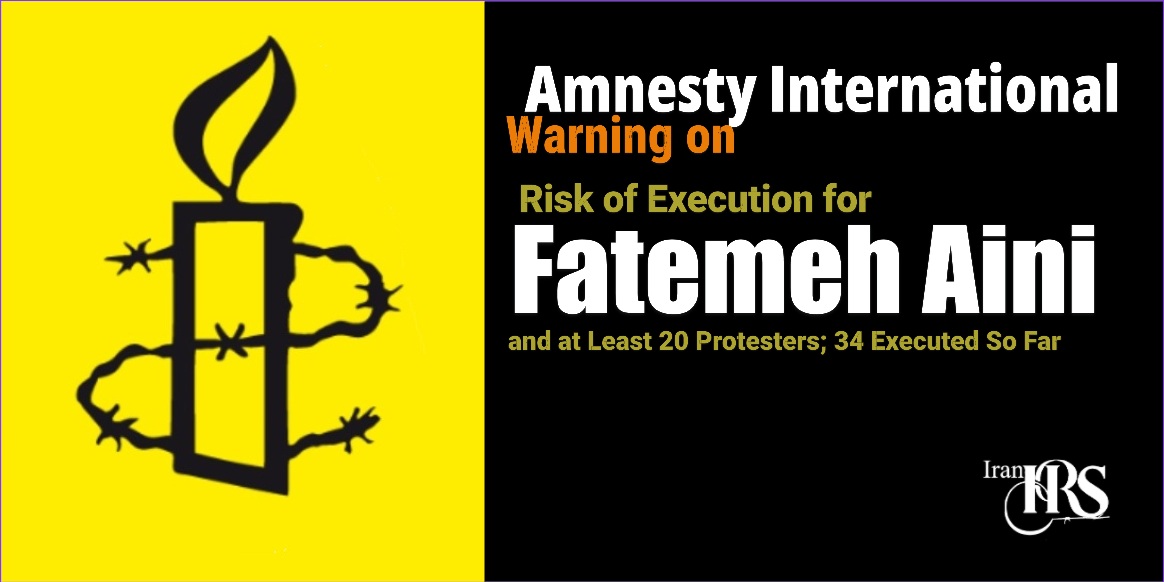
Amnesty International, in two separate warnings, called for an immediate halt to executions in Iran. The organization warned of the risk of execution for Fatemeh Aini, a 31-year-old prisoner held in Lakan Prison, Rasht, while simultaneously announcing that at least 34 people have been executed in connection with the January 2026 protests. According to the organization, the death sentences of at least 20 other protesters have been affirmed by the Supreme Court, putting their lives in immediate danger
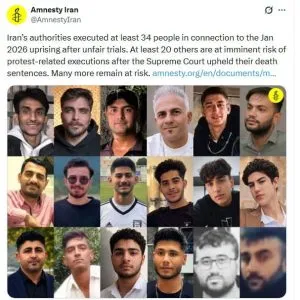
Iran Human Rights Society, Tuesday, October 20, 2026– Amnesty International issued two messages on its dedicated Iran account on the X social media platform, warning against the continuation of death sentences and the risk to prisoners sentenced to death. In one message, the organization called for an immediate halt to any plans for the execution of Fatemeh Aini in Lakan Prison, Rasht. In the other message, it announced that following the execution of at least 34 people in connection with the January 2026 protests, at least 20 others face the imminent threat of execution.
Amnesty International Warning on Risk of Execution for Fatemeh Aini in Lakan Prison, Rasht
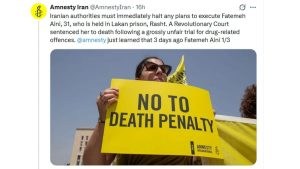
In a message regarding Fatemeh Aini, Amnesty International called for an immediate halt to any plans to execute this prisoner.
Fatemeh Aini, 31, is held in Lakan Prison, Rasht, where the Revolutionary Court sentenced her to death in a case related to drug offenses.
Amnesty International described her trial process as grossly unfair and warned of her fate.
In the viewable text of the organization’s message, receipt of new information regarding Fatemeh Aini’s condition was mentioned, though full details of this information are not specified in the first section of the message.
Confirmation of Death Sentences for at Least 20 People in Supreme Court
In a separate warning regarding the execution of protesters, Amnesty International announced that the Supreme Court affirmed the death sentences of at least 20 individuals in cases linked to the January protests.
The organization stressed in its Urgent Action document, published on October 16, 2026, that these sentence confirmations occurred from April 2026 onward.
Based on Amnesty International’s assessment, these individuals now face the imminent risk of execution, and a larger number may also be at risk of capital punishment.
Amnesty International: At Least 34 People Executed in Connection with Protests
Amnesty International stated that at least 34 people have been executed in connection with the January 2026 protests following unfair trials accompanied by reports of torture.
The organization also warned against statements by government officials regarding prioritizing the execution of death sentences for protesters.
Amnesty International’s reports point to the deprivation of legal counsel during interrogation stages, the use of forced confessions, failure to investigate torture complaints, and trials in Revolutionary Courts.
Concerns Over Expansion of Executions Following Unfair Trials
Amnesty International’s two recent warnings concern cases of differing natures: Fatemeh Aini was sentenced in a drug-related case, whereas the figure of 34 executions and 20 convicts at risk pertains to cases linked to the January protests.
However, the common theme of both warnings is the imposition or execution of the death penalty following trials in which fair trial guarantees have been severely undermined.
Amnesty International called for urgent action to prevent the execution of death sentences and to protect the lives of convicts.
Legal Review of Death Sentences Based on Domestic Laws
The dictatorship’s laws governing Iran have always been criticized for restricting defense rights and conflicting with fair trial standards. Reviewing these cases under domestic laws does not constitute an endorsement of these laws, but is done to demonstrate the failure to comply with even these regulations.
Legal Ambiguities of the Cases
Amnesty International reported unfair trials and torture in cases linked to the protests. In Fatemeh Aini’s case as well, the organization described the judicial process as grossly unfair.
Relevant Legal Articles
Articles 35, 37, and 38 of the Constitution relate to the right to counsel, the presumption of innocence, and the prohibition of torture. Articles 48 and 190 of the Code of Criminal Procedure also specify the accused person’s defense rights. Article 169 of the Islamic Penal Code considers confessions resulting from torture or coercion to lack legal validity.
Instances of Legal Violations
The use of coerced confessions and denying defendants effective defense conflict with the aforementioned legal guarantees. In cases culminating in execution, such violations carry particular weight, as the execution of the sentence is irreversible.
Review of the Subject from a Human Rights Perspective and Violations of International Standards
Articles 3, 5, 10, and 11 of the Universal Declaration of Human Rights protect the right to life, prohibition of torture, fair trial, and the presumption of innocence. Article 6 of the International Covenant on Civil and Political Rights limits the death penalty to the most restricted permissible cases under international law, and Articles 7 and 14 prohibit torture and violations of defense rights.
According to the interpretation of the UN Human Rights Committee, drug offenses do not fall under the category of “most serious crimes” permissible for the application of capital punishment.
See also the below articles:
- Amnesty Urgent Warning: 20 Iranian Protesters Facing Imminent Execution
- UN Special Rapporteur Joins “No to Execution Tuesdays” Campaign
Follow Iran Human Rights Society on social networks:
Telegram /Twitter /Instagram / YouTube / Facebook
Join Iran Human Rights Society on Twitter