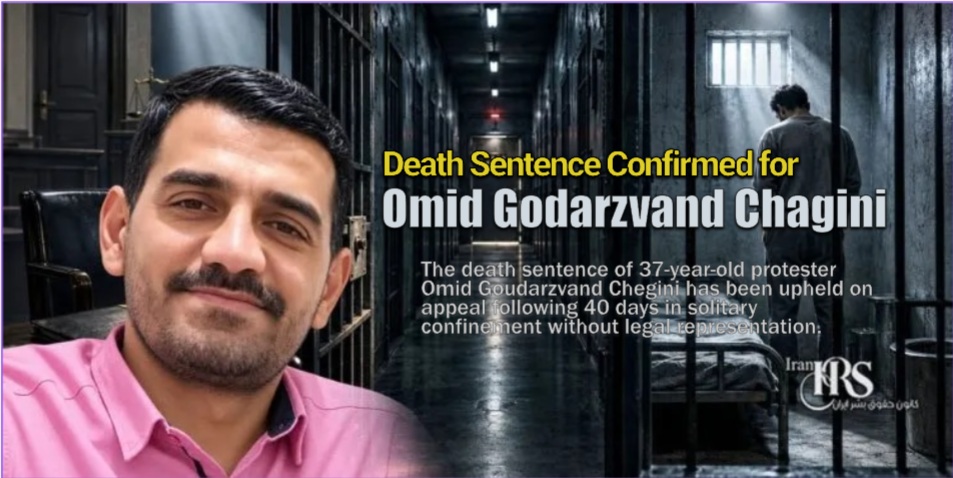
The death sentence of Omid Goudarzvand Chegini, a protester detained during the January 8 protests in Qazvin, has been upheld on appeal; he was previously held in solitary confinement for approximately 40 days in the IRGC Intelligence Detention Center and denied a lawyer of his choice throughout proceedings.

Iran Human Rights Society | September 18, 2026- The death sentence of Omid Godarzvand Chagini, a 37-year-old protester arrested during the January 8 protests in Qazvin, has been upheld at the appeals stage. The initial sentence was issued by Judge Davoud Tashakkori of Branch 2 of the Qazvin Revolutionary Court. Godarzvand Chagini is currently detained in Qazvin’s Choobindar Prison. Based on available information, he faces the risk of execution after spending approximately 40 days in solitary confinement and being denied the right to retain defense counsel of his choice.
Confirmation of the Death Sentence on Appeal
Omid Godarzvand Chagini is among those arrested during the January 8 protests in Qazvin whose death sentence, originally handed down by the court of first instance, has now been affirmed by the appellate court.
According to available details, the initial ruling was issued by Judge Davoud Tashakkori, presiding over Branch 2 of the Qazvin Revolutionary Court. The charge brought against Godarzvand Chagini is specified as “destruction of the entrance to the Qazvin Governorate building.”
Further details regarding the evidence relied upon by the court to issue the death penalty have not been disclosed in the available information.
Omid Godarzvand Chagini, aged 37, previously served in the Law Enforcement Command before resigning from the force. He is presently held in Qazvin’s Choobindar Prison, where the confirmation of his death sentence on appeal places his case in a critical condition.
Godarzvand Chagini Denies Destruction Charges
During his defense proceedings, Omid Godarzvand Chagini rejected the charges against him. He stated that although he was present at the scene at the time of the incident, he played no part in destroying or setting fire to the entrance of the Qazvin Governorate.
Consequently, a central aspect of the case involves the conflict between the formal charges and the defendant’s statement. Nevertheless, details regarding how his defense was examined or the specific grounds used by the court to reject his statements remain unpublished.
40 Days of Solitary Confinement in IRGC Intelligence Detention
Reports indicate that following his arrest, Omid Godarzvand Chagini was held in solitary confinement for approximately 40 days at an Intelligence Organization of the Islamic Revolutionary Guard Corps (IRGC) detention center.
Prolonged detention in solitary confinement, particularly during the investigative phase prior to the clarification of a detainee’s legal status, imposes significant psychological pressure. In the case of Godarzvand Chagini, available records do not clarify the precise conditions of his confinement or whether he was permitted family visitation or contact during this period.
Denial of Chosen Legal Counsel
Another critical concern in the proceedings of Omid Godarzvand Chagini’s case is the denial of his right to select independent legal counsel.
According to received information, the prisoner was deprived of the opportunity to choose his own lawyer during the judicial process. This issue holds particular
gravity in a case resulting in a capital sentence, as effective access to chosen counsel and an adequate defense constitute fundamental rights in judicial proceedings.
The available information does not provide details on the role played by the court-appointed attorney in the proceedings or how the defense arguments were evaluated by the court.
Legal Examination under Domestic Law
The legal frameworks applied in Iran have faced persistent criticism for failing to align with fair trial standards and for restricting civil rights. Examining this case under domestic law does not signify endorsement of these statutes, but rather serves to highlight the failure to uphold even existing statutory provisions.
Article 35 of the Constitution of the Islamic Republic of Iran recognizes the right to legal counsel, while Article 37 emphasizes the presumption of innocence. Furthermore, Article 38 strictly prohibits all forms of torture for obtaining confessions or gathering information. The denial of chosen defense counsel alongside extended solitary confinement in a capital case underscores the necessity of scrutinizing whether the defendant’s right to a defense was observed.
Human Rights Assessment
The issuance and confirmation of a death sentence for an individual who has denied the accusation of destruction, while being subjected to approximately 40 days of solitary confinement and deprived of chosen legal counsel, raises severe concerns regarding the right to life and the right to a fair trial.
Articles 3, 5, 10, and 11 of the Universal Declaration of Human Rights affirm the right to life, the prohibition of inhumane treatment, the right to a fair trial, and the presumption of innocence. Similarly, Articles 6, 7, and 14 of the International Covenant on Civil and Political Rights protect the right to life, prohibit torture, and guarantee fair trial standards.
See also the below articles:
- Metsola and Amnesty International: Prisoner Release and Justice for Nationwide Protests
- Escalating Pressure in Ahvaz; Concerns Over Majid Sharifi’s Condition in Intelligence Detention Center
Follow Iran Human Rights Society on social networks:
Telegram /Twitter /Instagram / YouTube / Facebook
Join Iran Human Rights Society on Twitter