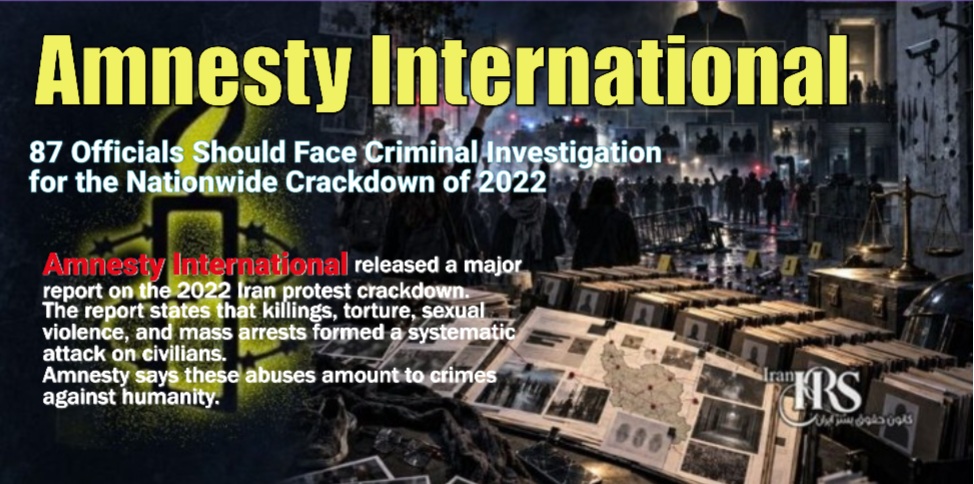
Amnesty International states in a massive report (over 1,000 pages) that killings, torture, sexual violence, enforced disappearances, and mass arrests during the nationwide protests of 2022 constituted a systematic attack on civilians and amount to crimes against humanity.
Iran Human Rights Society Wednesday, 16 September 2026 (original date: 25 Shahrivar 1405 → 16 September 2026) Amnesty International published a detailed report on 16 September 2026, coinciding with the fourth anniversary of the death of Jina Mahsa Amini and the start of the 2022 nationwide protests, outlining the command structure and responsibility of state officials involved in the crackdown.
A Report Exceeding 1,000 Pages
The report analyzes how decisions were made, how operations were organized, and how repression was executed across different cities. Amnesty International identifies 87 senior and local officials whose potential roles in crimes against humanity warrant criminal investigation.
The organization concludes that killings, torture, sexual violence, arbitrary detention, enforced disappearances, and targeted persecution based on political belief, gender, ethnicity, or religion were not isolated or uncontrolled acts. They were carried out under a state policy through a coordinated chain of command.
Amnesty warns that impunity for responsible officials increases the risk of repeated killings in future protests and stresses the need for an international criminal justice mechanism.
A Report Based on Hundreds of Interviews and Thousands of Documents
Amnesty’s investigation took several years. Researchers interviewed 270 people, including protesters, former detainees, families of victims, eyewitnesses, lawyers, human rights defenders, journalists, and medical personnel.
More than 2,000 videos were analyzed and verified. Additional evidence included official documents, judicial orders, court rulings, forensic medical records, statements by officials, and leaked confidential documents.
This body of evidence enabled reconstruction of the decision‑making hierarchy from top leadership down to provincial and local commanders. Amnesty sent its findings to senior officials and the 87 named individuals, but received no response before publication.
Documenting 377 Deaths, Including 56 Children
Amnesty collected and examined information on 377 protesters and civilians killed during the protests. Among them were 56 children.
A separate document published alongside the main report lists victims’ names, locations, dates of death, and in some cases personal photos or images of their graves — one of the most comprehensive documented lists of victims of the 2022 nationwide protests.
Breakdown by Amnesty International:
- 326 killed by gunfire or other lethal weapons during crackdowns or in militarized zones
- 18 died in government detention centers
- 10 died shortly after release due to injuries from torture or pressure
- 23 disappeared after attending or supporting protests; their bodies were later found under suspicious circumstances
Amnesty notes the real number of victims is likely higher due to communication restrictions, threats to families, confiscation of medical records, and rushed burials.
Use of Military‑Grade Weapons Against Protesters
Evidence shows security forces used assault rifles, handguns, machine guns, shotguns, and vehicles equipped with mounted guns.
In many cases, forces fired directly at unarmed protesters and civilians. Security personnel even chased fleeing individuals and shot them at close range.
Leaked official documents show orders for “severe” confrontation and continuation of operations despite rising casualties. One recorded directive instructed street forces to proceed without restraint, even to the point of killing protesters.
Senior officials not only failed to stop the shootings but repeatedly endorsed and supported the crackdown. Amnesty interprets this as evidence of a state policy to use lethal force to suppress protests.
Identification of 87 Officials in the Chain of Command
Amnesty identifies 87 officials who should face criminal investigation for designing, commanding, facilitating, or executing the crackdown.
The list includes:
- 62 security and military commanders
- 25 officials from the Interior Ministry, governors, district governors, and administrative authorities linked to security councils
Among the 62 security commanders:
- 33 are IRGC commanders
- 27 are police commanders
In total:
- 10 national‑level officials
- 77 regional, provincial, and local officials
Local‑level investigations focused on command structures in 17 counties across Kurdistan, Kermanshah, and West Azerbaijan provinces.
Names appearing in the list include:
- Ali Khamenei, Commander‑in‑Chief of the Armed Forces during the protests
- Mohammad Bagheri, then‑Chief of the Armed Forces General Staff
- Ahmad Vahidi, then‑Minister of Interior
- Majid Mirahmadi, then‑Deputy Minister for Security and Law Enforcement
Being listed does not constitute a judicial ruling. Amnesty calls for independent criminal investigations to assess each individual’s responsibility based on position, authority, orders issued, knowledge of crimes, and actions or failures to prevent them.
Disproportionate Impact on Kurdish and Baluch Citizens
One of the report’s key findings is the extremely high proportion of Kurdish and Baluch victims — together comprising 62% of all documented deaths.
Amnesty recorded:
- 106 Baluch citizens, including 20 children, killed in Sistan and Baluchestan
- On 30 September 2022 (original: 8 Mehr 1401 → 30 September 2022), security forces opened fire after Friday prayers in Zahedan, killing 87 people
It also documented:
- 95 Kurdish citizens, including 13 children, killed in Kurdistan, Kermanshah, and West Azerbaijan
Most were killed by gunfire; others died from beatings, direct impact from tear‑gas canisters, or deliberate vehicle attacks by security forces.
Amnesty concludes that killings and torture of Kurdish and Baluch citizens were driven by political and ethnic motives, meeting criteria for crimes against humanity under persecution.
Torture, Sexual Violence, and Forced Confessions
The report states that tens of thousands were arbitrarily detained during the 2022 protests, including young children.
Many were arrested without warrants and held for days or weeks in unknown locations — including warehouses, schools, residential buildings, and unofficial detention sites.
Documented torture methods include:
- Beatings
- Electric shocks
- Sleep deprivation
- Death threats
- Threats of sexual assault
- Denial of medical treatment
- Threats against family members
Interrogators pressured detainees to write or record forced confessions.
Amnesty documented 45 cases of rape and other forms of sexual violence against women, men, and children. Among these:
- 16 individuals — including six women, seven men, a 14‑year‑old girl, and two boys aged 16 and 17 — were subjected to rape.
Sexual violence was used as a tool of torture, humiliation, punishment, and intimidation.
Enforced Disappearances and Pressure on Families
Authorities frequently concealed detainees’ whereabouts. Families searched police stations, prosecutors’ offices, revolutionary courts, and prisons, but officials refused to provide information.
Families of victims faced:
- Threats
- Summons
- Arrests
- Prevention of funeral ceremonies
- Pressure to accept fabricated causes of death
In some cases, bodies were released only on the condition of night‑time burial or ceremonies under security supervision.
Amnesty considers these actions part of a policy to harass grieving families and conceal the scale of repression.
Call for an International Criminal Justice Mechanism
Amnesty urges the UN General Assembly to establish an independent mechanism to collect evidence, identify perpetrators, and prepare criminal files related to crimes against humanity in Iran.
It also calls on the UN Security Council to refer Iran’s case to the International Criminal Court.
Countries are urged to initiate criminal investigations under universal jurisdiction and issue arrest warrants when evidence is sufficient.
Universal jurisdiction allows courts to prosecute grave crimes such as torture and crimes against humanity even when committed outside their territory.
Amnesty warns that lack of accountability emboldens officials to repeat mass killings in future protests. Prosecution is not only for past victims — it is essential to prevent new crimes.
See also the below articles:
- Sara Moussiqi Detained in Qarchak Prison with Untreated Interrogation Injuries
- Lack of Information Regarding Three Women Prisoners in Fardis Prison, Karaj
Follow Iran Human Rights Society on social networks:
Telegram /Twitter /Instagram / YouTube / Facebook
Join Iran Human Rights Society on Twitter