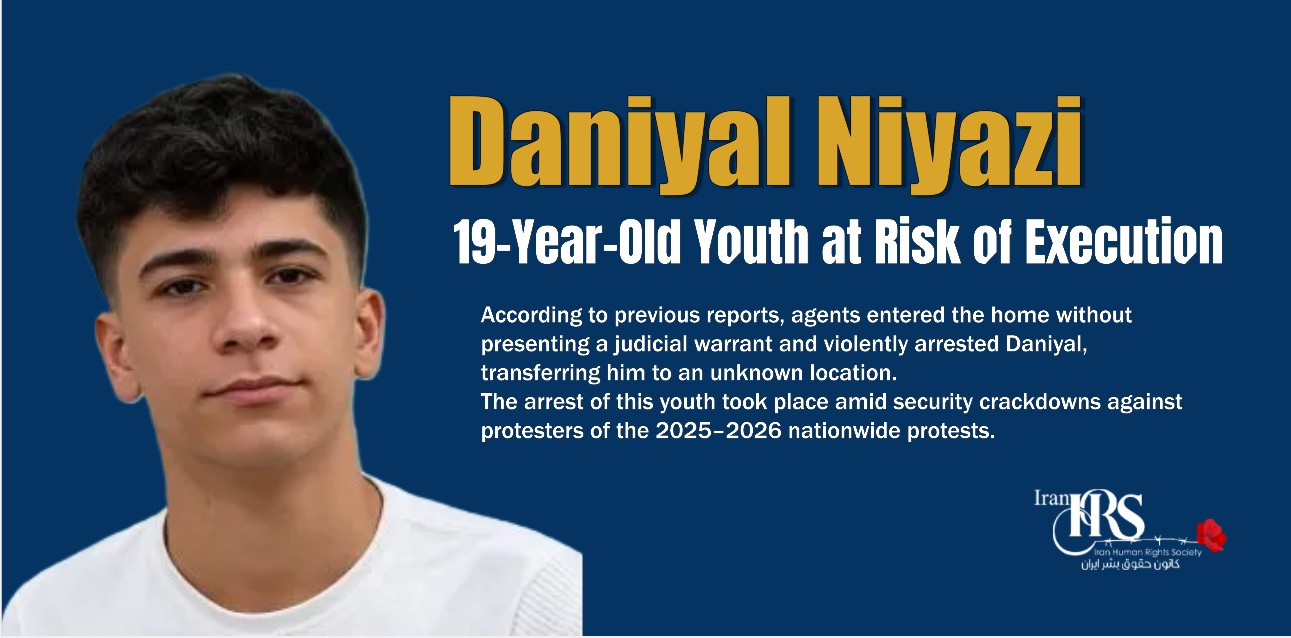
Daniyal Niyazi, a detainee of the 2025–2026 nationwide protests in Shirvan, faces the heavy charge of “Moharebeh” (enmity against God) and the risk of a death sentence. This young man, who was only 18 years old at the time of his arrest, was subjected to physical torture during the initial hours of detention, according to received reports, and forced confessions were extracted from him.

Iran Human Rights Society, Sunday, November 15, 2026 – Daniyal Niyazi, a 19-year-old youth from Shirvan in North Khorasan province, after about 10 months of detention in the course of the 2025–2026 nationwide protests, still faces the charge of “Moharebeh” and the risk of a death sentence.Received reports indicate physical torture, the extraction of forced confessions, and limited access to a chosen legal counsel. His objection to the provisional detention order had also been previously rejected by the court.
Arrest of Daniyal Niyazi at Age 18 through Security Forces Raid
Daniyal Niyazi was arrested on January 12, 2026, when he was only 18 years old, during a raid by security forces on his family home in Shirvan.
Prior to his arrest, he was engaged in manual labor to provide for his living expenses.
According to previous reports, agents entered the home without presenting a judicial warrant and violently arrested Daniyal, transferring him to an unknown location.
The arrest of this youth took place amid security crackdowns against protesters of the 2025–2026 nationwide protests.
Charge of Moharebeh and Risk of Death Sentence for Daniyal Niyazi
Following his arrest, several heavy charges were raised against Daniyal Niyazi.
These charges include “Moharebeh,” “participation in attempted intentional murder,” “participation in intentional assault and battery,” “membership in an assembly of more than three people against internal security,” “disrupting public order,” and “propaganda activities against the system.”
The charge of Moharebeh is among the criminal headings that, under ruling laws, can lead to the issuance of a death sentence.
Nonetheless, in available information, the issuance of a final death sentence for Daniyal Niyazi has not been reported.
Levying such a charge against a youth who was 18 years old at the time of his arrest has created serious concern regarding the future of his case and his fate.
Physical Torture and Extraction of Forced Confessions in the Initial Hours of Detention
According to published information, Daniyal Niyazi was subjected to severe physical torture during the first 24 hours of detention.
Reports indicate that interrogators extracted forced confessions from this youth by applying physical and psychological pressure.
In a previous report by the Iran Human Rights Society regarding the risk of execution of Daniyal Niyazi after 38 days of detention and deprivation of a lawyer, attention was drawn to the role of confessions obtained under pressure in building the case.
Confessions obtained through torture or coercion lack legal validity and cannot serve as the basis for a conviction.
Deprivation of Chosen Legal Counsel and Confirmation of Provisional Detention
According to received information, the lawyer introduced by Daniyal Niyazi’s family has not had access to visit and study his case.
This youth’s case was formed in Branch 2 of the General and Revolutionary Prosecutor’s Office of Shirvan.
Following an objection to the provisional detention order, Branch 103 of the Shirvan Criminal Court Two rejected his objection and confirmed the continuation of his detention.
The Iran Human Rights Society had previously addressed this judicial decision in its report Confirmation of Provisional Detention of Daniyal Niyazi on Charge of Moharebeh.
This decision pertained to the continuation of detention and does not signify the proof of charges or the issuance of a final verdict.
Legal Review of Daniyal Niyazi’s Case Based on Domestic Laws
The dictatorial laws ruling over Iran have always been criticized due to restricting human rights and contradicting fair trial standards. Reviewing this case does not mean endorsing these laws, but rather serves to demonstrate non-compliance with even these very regulations.
- Legal Ambiguities of the Case: The validity of confessions, interrogation conditions, limited access to a lawyer, and the necessity of continuing provisional detention are among the primary ambiguities of the case.
- Related Legal Articles: Articles 35 and 38 of the Constitution emphasize the right to a lawyer and the prohibition of torture. Article 169 of the Islamic Penal Code also considers confessions resulting from torture and coercion invalid.
- Instances of Law Violation: Extracting forced confessions and preventing a lawyer’s effective defense, upon verification, are considered a violation of the legal guarantees of a fair trial.
Review of Daniyal Niyazi’s Case from a Human Rights Perspective
Articles 5, 9, and 10 of the Universal Declaration of Human Rights emphasize the prohibition of torture, arbitrary detention, and the right to a fair trial.
Articles 7, 9, and 14 of the International Covenant on Civil and Political Rights also explicitly set forth these same rights.
The continuation of Daniyal Niyazi’s detention alongside a charge carrying the death penalty and reports of torture highlights the necessity of independent proceedings, guaranteeing the right to defense, and reviewing his judicial status.
See also the below articles:
- Peyman Farahavar Faces Imminent Risk of Execution in Rasht
- UN Election of Iran to Program Committee Sparks Outrage
Follow Iran Human Rights Society on social networks:
Telegram /Twitter /Instagram / YouTube / Facebook
Join Iran Human Rights Society on Twitter