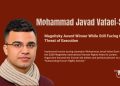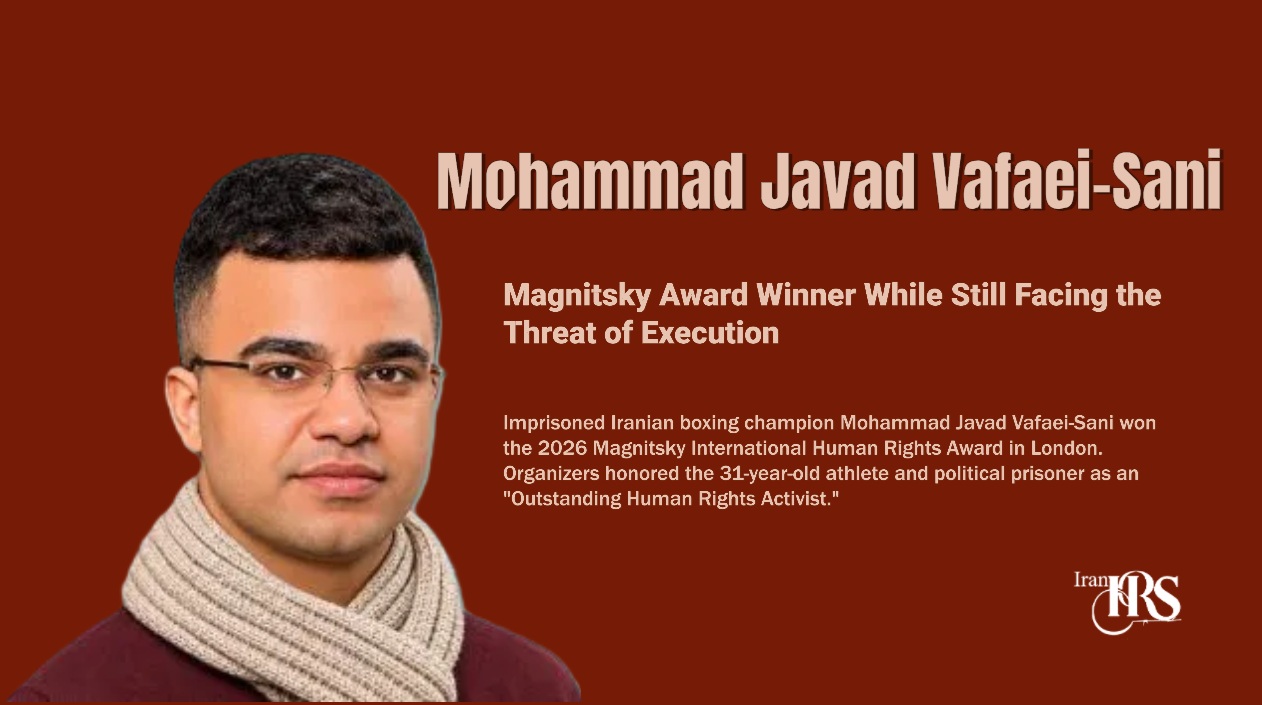
Mohammad Javad Vafaei-Sani, a 31-year-old boxing champion, coach, and political prisoner sentenced to death, received the 2026 Magnitsky International Human Rights Award in London; simultaneously, sports and human rights figures have called for a halt to his sentence execution and his release.
Iran Human Rights Society, Friday, November 13, 2026 – On Thursday night, November 12, 2026, in London, the 2026 Magnitsky International Human Rights Award in the category of “Outstanding Human Rights Activist” was awarded to Mohammad Javad Vafaei-Sani, a 31-year-old political prisoner sentenced to death.
This award was granted to him under circumstances where Mohammad Javad Vafaei-Sani, a champion and coach of martial arts and boxing and holder of a national championship silver medal, remains confined in Vakilabad Prison in Mashhad and faces the imminent execution of his death sentence. The granting of this award has met with reactions from a number of international figures, once again placing his case at the center of global attention.
The Magnitsky Award for Mohammad Javad Vafaei-Sani
The Magnitsky International Human Rights Award, one of the prestigious international awards in the field of human rights, is granted to honor individuals who have stood against repression, corruption, and human rights violations.
Mohammad Javad Vafaei-Sani was introduced as the winner of the 2026 award in the category of “Outstanding Human Rights Activist.” This selection took place while he himself did not have the possibility of attending the ceremony freely and receiving the award in person, remaining confined in Vakilabad Prison in Mashhad.
The granting of this award has raised Mohammad Javad Vafaei-Sani’s profile even further in the international arena, drawing the attention of human rights and sports organizations and figures to his situation and the danger of his death sentence execution.
Mohammad Javad Vafaei; Boxing Champion in Prison
Mohammad Javad Vafaei-Sani, 31 years old, is a champion and coach of martial arts and boxing and a holder of a national championship silver medal.
According to published information, he was arrested on February 8, 2020, due to participating in the November 2019 protests and supporting the People’s Mojahedin Organization of Iran, and has now spent nearly seven years in prison.
Reports regarding his detention period indicate torture, physical and psychological pressures, and prolonged imprisonment.
During judicial proceedings, Mohammad Javad Vafaei-Sani faced charges including membership in the People’s Mojahedin Organization of Iran and “Efsad-fil-Arz” (corruption on Earth), and was sentenced to death on a total of three occasions. Two of his previous death sentences were overturned in judicial stages, but the death sentence was issued once again and ultimately confirmed.
Washington Times: A Champion Who Cannot Receive His Award
The Washington Times, in a report regarding the selection of Mohammad Javad Vafaei-Sani, emphasized that he cannot travel to London to receive his award because he remains in prison and faces a death sentence.
The newspaper linked his case to the November 2019 protests, writing that Vafaei-Sani faced imprisonment and intense pressures following his arrest. The report also pointed to widespread support from sports figures for him; support that demonstrates Mohammad Javad Vafaei-Sani’s case has transcended the level of a domestic judicial file and transformed into an issue in the international arena of sports and human rights.
In past years, prominent world athletes including Martina Navratilova, Sharon Davies, Riley Gaines, Tracy Edwards, and Craig Foster have also called for a halt to the execution of Mohammad Javad Vafaei-Sani’s sentence. The World Boxing Council has likewise asked ruling authorities to annul his death sentence.
Tracy Edwards: The World Must Act to Save His Life
Tracy Edwards, a champion and well-known figure in British sports, simultaneously with the granting of the award, described Mohammad Javad Vafaei-Sani’s situation as an example of the contradiction between sporting values and political repression.
She emphasized that sports must symbolize courage, dignity, hope, and unity, and it is unacceptable for an athlete to face the death penalty due to political beliefs. Edwards called for action by athletes, sports federations, governments, and human rights organizations to prevent the execution of Vafaei-Sani’s sentence.
She also stressed that merely granting an award is not sufficient to save the life of this political prisoner, and the international community must act to prevent sentence execution by highlighting his case and exerting continuous pressure.
Call for Annulment of Death Sentence and Release of Mohammad Javad Vafaei
David R. Boyd, environmental and human rights activist and expert, also reacted to the granting of the Magnitsky Award to Mohammad Javad Vafaei, calling for the annulment of his sentence.
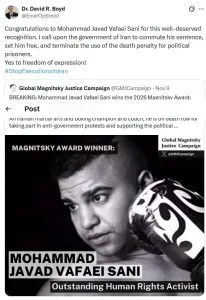
Boyd asked the Iranian government to commute Vafaei’s death sentence, release him, and halt the use of the death penalty against political prisoners. He also emphasized freedom of expression.
This stance demonstrates that the Magnitsky Award is not merely a symbolic appreciation of Mohammad Javad Vafaei, but has transformed into a platform for raising international demands once again regarding the annulment of the death sentence and the release of political prisoners.
Three Death Sentence Issuances for Mohammad Javad Vafaei-Sani
Mohammad Javad Vafaei-Sani, a detainee of the November 2019 protests, faced a heavy case following his arrest. According to the report of the Iran Human Rights Society, the Judiciary convicted him on charges including supporting anti-government currents and “Efsad-fil-Arz.”
Published information regarding his case indicates that Mohammad Javad Vafaei-Sani’s death sentence was overturned by the Supreme Court in two stages, but the Mashhad Revolutionary Court issued a death sentence once again in 2024. This third death sentence was also confirmed by the Supreme Court in 2025.
According to published reports, he has been subjected to severe pressures during his imprisonment and has spent periods in solitary confinement. Reports concerning his case also speak of physical and psychological tortures and repeated threats of death sentence execution.
Mohammad Javad Vafaei-Sani’s Message from Prison
Simultaneously with the granting of the Magnitsky Award, a message from Mohammad Javad Vafaei-Sani, the political prisoner sentenced to death, has been published.
The message emphasizes continued resilience and steadfastness in his stance; a message published under circumstances where this political prisoner still faces the risk of death sentence execution.
The granting of the Magnitsky Award in London and the publication of his message from prison once again highlight the contradiction between Mohammad Javad Vafaei-Sani’s international standing as an outstanding human rights activist and his conditions inside prison.
An Award Versus a Death Sentence
The granting of the international Magnitsky Award to Mohammad Javad Vafaei-Sani took place under circumstances where his case still faces the risk of death sentence execution. On one hand, the ruling Judiciary has maintained his death sentence after multiple reviews, and on the other hand, international institutions, athletes, and figures view his case as a symbol of political repression and human rights violations.
The disparity between these two images makes the significance of this award even more prominent: while Mohammad Javad Vafaei-Sani is in prison under the shadow of a death sentence, his name has been raised internationally as an outstanding human rights activist.
Human Rights Violations in Mohammad Javad Vafaei’s Case
Reports regarding torture, prolonged solitary confinement, repeated issuance and confirmation of death sentences, and allegations of deprivation of a fair trial have created serious human rights concerns regarding Mohammad Javad Vafaei’s case.
These matters conflict with the fundamental principles enshrined in Article 3 of the Universal Declaration of Human Rights regarding the right to life and personal security, and Article 5 regarding the prohibition of torture and cruel, inhuman, or degrading treatment or punishment. Furthermore, the right to a fair trial is emphasized in Article 10 of the Universal Declaration of Human Rights.
See also the below articles:
- Khavaran; From the Mass Graves of the 1988 Massacre to Wall-Building and the Siege of Seeking Justice
- Mohammad Javad Vafaei-Sani Wins the 2026 Magnitsky International Human Rights Award
Follow Iran Human Rights Society on social networks:
Telegram /Twitter /Instagram / YouTube / Facebook
Join Iran Human Rights Society on Twitter