The place that government agents referred to with the derogatory name “La’nat-abad” (Abode of the Accursed) became, through the persistent pursuits of the victims’ families, one of the most prominent symbols of seeking justice; a cemetery where access restrictions, concrete walls, and surveillance cameras have failed to erase it from the public memory.
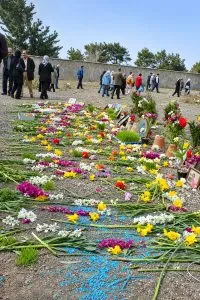
Iran Human Rights Society, Friday, November 13, 2026 – Khavaran Cemetery, located in southeast Tehran, is not merely the burial site of a number of executed political prisoners. This land holds a history of concealment regarding the slaughter of prisoners, depriving families of their loved ones’ bodies, and their enduring struggle to uncover the truth. The narrative underlying this report describes the path leading to Khavaran’s back entrance; a low-visibility route that reaches a locked door monitored by cameras. For the families, these doors and walls are a continuation of the same deprivation that began with the lack of information regarding the prisoners’ fate.
“La’nat-abad”; A Name to Humiliate the Executed
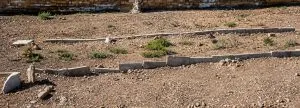
The history of burying political prisoners in Khavaran is not limited to the year 1988. Since 1981, a portion of the lands adjacent to the cemeteries of followers of other faiths was used to bury executed political dissidents. This area lacked the amenities and conventional markers of an official cemetery.
In historical accounts, government officials and agents are noted to have used the terms “La’nat-abad” and “Kfr-abad” (Abode of Infidels). This naming was tied to a discriminatory outlook that deemed certain political dissidents unworthy of burial in public cemeteries due to their beliefs and convictions.
Therefore, this title must be recognized as part of the language of humiliation and exclusion, rather than a name chosen by the families for their loved ones’ burial place. By contrast, the name Khavaran endured through the presence of families and the perpetuation of the victims’ memory.
Info Box | History and Restrictions of Khavaran
| Subject | Information |
| Location | Southeast Tehran |
| Beginning of Political Dissidents’ Burial | From 1981 |
| Known Mass Graves | Associated with the executions of the 1980s, including the 1988 massacre |
| Main Wave of the 1988 Massacre | July and August |
| Warnings Regarding Destruction | December 2008 and January 2009 |
| Publication of Wall-Building and Camera Images | June 2022 |
| Families’ Demand | Truth-seeking, preservation of graves, free access, and accountability |
Khavaran Prior to the Summer 1988 Massacre
In the early years of the 1980s, the bodies of a number of political prisoners, particularly leftist dissidents, were buried in Khavaran without being handed over to their families. Some families later became aware of the approximate burial location; others never received precise directions.
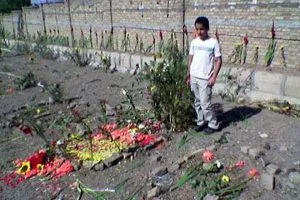
This background is significant because Khavaran in the summer of 1988 was not land entirely devoid of prior burial history. Families had traveled to this location prior to that point to commemorate those executed during the early years of the decade. These very visits played a role in revealing the signs of mass burials.
The presence of individual graves and unknown burial spots alongside mass graves has complicated Khavaran’s history. Not all of its sections can be attributed to a single day, a single wave of executions, or one political group. Accurate reconstruction of this history requires the protection of the site and independent investigation.
The Massacre of Political Prisoners in 1988
In the summer of 1988, over 30,000 political prisoners were secretly executed in prisons across the country. Many of them had previously been tried and were serving their prison sentences.
The main bulk of the slaughter occurred from late July to September 1988. Prisoners’ communication with the outside world was severed, and families remained uninformed of their status for a prolonged period.
The executions initially engulfed a large number of prisoners affiliated with the People’s Mojahedin Organization of Iran, and in the final days, leftist prisoners. The victims’ bodies were hidden across various parts of the country in nameless individual graves or mass graves. Khavaran is one of the most well-known of these locations, though it is not the burial site of all victims of the 1988 massacre.
A broader elaboration of the contexts and process of this slaughter is provided in the report The ’88 Massacre; From Khomeini’s Fatwa to the Demand for Justice.
Nighttime Transfer of Bodies and Burial in Mass Graves
The narrative submitted for this report speaks of preparing trenches with heavy machinery and the nighttime transfer of bodies using regular and refrigerated trucks. In this account, the corpses are placed in pits and subsequently covered with soil.
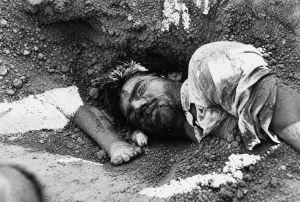
This description provides a picture of clandestine burial and the deprivation of families from identifying and burying their loved ones. However, the type of vehicle, the transfer route, and the timing of each burial shift cannot be generalized to all Khavaran graves without specific testimony or independent documentation.
What has been established in human rights documentation is the clandestine burial of victims and the failure to announce the fate and exact location of their bodies. The total number of executions nationwide should also not be presented as the number of individuals buried in Khavaran.
To determine the number of victims in each grave, the burial sequence, and their identities, forensic examinations are essential. These investigations must be independent, involve the participation of families, and be accompanied by the preservation of evidence.
How Families Discovered the Mass Graves
The families’ accounts indicate that the discovery of the graves was the result of their own searches, rather than transparent announcements by officials. Fresh soil, altered terrain contours, and corpses that were not fully covered drew the attention of visitors.
In recorded testimonies, families have spoken of witnessing signs of bodies beneath a shallow layer of soil and their efforts to cover them. Photographs of these encounters were also documented.
These testimonies show that the discovery of mass graves was not an isolated event with a single date. Signs had been observed prior to the peak of the summer slaughter, and other graves were identified in subsequent months.
Therefore, the narrative of burials must be structured while preserving differences in timelines. Not all graves in Khavaran can be attributed to a single night, nor can one family’s observation be generalized to the entire site.

A Cemetery That Became a Gathering and Protest Site
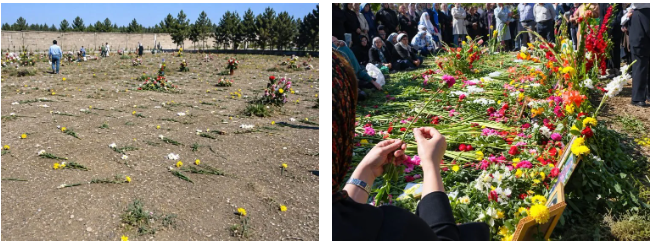
By attending Khavaran, families preserved the memory of loved ones whose very burial sites the ruling authority had concealed. Leaving flowers, reading names, and gathering were ways to counter this erasure.
Initially, Khavaran was portrayed as a symbol of pride and unyielding resistance, but this meaning can be seen as ongoing and current through the sustained presence of families and their insistence on preserving the victims’ names.
For a family that lacks a specific grave, the entire site can serve as a place of mourning. For this reason, altering the land or preventing access is not merely a restriction on reaching a physical location; it targets the family’s connection to their loved one’s final marker.
In this process, Khavaran transformed from a clandestine burial ground into a space of public remembrance. By preserving narratives, the families did not allow the namelessness of the graves to lead to the oblivion of their owners.

Concrete Wall-Building and Camera Installation in 2022
One of the documented stages of intensified restrictions dates back to 2022. On June 6 of that year, images of concrete walls and surveillance equipment surrounding Khavaran were published.
Reports from that same period also informed of altered access routes and the installation of a new entrance. The families regarded these measures as a fresh restriction on their presence and mourning.
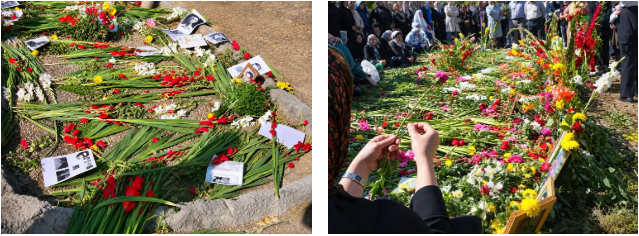
In September 2022, Amnesty International documented the construction of concrete walls approximately two meters high. These walls replaced shorter walls and fences that had previously allowed a view of the site from the outside.
The organization also reported the installation of five cameras inside the compound and along the outer street. In its assessment, these surveillances were employed to intimidate families and deter people from visiting the site. Images and videos were also reviewed to corroborate the visitors’ narrative.
Destruction of Markers; A Threat to Truth-Seeking
Khavaran had faced threats of alteration and destruction even prior to the wall-building. In January 2009, warnings were issued regarding the destruction of grave markers and the bulldozing of the site.
Amnesty International called for an immediate halt to the destruction, the preservation of the site, and the initiation of forensic investigations. The primary concern was the destruction of evidence and depriving families of truth, justice, and reparation.
Preserving a mass grave is not merely maintaining the surface appearance of the land. The location of bones, clothing, accompanying personal items, and soil layers may hold vital significance for identifying victims. Any tampering without specialized examination can compromise these possibilities.
Dr. Javaid Rehman: The 1967/1988 Political Prisoners Massacre, a Crime Against Humanity
Dr. Javaid Rehman, the former UN Special Rapporteur on the situation of human rights in Iran, in his final report regarding “atrocious crimes” in Iran, considered the widespread and extrajudicial executions of political prisoners in 1988 to constitute a crime against humanity. He emphasized in this report that thousands of political prisoners arbitrarily held in prisons were executed during these slaughters without access to a fair judicial process, and these actions can be examined within the framework of crimes against humanity, including murder and extermination.

Rehman also addressed torture, harassment, enforced disappearances, and other inhuman behaviors against political prisoners and their families, emphasizing that the scars of these crimes persist after decades. According to him, many families remain uninformed of their loved ones’ fate and burial locations, and have been deprived of the right to truth, justice, and accountability.
The report stressed that extensive evidence exists regarding these crimes, yet many individuals who played a role in them continue to enjoy immunity from accountability and punishment. Rehman called for truth-seeking, accountability, and an end to the impunity of those responsible for these crimes.
Legal Review of the Khavaran Issue Based on Domestic Laws
The dictatorial laws ruling over Iran have always been criticized due to restricting human rights. Reviewing this matter does not mean endorsing these laws, but rather serves to demonstrate the non-compliance with even these very guarantees.
- Legal Ambiguities: Documentation of executions, identities of the buried, location of bodies, and the responsibility of decision-makers must be clarified.
- Related Legal Articles: Articles 34 through 39 of the Constitution address the right to seek justice, defense, presumption of innocence, and the prohibition of torture and violation of dignity.
- Matters Requiring Investigation: Executions without fair trial, concealing the prisoner’s fate, and threatening justice-seeking families require independent investigation. Historical evaluation must also distinguish between laws in force at the time of occurrence.
Review of Khavaran from a Human Rights Perspective
Khavaran is intertwined with the right to life, the prohibition of torture, a fair trial, and the right of families to know the truth. Concealing the fate and burial location of victims prolongs the suffering of survivors.
Extrajudicial executions and enforced disappearances associated with the 1988 massacre have been examined in human rights assessments as crimes against humanity. Preserving the graves, family access, protecting witnesses, and independent investigation are prerequisites for accountability.
Until the identities of the victims and the manner of their burial are clarified, Khavaran is not merely a historical memorial; it is a site containing potential evidence and the living demand of families who continue to seek answers.
See also the below articles:
- Mohammad Javad Vafaei-Sani Wins the 2026 Magnitsky International Human Rights Award
- Issuance of Death Sentence for Abolfazl Sadaghat and Four Other Protesters in Mashhad; Growing Concerns Over Political Executions
Follow Iran Human Rights Society on social networks:
Telegram /Twitter /Instagram / YouTube / Facebook
Join Iran Human Rights Society on Twitter