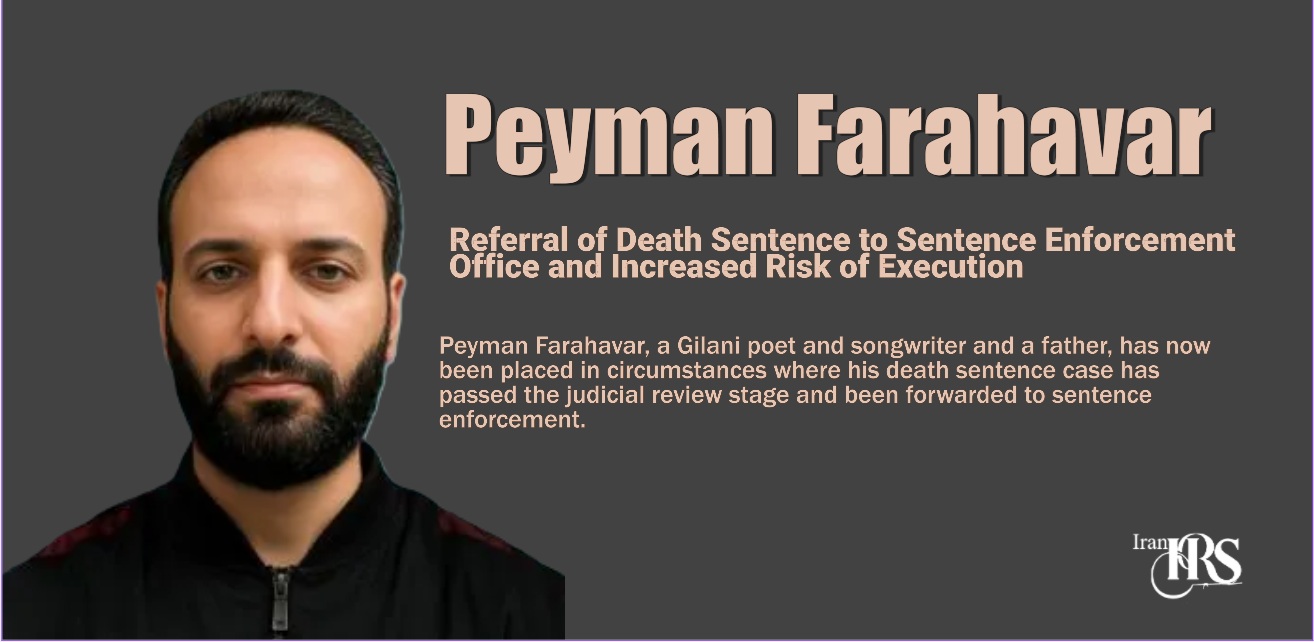
The case of Peyman Farahavar, a poet and Gilani political prisoner confined in Lakan Prison of Rasht, has been referred to the Sentence Enforcement Office following the re-confirmation of his death sentence and the rejection of his retrial request; he faces a death sentence on charges of “Baghy” (armed rebellion), “Moharebeh” (enmity against God), and connection and affiliation with the People’s Mojahedin Organization of Iran.
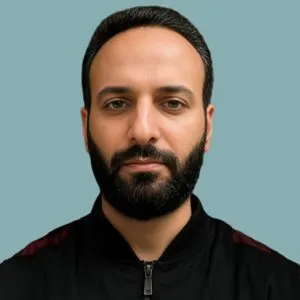
Iran Human Rights Society, Saturday, November 14, 2026 – The risk of executing the death sentence of Peyman Farahavar, a 38-year-old poet and political prisoner confined in Lakan Prison of Rasht, has heightened following the referral of his case to the Sentence Enforcement Office. According to published reports, Peyman Farahavar learned about the receipt of the notification referring his case to the Sentence Enforcement Office during a phone call with his family on November 9, 2026. His death sentence had previously been confirmed by Branch 39 of the Supreme Court, and his request for a retrial had also been rejected. With the entry of the case into the sentence enforcement stage, family concerns regarding the likelihood of the sentence being carried out have escalated.
Referral of Peyman Farahavar’s Case to the Sentence Enforcement Office
Peyman Farahavar, a Gilani poet and songwriter and a father, has now been placed in circumstances where his death sentence case has passed the judicial review stage and been forwarded to sentence enforcement.
According to published information, Peyman Farahavar informed his family of receiving the case referral notice through a phone call on Monday, November 9. No date has been announced for the execution of the sentence thus far, but the transfer of the case to sentence enforcement has sharply increased concerns regarding the risk of sentence implementation.
Peyman Farahavar’s death sentence had previously been issued by Branch 1 of the Revolutionary Court of Rasht, headed by Ahmad Darvish-Goftar. This sentence was subsequently confirmed by Branch 39 of the Supreme Court, and his retrial request was also rejected in April/May 2026.
Peyman Farahavar; Gilani Poet, Worker, and Social Activist
Peyman Farahavar, with his full name Amin Farahavar Gisavandani, was born on December 23, 1988, in Rasht. He is a poet, cultural and social activist, and has engaged in literary activities under the pen name “Sheida.”
Published reports concerning his background indicate that a significant portion of his activities has been dedicated to poetry, social issues, justice-seeking, the plight of farmers, the destruction of Gilan’s environment, and protests against land grabbing and economic disorders.
Peyman Farahavar is a worker and a father, and prior to his recent arrest, he also had a history of detention due to social and protest activities. He was arrested by security forces in August/September 2024 and initially transferred to the Intelligence Department detention center, and following the conclusion of interrogations, was transferred to Lakan Prison of Rasht.
Peyman Farahavar’s Affiliation with the People’s Mojahedin Organization of Iran
Peyman Farahavar’s affiliation with the People’s Mojahedin Organization of Iran has also been raised in his judicial case. In reports concerning his case, he has been introduced as a supporter of the Mojahedin organization, and this matter, alongside the charges of “Baghy” and “Moharebeh,” has been relied upon by the Judiciary.
Charges of “Baghy” and “Moharebeh”
Peyman Farahavar was sentenced to death on charges of “Baghy” and “Moharebeh” by Branch 1 of the Revolutionary Court of Rasht. He was also sentenced to three months in imprisonment for “propaganda against the system.”
Human rights reports regarding his case state that a significant portion of the case documentation relates to his poems, writings, and social and protest activities.
In the legal review of the case, serious criticisms have been raised regarding the basis for issuing the death sentence and the realization of the legal elements of the charges of “Moharebeh” and “Baghy.” Among these are questions regarding the adequacy of evidence and their conformity with the legal conditions of these charges concerning actions described in the case as armed operations or the creation of widespread insecurity.
Additionally, numerous ambiguities have been raised regarding the reliance on certain materials and security reports and the manner in which evidence was collected.
Trials Without the Presence of Chosen Legal Counsel
One of the most significant points of objection in Peyman Farahavar’s case is the manner in which the court session was held.
Published reports indicate that the trial session in Branch 1 of the Revolutionary Court of Rasht was held without the presence of his chosen legal counsel. This matter holds special importance in a case where the prescribed punishment is death.
It has also been reported that a major portion of the documentation relied upon by the Judiciary consisted of reports from security institutions and confessions extracted during the interrogation period. Serious questions have also been raised regarding the manner in which these confessions were obtained and the validity of certain evidence.
Peyman Farahavar’s Physical Condition
Peyman Farahavar has also faced physical difficulties during his detention.
Prior to his arrest, he had undergone gallbladder surgery and subsequently suffered from severe pain in the surgical area and physical health problems. Human rights reports have informed of his deprivation of proper medical treatment and the refusal of prison authorities to dispatch him for specialized examinations.
In addition to problems related to his abdominal condition, he has also faced vision problems. The persistence of this situation under prison conditions and limited access to medical services have heightened concerns regarding his physical health.
Warning Regarding the Risk of Sentence Execution
In the latest developments, following the rejection of retrial requests, Peyman Farahavar’s case has been sent to the Sentence Enforcement Unit. This development has made the risk of his death sentence execution more serious.
Prior to this, judicial authorities had also verbally informed of the arrival of the sentence execution order to the relevant unit.
Referral of the case to sentence enforcement does not mean the announcement of a definitive execution date, but it indicates the entry of the case into a stage where the risk of sentence implementation has increased compared to previous stages.
Amnesty International’s Warning Regarding Peyman Farahavar
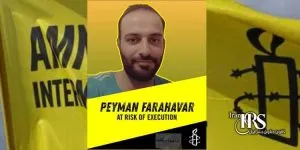
Amnesty International had also previously warned about the risk of sentence execution for Peyman Farahavar and dozens of other political prisoners, placing his name among political prisoners facing the imminent risk of execution.
This concern is raised under circumstances where the use of the death penalty against political prisoners and protesters has turned into one of the most prominent matters of objection by human rights institutions.
Legal Review of Peyman Farahavar’s Case
This review does not mean endorsing the dictatorial laws ruling over Iran; the objective is to examine whether, even by using these very laws as a criterion, the process of proceedings and the issuance of the death sentence complied with legal requirements or not.
In Peyman Farahavar’s case, the absence of a chosen lawyer in the court session, reliance on contested security reports, questions regarding the validity of presented evidence, and disagreement over the realization of the legal elements of “Baghy” and “Moharebeh” are among the matters requiring serious judicial review.
Issuing a death sentence in a case with such ambiguities highlights the necessity of the defendant enjoying effective defense, access to chosen legal counsel, and an independent and impartial trial.
Human Rights Violations in Peyman Farahavar’s Case
Peyman Farahavar’s case encounters matters that conflict with fundamental human rights standards.
Article 3 of the Universal Declaration of Human Rights emphasizes the right to life, liberty, and security of person, and the issuance and implementation of a death sentence directly place this fundamental right at risk of deprivation.
Article 5 of the Universal Declaration of Human Rights prohibits any form of torture and cruel, inhuman, or degrading treatment or punishment; reports concerning ill-treatment during the interrogation period and medical deprivation are concerning from this perspective.
Furthermore, Article 10 of the Universal Declaration of Human Rights emphasizes the right of every individual to a fair and public hearing by an independent and impartial tribunal; a matter that, given reports regarding the holding of the court session without the presence of chosen legal counsel, assumes special significance.
See also the below articles:
- UN Election of Iran to Program Committee Sparks Outrage
- Mohammad Javad Vafaei-Sani Receives 2026 Magnitsky Award
Follow Iran Human Rights Society on social networks:
Telegram /Twitter /Instagram / YouTube / Facebook
Join Iran Human Rights Society on Twitter