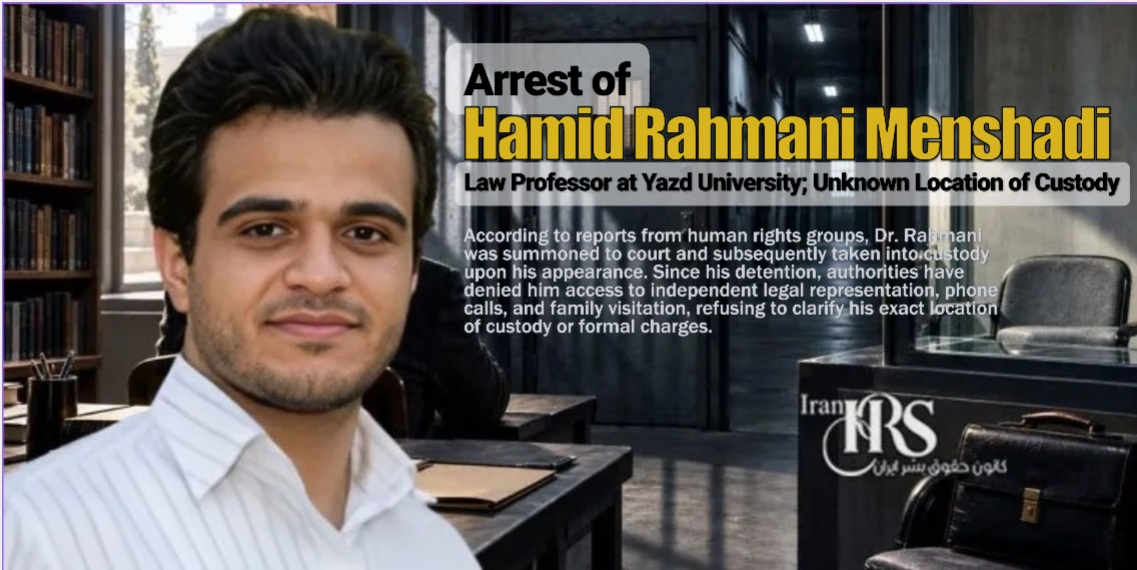
Hamid Rahmani Menshadi, a 45-year-old law professor at Yazd University, has been detained for nearly two weeks and transferred to an undisclosed location; his family has thus far been denied visitation and access to legal counsel

Iran Human Rights Society, Thursday, September 24, 2026- Hamid Rahmani Menshadi, a law professor at Yazd University, has been in detention for approximately two weeks, with no precise information published to date regarding his place of custody, the status of his case, or potential charges against him. According to received information, the university professor’s family has been unable to visit him, and there is no confirmation of his access to an attorney. His relatives are demanding clarification on the law professor’s status and the provision.
Arrest of Hamid Rahmani Menshadi and Lack of News Regarding His Condition
Based on available information, Hamid Rahmani Menshadi, 45, a law professor at Yazd University, was arrested approximately two weeks ago and subsequently transferred to an undisclosed location.
Despite the passage of this timeframe, clear information regarding his location of detention has yet to be released. His family has been unable to visit him, and no specific reports have been published regarding his access to a lawyer.
The family’s complete lack of knowledge regarding the detention facility and legal standing of a detainee, particularly as the period of detention prolongs, has heightened serious concerns regarding his well-being.
Academic and Judicial Protests Prior to Arrest
According to received reports, prior to his arrest, Rahmani Menshadi had published content on social media concerning issues related to Yazd University and the judicial system in Yazd.
It is reported that he raised objections regarding the performance of certain university administrators as well as four judges in Yazd, posting commentary on social media regarding their conduct.
Based on this same information, disputes between the law professor and certain university officials and judges stemmed from several judicial cases and the manner in which they were processed.
However, existing information does not specify the exact details of these judicial cases or the precise content of the posts published by Rahmani Menshadi.
Ambiguity Surrounding Charges and Judicial Authority
Despite nearly two weeks having elapsed since the arrest of Hamid Rahmani Menshadi, details regarding potential charges against him have not been announced.
Furthermore, it remains unclear which security agency or detention facility is holding him, or which judicial branch is responsible for overseeing his case.
The absence of information regarding the charges and place of detention severely restricts any evaluation of the case’s legal process. The family and relatives of this university professor demand that official and clear information regarding his status be provided at the earliest opportunity.
Concerns Over Lack of Legal Representation
One of the primary concerns in the case of Hamid Rahmani Menshadi is the report of his deprivation of access to defense counsel.
Access to a lawyer is among the most essential defense guarantees during judicial proceedings. In cases where the possibility of security or judicial charges exists, effective and timely access to legal representation becomes even more critical.
Given that potential charges against Rahmani Menshadi have not yet been specified, it is impossible to evaluate the legal nature of the case or the exact grounds for his arrest. Nonetheless, clarifying his legal status and granting access to family and legal counsel remain the main demands of his relatives.
Information Box | Case Information at a Glance
| Subject | Details |
|---|---|
| Name | Hamid Rahmani Menshadi |
| Age / Profession | 45 years old / Law Professor at Yazd University |
| Detention Duration | Approximately two weeks (As of late September 2026) |
| Location of Custody | Undisclosed / Unknown location |
| Primary Pre-Arrest Activity | Public criticism of Yazd University administrators and four local judges on social media |
| Current Legal Status | Incommunicado / Unannounced formal charges / Unknown judicial authority |
| Rights Restrictions | Denied family visitation; denied access to defense counsel |
Legal Review of Hamid Rahmani Menshadi’s Case Based on Domestic Laws
The laws enforced in Iran face widespread criticism due to portions contradicting fair trial standards and restricting defendants’ defense rights. Reviewing this case under domestic statutes does not constitute an endorsement of these laws, but serves to examine whether even internal statutory guarantees are being upheld.
Legal Ambiguities of the Case
- Article 32 of the Constitution: Mandates the immediate notification of charges in writing to a detainee and requires prompt legal determination of detention status.
- Article 35 of the Constitution: Formally guarantees the right of all individuals to select defense counsel in all stages of legal proceedings.
- Article 37 of the Constitution: Establishes the presumption of innocence until proven guilty in a competent court.
- Procedural Violations: Continued incommunicado detention, failure to notify charges, and deprivation of legal counsel represent direct violations of statutory protections codified within internal law.
Reviewing the Case from the Perspective of Human Rights and International Standards
International human rights frameworks strictly prohibit arbitrary detention and mandate full procedural safeguards for all individuals deprived of liberty.
Human Rights Ambiguities of the Case
The ongoing failure to disclose Rahmani Menshadi’s detention facility, the withholding of formal charges, and the denial of access to independent legal counsel highlight a severe breach of binding international fair trial guarantees.
Related International Documents
- Article 9 of the Universal Declaration of Human Rights (UDHR): Prohibits arbitrary arrest, detention, or exile.
- Article 10 of the Universal Declaration of Human Rights (UDHR): Guarantees full equality to a fair and public hearing by an independent and impartial tribunal.
- Article 14 of the International Covenant on Civil and Political Rights (ICCPR): Sets forth comprehensive fair trial guarantees, including prompt notification of charges, adequate time to prepare defense, and immediate access to legal representation.
Up to the time of drafting this report, no further information regarding the place of detention, formal charges, or judicial process for this Yazd University law professor has been made available.
See also the below articles:
- Forced Confessions and Detention of Dr. Sobhan Esmailpour
- Ward 7 of Evin Prison: Severe Overcrowding, Unsanitary Conditions, and Medical Neglect
Follow Iran Human Rights Society on social networks:
Telegram /Twitter /Instagram / YouTube / Facebook
Join Iran Human Rights Society on Twitter