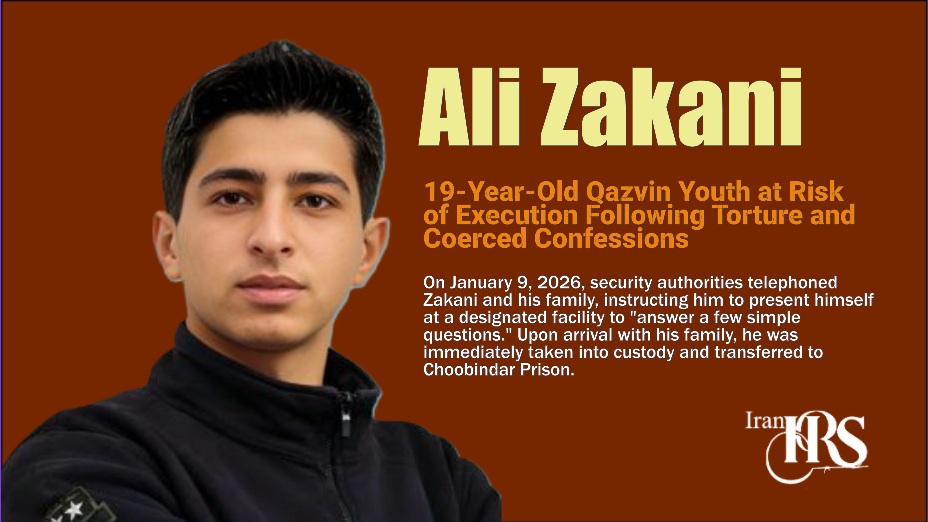
Ali Zakani, 19 years old and from Mahmudabad, Qazvin, was arrested after presenting himself to security authorities following a phone call and was transferred to Choobindar Prison. According to received information, he was subjected to severe physical beatings during interrogation and, following the issuance of a death sentence, has been denied family visitations

Iran Human Rights Society, Saturday, October 10, 2026– Ali Zakani, a 19-year-old youth from Mahmudabad, Qazvin, is among those detained during the 2025 nationwide protests and is currently at risk of execution in Qazvin’s Choobindar Prison. According to received information, he was subjected to severe physical torture
during interrogations, resulting in two broken ribs and three to four damaged and broken teeth due to physical assaults.
Arrest of Ali Zakani Following Security Contact
Ali Zakani was arrested on January 9, 2026, one day after the January 8 protests, following a telephone contact from security authorities. Based on reports, he and his family were informed during this call that he should present himself to answer a few simple questions.
Ali Zakani went to the designated location accompanied by his family, but was taken into custody by security forces immediately upon arrival. Following his arrest, he was transferred to Choobindar Prison in Qazvin and has been incarcerated there ever since.
Severe Torture to Extract Confessions
According to published details regarding Ali Zakani’s situation, he was subjected to intense physical pressure and severe beatings during his interrogation period. The severity of these assaults was such that two of his ribs were broken and three to four of his teeth were damaged and broken.
The reports further indicate that these physical pressures were applied with the objective of extracting coerced confessions from the prisoner. These reports of torture and forced confessions under pressure highlight the necessity of an independent review into the interrogation conditions and the validity of confessions attributed to him.
Ambiguity in Due Process and Restrictions on Defense Rights
Ali Zakani’s case was adjudicated by a judge named Asadi. Although he had legal representation, according to received information, effective defense guarantees were not provided, and restrictions were imposed on the defense process.
Further details regarding the number of court sessions, the content of the indictment, and the primary evidence relied upon to issue the death sentence remain unavailable. It also remains unconfirmed to what extent the confessions extracted during interrogation played a role in issuing the capital verdict.
Denial of Family Visitation Following Sentencing
Ali Zakani was permitted family visits prior to the issuance of his death sentence, but this access was revoked after the verdict was issued and formally communicated.
The denial of family visitation continues while his family remains deeply alarmed over his physical condition and judicial fate. They are currently in a critical situation, expressing acute concern over the imminent risk of execution facing their 19-year-old son.
Given Ali Zakani’s young age, as well as reports of torture, coerced confessions, and restrictions on effective defense, clarifying the details of his interrogation and trial proceedings through an independent investigation is of critical importance.
Legal Review of the Case Based on Domestic Laws
Reviewing this case under domestic statutes does not signify an endorsement of existing legal frameworks, but serves to demonstrate that even internal statutory regulations are being directly bypassed.
Relevant Statutory Provisions
- Article 35 of the Constitution: Guarantees the fundamental right of all defendants to retain legal counsel across all stages of judicial proceedings.
- Article 38 of the Constitution: Expressly forbids all forms of torture to extract confessions or obtain information, declaring coerced statements legally void.
Procedural Violations
In a capital case resulting in a death sentence, allegations involving physical torture and forced confessions require independent investigation, as extracting statements under physical assault directly violates statutory protections codified under domestic law.
Human Rights Violations Regarding the Death Sentence
The death sentence and treatment of Ali Zakani conflict directly with fundamental international human rights principles:
- Article 5 of the Universal Declaration of Human Rights (UDHR): Explicitly dictates that no one shall be subjected to torture or to cruel, inhuman, or degrading treatment or punishment.
- Article 10 of the Universal Declaration of Human Rights (UDHR): Entitles everyone to a fair and public hearing by an independent and impartial tribunal.
- Article 11 of the Universal Declaration of Human Rights (UDHR): Upholds the presumption of innocence and guarantees all necessary defense protections for anyone charged with a penal offense.
See also the below articles:
- Arrest of Niloofar Haghi in Kermanshah and Transfer to an Unknown Location
- European Parliament Calls on Iran to Revoke Death Sentences of Two Women Protesters
Follow Iran Human Rights Society on social networks:
Telegram /Twitter /Instagram / YouTube / Facebook
Join Iran Human Rights Society on Twitter