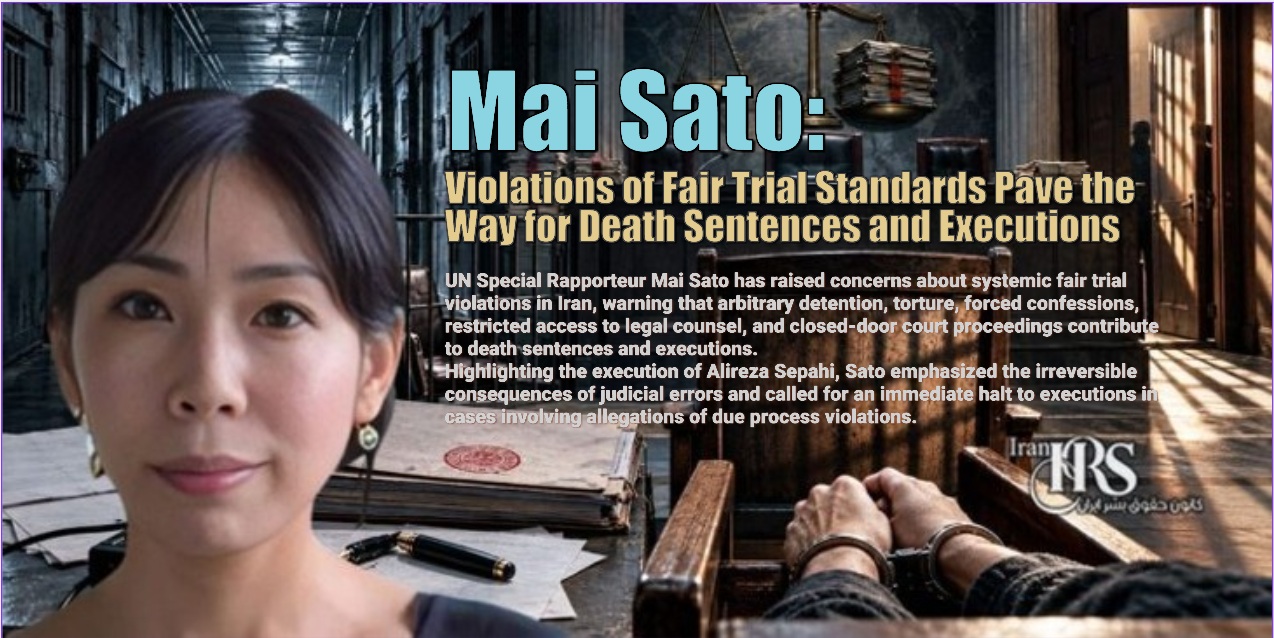
Mai Sato, the United Nations Special Rapporteur on the human rights situation in Iran, stated that arbitrary detention, torture, forced confessions, denial of access to a lawyer of one’s choice, and closed-door trials are signs of the institutionalization of fair trial violations within Iran’s judicial system.
Iran Human Rights Center, Thursday, October 8, 2026 – In a series of recent posts on X, Mai Sato warned about the issuance and implementation of death sentences following trials that fail to meet fair trial standards. She emphasized that judicial violations are not limited to cases related to the January 2026 protests but have a long history within the country’s judicial structure.
According to Sato, arbitrary detention, torture and ill-treatment during investigations, the use of coerced confessions as evidence, restrictions on access to a lawyer of one’s choosing, non-public Revolutionary Court hearings, and the failure to publish full verdicts deprive defendants of an effective defense. When such proceedings result in death sentences and executions, judicial errors become irreversible.
Fair Trial Violations Extend Beyond the January Protests
Sato stressed that violations of fair trial principles are not confined to those detained during the January 2026 protests. These practices have become entrenched in the judicial system over many years and have intensified during periods of public unrest.
Political and security-related detainees often face serious restrictions from the moment of arrest. Solitary confinement, denial of contact with family members, uncertainty about their whereabouts, lengthy interrogations, pressure to admit accusations, and denial of access to a lawyer of their choice are among the issues that arise before trial.
Under such circumstances, cases are often built on security agency reports and statements obtained during interrogations before defendants have a meaningful opportunity to defend themselves. If courts rely on these materials without independently examining the circumstances of detention and questioning, judicial independence and impartiality are effectively undermined.
Execution of Alireza Sepahi Amid Judicial Concerns
One case highlighted by Sato was the execution of Alireza Sepahi, who had been arrested during the January 2026 protests in Isfahan. His death sentence was carried out early on Monday, October 5, 2026, at Dastgerd Prison in Isfahan while his lawyer was still pursuing a request for judicial review.
Sepahi’s case was linked to events in Ali Khani Square in Isfahan, where numerous citizens were arrested and several defendants received death sentences. Concerns had been raised regarding the circumstances of arrest, interrogation methods, the reliability of confessions, and restrictions on legal representation.
Sato stated that carrying out an execution in a case marked by such uncertainties underscores the urgent need for a halt to executions. Executing a sentence before legal appeals and review mechanisms are fully exhausted permanently removes the possibility of correcting a judicial mistake.
According to published reports, at least twelve defendants in the case faced death sentences during a single court session. Collective proceedings involving charges that may result in the death penalty raise serious concerns about whether each defendant’s role, evidence, defense arguments, and personal circumstances were individually assessed.
The Lasting Impact on Families
In another message, Sato wrote that the consequences of capital punishment affect not only the condemned individual but also their family, both before and after the execution.
The execution of Alireza Sepahi had previously been postponed due to a heart condition. From that point onward, he and his family lived under constant pressure, without clear information about when the sentence might be carried out. Sudden transfers to solitary confinement, suspension of phone calls, and unofficial reports of imminent execution create an atmosphere of continuous anxiety for families of death-row prisoners.
Families often move between prisons, prosecutors’ offices, and courts seeking information, final visits, suspension of sentences, or access to case files. In some cases, they are not informed in a timely manner about the execution itself. Refusal to return the body, restrictions on funeral ceremonies, and pressure to prevent public discussion can extend the punishment to the family of the executed person.
Forced Confessions Used Instead of Reliable Evidence
A central concern raised by Sato was the use of confessions allegedly obtained through pressure, torture, or ill-treatment. Statements made by someone held in solitary confinement, denied legal counsel, and under the complete control of interrogators cannot, by themselves, be considered reliable evidence, especially in cases involving the death penalty.
In some political cases, recorded statements from detainees are broadcast by state media before any trial takes place. Such actions violate the presumption of innocence and present the detainee as guilty in the eyes of the public before judicial proceedings have occurred.
Courts are obligated to independently investigate allegations of torture and coercion during interrogations. However, in many cases, complaints of mistreatment are not adequately examined, and the same disputed confessions become the basis for severe sentences or death penalties. Sato warned that executions based on such procedures greatly increase the risk of arbitrary deprivation of life.
Denial of Legal Counsel and Closed Trials
Restrictions on access to a lawyer of one’s choice were another issue highlighted by Sato. Defendants in political and security-related cases may be allowed to select legal representation only from a list approved by the judiciary during the preliminary investigation stage.
The presence of an independent lawyer is particularly important during the first days and weeks of detention, when defendants are most vulnerable to intensive interrogations. Legal counsel can help prevent unlawful pressure and ensure that allegations of torture or mistreatment are documented promptly. If a lawyer becomes involved only after interrogations have concluded, it becomes much more difficult to challenge evidence gathered in their absence.
Sato also criticized the practice of holding Revolutionary Court proceedings behind closed doors and failing to publish complete judicial rulings. The lack of transparency prevents legal experts and independent observers from examining what evidence was relied upon and how defendants’ arguments were considered.
Four Years After the Death of Jina Mahsa Amini
Referring to the fourth anniversary of the death of Jina Mahsa Amini while in the custody of the morality police, Sato stated that the underlying causes of public dissatisfaction remain unresolved. She described the January 2026 protests as another chapter of loss and suffering and wrote that, rather than addressing public demands, the authorities have responded to successive waves of protest with repression.
Mass arrests of protesters, the filing of security-related charges, the issuance of harsh sentences, and the use of the death penalty have intensified concerns that capital punishment is being used to instill fear in society. Sato called for a halt to executions and for independent reviews of cases involving allegations of torture, forced confessions, denial of access to a lawyer of one’s choice, or non-public judicial proceedings.
See also the below articles:
- Bahareh Aghaei Sentenced to 20 Years as Pressure on Iranian Lawyers Intensifies
- Sudden Cancellation of Shahin Zoughi-Tabar’s Prison Visit Raises Human Rights Concerns
Follow Iran Human Rights Society on social networks:
Telegram /Twitter /Instagram / YouTube / Facebook
Join Iran Human Rights Society on Twitter