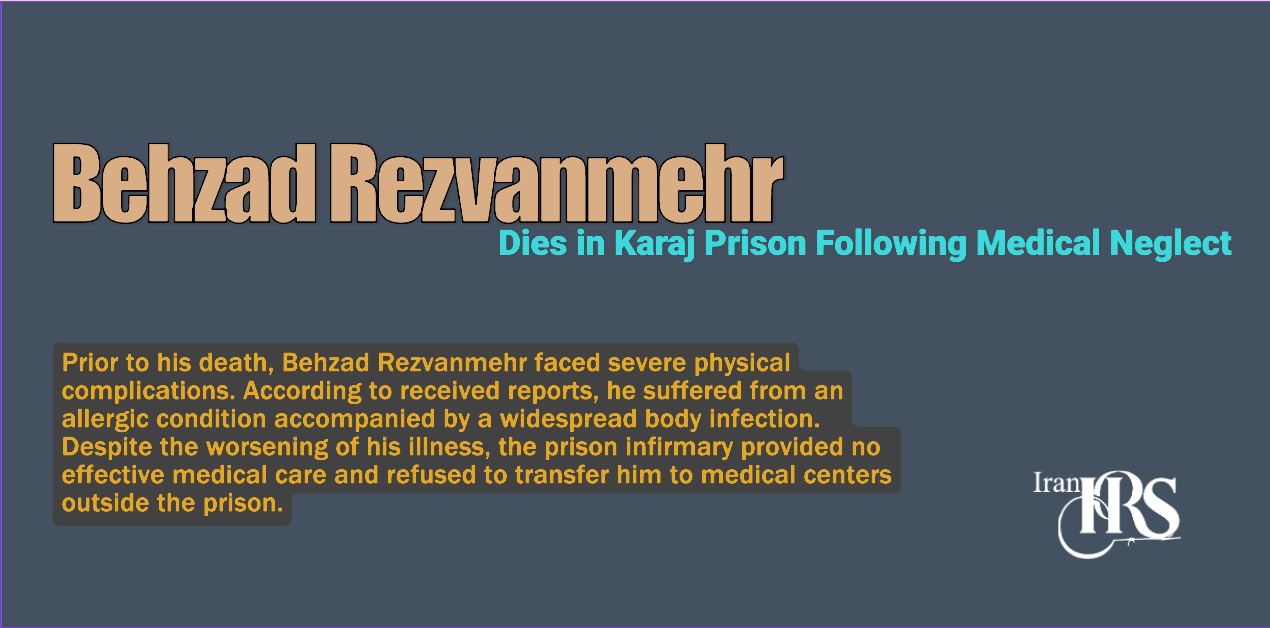
Behzad Rezvanmehr, a political prisoner incarcerated in Karaj Central Prison, died on the morning of Thursday, October 15, 2026, following the aggravation of his illness and denial of medical care. Suffering from a widespread body infection, he had visited the prison infirmary the night prior to his death, but was returned to the ward after receiving an injection. This political prisoner had previously been subjected to severe torture and spent the majority of his detention period in solitary confinement
Iran Human Rights Society, Thursday, October 15, 2026– Behzad Rezvanmehr, a political prisoner incarcerated in Karaj Central Prison, lost his life on the morning of Thursday, October 15, following the worsening of his illness and the lack of medical attention. According to received information, this prisoner suffered from a severe allergic condition accompanied by a widespread body infection, but prison infirmary officials refused to provide appropriate treatment or transfer him to an outside hospital facility. His cellmates discovered his lifeless body on Thursday morning.
Death of Behzad Rezvanmehr Following Visit to Karaj Central Prison Infirmary
On the evening of Wednesday, October 14, Behzad Rezvanmehr visited the Karaj Central Prison infirmary due to the aggravation of his illness and the deterioration of his physical condition.
According to received information, instead of conducting specialized medical examinations and preparing his transfer to a hospital, infirmary staff merely administered an injection and returned him to the ward.
The political prisoner spent the final hours of his life in the ward, and on Thursday morning, his cellmates discovered his lifeless body.
Information regarding the specific type of injection administered, the medical diagnosis, and the definitive cause of death remains unavailable.
Widespread Body Infection and Refusal of Hospital Transfer
Prior to his death, Behzad Rezvanmehr faced severe physical complications. According to received reports, he suffered from an allergic condition accompanied by a widespread body infection.
Despite the worsening of his illness, the prison infirmary provided no effective medical care and refused to transfer him to medical centers outside the prison.
The continuation of his illness without specialized treatment progressively deteriorated the prisoner’s physical condition.
His death following a visit to the infirmary highlights the necessity of examining the actions of the medical staff, the decisions of prison officials regarding medical furloughs, and the reasons for returning a sick prisoner to the ward.
Severe Torture and Prolonged Solitary Confinement
Behzad Rezvanmehr was arrested by security forces in early 2026 on charges of opposition to the ruling system.
According to received information, he was subjected to severe torture following his arrest and spent the majority of his detention period in solitary confinement.
Reports of severe torture and prolonged solitary confinement, alongside the subsequent denial of medical treatment, raise grave concerns regarding the treatment of this political prisoner.
Details of the torture methods and resulting injuries are unlisted in available information, and the potential connection between these injuries and his medical state prior to death requires specialized examination.
Necessity of Investigating the Cause of Death and Responsibility of Prison Authorities
The death of Behzad Rezvanmehr in Karaj Central Prison brings forward the issue of prison officials’ responsibility to protect the lives of prisoners and provide essential medical care.
An independent review of his medical file, infirmary visit records, administered treatments, and the reasons for denying transfer to a hospital is essential to clarify the circumstances of his death.
Furthermore, allegations regarding torture and prolonged solitary confinement must be investigated to determine the potential responsibility of involved officers and authorities.
Legal Review of Behzad Rezvanmehr’s Case Based on Domestic Laws
This review does not signify an endorsement of the dictatorship’s laws governing Iran, but serves to demonstrate the failure to observe even these regulations. Article 38 of the Constitution prohibits torture, and Article 108 of the Executive Regulations of the Prison Organization forbids physical and psychological abuse of prisoners. Articles 137 and 140 of these regulations emphasize emergency transfers of sick prisoners and the provision of medical services. The reported torture and medical deprivation regarding Rezvanmehr conflict directly with these statutory provisions.
Human Rights Review of the Case and Violation Standards
The torture, prolonged solitary confinement, and denial of necessary medical care to Behzad Rezvanmehr constitute severe violations of fundamental prisoner rights. Article 3 of the Universal Declaration of Human Rights protects the right to life and personal security. Article 5 strictly prohibits torture and inhuman treatment, and Article 25 recognizes the right to medical care. Furthermore, the Nelson Mandela Rules emphasize the provision of healthcare, the protection of prisoners’ health, and strict restrictions on the use of solitary confinement.
See also the below articles:
- Varisheh Moradi Sentenced to Death a Second Time in Tehran
- Dr. Ahmad Rahimi Facing Risk of Capital Indictment in Iran
Follow Iran Human Rights Society on social networks:
Telegram /Twitter /Instagram / YouTube / Facebook
Join Iran Human Rights Society on Twitter