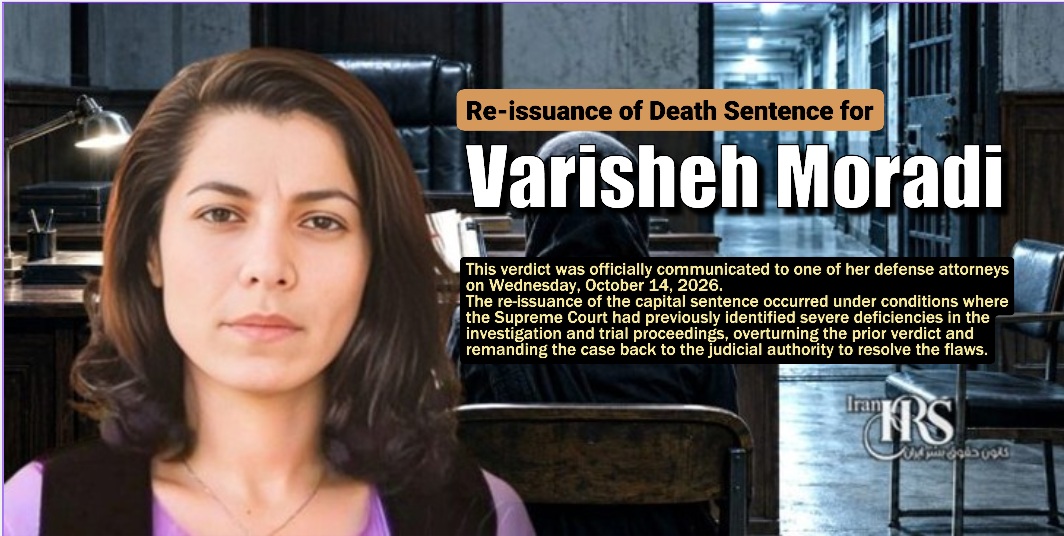
Branch 15 of the Tehran Revolutionary Court has, for the second time, sentenced political prisoner Varisheh Moradi, incarcerated in Evin Prison, to death on the charge of “membership in a Baghi group.” This sentence was issued despite the Supreme Court having previously overturned her death sentence due to serious deficiencies in the investigation. Defense attorneys state that the court again imposed the death penalty without resolving the identified deficiencies

Iran Human Rights Society, Wednesday, October 14, 2026– Varisheh Moradi (Mirzaei), a political prisoner, has been sentenced to death for the second time by Branch 15 of the Tehran Revolutionary Court. This verdict was officially communicated to one of her defense attorneys on Wednesday, October 14, 2026. The re-issuance of the capital sentence occurred under conditions where
the Supreme Court had previously identified severe deficiencies in the investigation and trial proceedings, overturning the prior verdict and remanding the case back to the judicial authority to resolve the flaws.
Notification of Varisheh Moradi’s Second Death Sentence
Amir Sajjadi, one of Varisheh Moradi’s defense attorneys, stated in an interview with Emtedad that Branch 15 of the Tehran Revolutionary Court has once again sentenced his client to death on the charge of “membership in a Baghi group.”
According to this attorney, the new ruling was communicated on Wednesday, October 14, and starting from the notification date, the case attorneys have 20 days to file an appeal with the Supreme Court.
Therefore, the new sentence is not yet final, and the possibility of a secondary review by the Supreme Court remains available.
Issuance of Death Sentence Without Resolving Investigation Deficiencies
Keyvan Azizi, another defense attorney representing Varisheh Moradi, criticized the proceedings, stating that Branch 15 of the Revolutionary Court re-issued the death sentence without conducting the supplementary investigations mandated by the Supreme Court.
According to him, rather than rectifying the fundamental flaws in the case, the court merely altered the charge title while repeating the same prior punishment.
This development raises serious questions regarding compliance with procedural requirements, execution of Supreme Court directives, and Varisheh Moradi’s right to an effective legal defense.
History of the Overturned Death Sentence of Varisheh Moradi
Previously, on December 10, 2025, the Supreme Court overturned the death sentence of this political prisoner.
In a prior report by the Iran Human Rights Society concerning the overturning of Varisheh Moradi’s death sentence and the remand of the case for re-examination, it was noted that procedural flaws and defects in the formal notification of charges served as primary reasons for overturning the initial ruling.
The first death sentence for Varisheh Moradi was issued in November 2024 by Branch 15 of the Tehran Revolutionary Court. From the outset, that ruling faced objections from defense attorneys and criticism regarding trial procedures.
Detention Background and Defense Right Restrictions
Varisheh Moradi was arrested by security forces in Sanandaj on August 1, 2023. Following interrogation in security detention facilities, she was transferred to Ward 209 of Evin Prison and subsequently moved to the women’s ward of Evin Prison on December 26 of the same year.
During initial trial proceedings, reports were also published regarding restrictions imposed on her defense rights. The Iran Human Rights Society previously covered her judicial obstacles in a report regarding the second court session for Varisheh Moradi and the limitations placed on her self-defense.
The re-issuance of the death sentence, despite the prior ruling being overturned, has heightened concerns regarding the fate of this political prisoner and the preservation of her defense rights.
Legal Review of Varisheh Moradi’s Case Based on Domestic Laws
This review does not signify an endorsement of the dictatorship’s laws governing Iran, but serves to demonstrate the failure to observe even these regulations. Articles 35 and 37 of the Constitution emphasize the right to legal counsel and the presumption of innocence. Article 190 of the Code of Criminal Procedure also recognizes the right to have legal representation during preliminary investigations. Re-issuing a death sentence without resolving the specific deficiencies identified by the Supreme Court, based on attorney statements, creates serious ambiguities regarding compliance with lawful due process.
Human Rights Review of the Case and Potential Violation Standards
Re-imposing the death penalty on Varisheh Moradi, despite reported procedural flaws in the trial process, raises serious concerns regarding the right to life and a fair trial. Article 3 of the Universal Declaration of Human Rights emphasizes the right to life. Article 10 guarantees the right to a fair and public hearing by an independent and impartial tribunal, and Article 11 specifies the presumption of innocence and essential defense guarantees. The repetition of capital punishment without resolving investigative flaws directly conflicts with these standards.
See also the below articles:
- Dr. Ahmad Rahimi Facing Risk of Capital Indictment in Iran
- UN Rapporteur Gina Romero Joins “No to Execution Tuesdays”
Follow Iran Human Rights Society on social networks:
Telegram /Twitter /Instagram / YouTube / Facebook
Join Iran Human Rights Society on Twitter