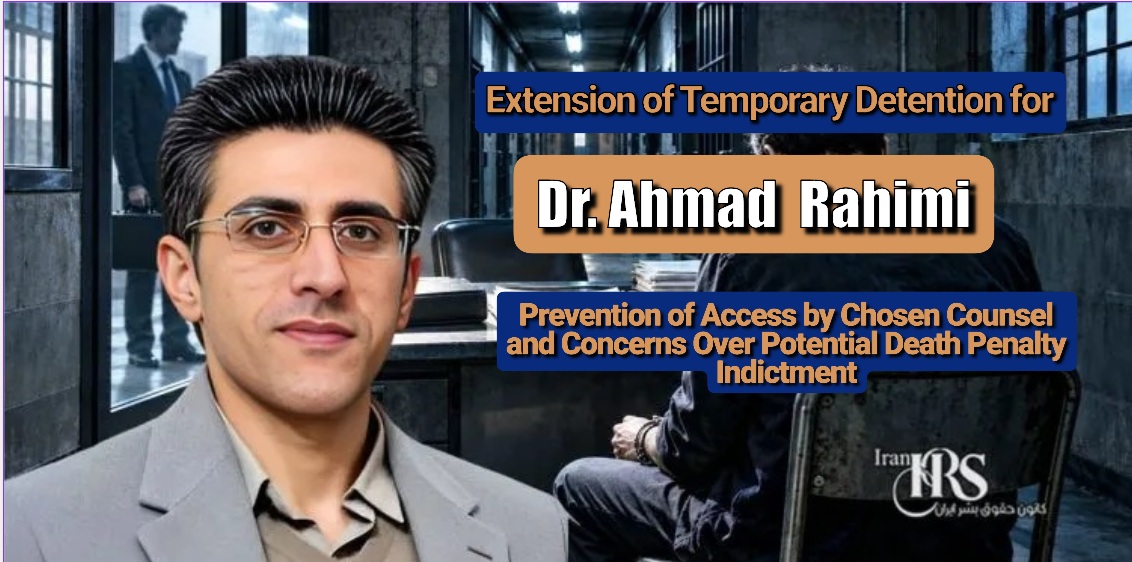
Dr. Ahmad Rahimi remains in temporary detention following his final interrogation session at the Mashhad Revolutionary Prosecutor’s Office; the interrogating magistrate rejected converting detention to bail, while reports indicate the potential issuance of an indictment carrying the death penalty and the exclusion of chosen legal counsel from accessing case files
Iran Human Rights Society, Tuesday, October 13, 2026– Dr. Ahmad Rahimi, a former faculty member at Ferdowsi University of Mashhad, remains in temporary detention following his final interrogation session on Monday, October 12, 2026. According to received information, the interrogating magistrate rejected converting his detention order to bail and extended his temporary

detention. Concurrently, preventing his chosen attorney from accessing case materials and the potential issuance of an indictment carrying capital punishment have heightened concerns for his family.
Interrogating Magistrate Rejects Release of Dr. Ahmad Rahimi on Bail
The final interrogation session for Dr. Ahmad Rahimi was held on Monday, October 12, at the Mashhad Revolutionary Prosecutor’s Office in the presence of a court-appointed lawyer. During this session, his final defense statements were taken, but Mohsen Vahedian Azimi, the interrogating magistrate in the case, deemed the presented defense insufficient to alter the attributed charges.
According to an informed source, the interrogating magistrate rejected converting the temporary detention order to bail and issued an order extending Ahmad Rahimi’s detention. As a result, judicial proceedings are continuing under the prior charges.
The source further claimed that Vahedian Azimi is among the trusted interrogators of the IRGC Intelligence Organization and bases his judicial decisions in security cases on the reports of officers from this institution. This assertion has not been independently verified.
Family Concern Over Potential Issuance of Death Penalty Indictment
Based on received information, the interrogating magistrate previously mentioned the possibility of issuing an indictment carrying the death penalty during a conversation with Ahmad Rahimi’s wife.
These statements have intensified the family’s concerns regarding Ahmad Rahimi’s fate. However, no formal information regarding the issuance of a capital indictment or a judicial ruling against him has been released, and the matter remains in the preliminary interrogation stage.
Prevention of Access by Chosen Counsel to Case Files
One of the most significant issues raised in Dr. Ahmad Rahimi’s case is the denial of access to case files and supporting prosecution evidence for his chosen defense attorney. According to the informed source, Rahimi’s chosen lawyer approached the judicial authority multiple times to review the case file and follow up on his client’s status, but the interrogating magistrate denied the requests.
In contrast, a court-appointed lawyer was designated for Ahmad Rahimi, who, according to those close to him, is not trusted by the family. It was also reported that this court-appointed attorney warned the family during a telephone contact against sharing case details with media outlets. According to received information, Ahmad Rahimi was brought to the final interrogation session wearing handcuffs and leg shackles.
Detention History and Physical Condition of Ahmad Rahimi
Dr. Ahmad Rahimi was arrested on March 17, 2026, in Mashhad. He holds a Ph.D. in Information Technology and is a former faculty member at Ferdowsi University of Mashhad.
Previously, the Iran Human Rights Society reported on more than six months of unresolved detention for Ahmad Rahimi in Vakilabad Prison, Mashhad, highlighting concerns over his physical condition, denial of access to chosen legal counsel, and medical issues.
That report referenced various health conditions, a physician’s warning regarding the risk of a stroke, and the refusal to transfer him to a hospital facility.
Legal Review of the Case Based on Domestic Laws
This review does not signify an endorsement of the dictatorship’s laws governing Iran, but serves to demonstrate the failure to observe even these regulations. Article 35 of the Constitution guarantees the right to legal representation, and Article 37 guarantees the presumption of innocence. Furthermore, Article 190 of the Code of Criminal Procedure emphasizes the right to have a lawyer present during preliminary investigations. The reported denial of access to case files for chosen legal counsel increases concerns regarding the protection of Ahmad Rahimi’s defense rights.
Human Rights Review of the Case and Violation Standards
The continued detention of Ahmad Rahimi, restrictions on chosen legal counsel accessing case files, and concerns over the potential issuance of a capital indictment intersect with human rights guarantees. Article 9 of the Universal Declaration of Human Rights prohibits arbitrary arrest; Article 10 emphasizes the right to a fair and independent hearing, and Article 11 stresses the presumption of innocence. Additionally, Article 3 protects the right to life. Compliance with these rights is essential in handling Ahmad Rahimi’s case.
See also the below articles:
- UN Rapporteur Gina Romero Joins “No to Execution Tuesdays”
- Continued Judicial Indecision Regarding Fatemeh Haghighat in Gorgan PrisonContinued Judicial Indecision Regarding Fatemeh Haghighat in Gorgan Prison
Follow Iran Human Rights Society on social networks:
Telegram /Twitter /Instagram / YouTube / Facebook
Join Iran Human Rights Society on Twitter