
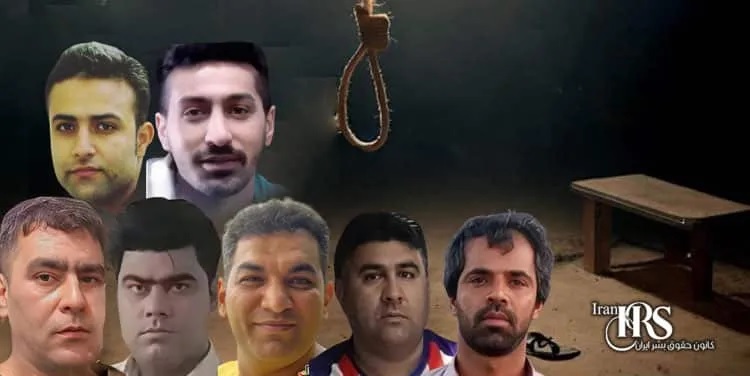
The number of prisoners executed in Khordad 1404 (May-June 2025) has reached 37. This means an average of 5 prisoners have been executed daily.

Iran Human Rights Society, Wednesday, 7 Khordad 1404 (May 28, 2025) – At least 10 prisoners were executed in Qezel Hesar, Adelabad Shiraz, Kerman, and Khash prisons. The execution of Pedram Madani was previously reported by the Iran Human Rights Organization.
This brings the total number of executions in Khordad to at least 37 prisoners, equating to more than 5 executions per day, or one execution every 4.8 hours.
Execution of Mohammad Hadi (Mehdi) Farhadi in Adelabad Prison, Shiraz
In the early hours of Wednesday, 7 Khordad 1404 (May 28, 2025), Mohammad Hadi (Mehdi) Farhadi was executed in Adelabad Prison, Shiraz. He was married, a resident of Shiraz, and had been arrested and sentenced to death on murder charges.
Execution of 5 Prisoners in Qezel Hesar Prison, Including a Juvenile Offender
In the early hours of Wednesday, 7 Khordad 1404 (May 28, 2025), Amir Hossein Mohammadi, Majid Bahrami, Seyed Abbas Laki Khosrokhani, Hojjat Havasi Geravand, and Afshin Azizi were executed in Qezel Hesar Prison.
Amir Hossein Mohammadi, son of Farzin, aged 22, was 17 at the time of his arrest, classifying him as a juvenile offender. He was arrested 5 years ago on murder charges and sentenced to death.
Majid Bahrami, known as Majid Khalife, was from Shahr-e Rey.
Seyed Abbas Laki Khosrokhani was from Nurabad, Lorestan.
Hojjat Havasi Geravand was from Kuhdasht.
Execution of Ali Akbar Mirzaei and Sanjar Nawabi in Kerman Prison
On the morning of Monday, 5 Khordad 1404 (May 26, 2025), Sanjar Nawabi and Ali Akbar Mirzaei were executed in Kerman Prison.
Ali Akbar Mirzaei was arrested 7 years ago on drug-related charges and sentenced to death.
Sanjar Nawabi was also charged with drug-related offenses.
Execution of Ehsan Hossein-Zehi in Khash Prison
In the early hours of Wednesday, 7 Khordad 1404 (May 28, 2025), Ehsan Hossein-Zehi, aged 30, son of Vahed, married with a child, and a resident of Khash, was executed in Khash Prison.
Conflict of Death Penalty with the Universal Declaration of Human Rights
Article 3 of the Universal Declaration of Human Rights explicitly states: “Everyone has the right to life.” This right is inalienable except in cases where a competent court issues a sentence for a crime recognized as such under the law.
The death penalty, as the ultimate punishment, directly contradicts this article because:
Right to Life: The right to life is a fundamental and non-derogable right. The death penalty deprives individuals of this right.
Irreversibility: Once executed, judicial errors cannot be rectified.
Torture and Inhumane Treatment: Some methods of execution are considered torture or inhumane treatment, violating the principles of the Universal Declaration of Human Rights.
Violation of Human Rights Obligations Regarding the Death Penalty
According to Article 6 of the International Covenant on Civil and Political Rights, to which Iran is a signatory, the issuance and execution of the death penalty are permissible only with full guarantees of a fair trial and for the most serious crimes. In many similar cases, lack of transparency, restrictions on the defendant’s legal rights, and issuance of sentences in courts lacking necessary independence are considered violations of this fundamental human rights principle.
Follow Iran Human Rights society on social networks:
Telegram /Twitter /Instagram / YouTube / Facebook
Join Iran Human Rights Society on Twitter






Discussion about this post