
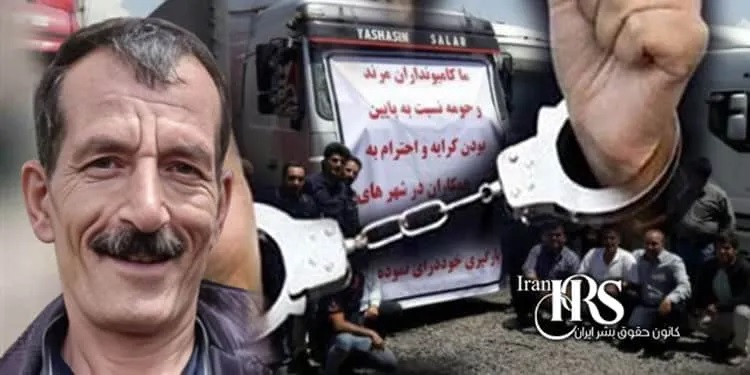
Security Forces Raid Striking Driver’s Home in Dehgalan, Transfer to Sanandaj Intelligence Agency, and Threats Against Family to Prevent Media Coverage; Security Crackdown Amid Public Support for Nationwide Truck Drivers’ Strike
Iran Human Rights Society, June 1, 2025 – On Wednesday, May 28, 2025, Ata Azizi, a striking truck driver in Dehgalan, was arrested by security forces from the city’s Intelligence Agency and transferred to the Sanandaj Intelligence Agency. This arrest occurred as the nationwide truck drivers’ strike, spanning over 150 cities, entered its tenth day and continues to receive widespread public support.
Ata Azizi was among the truck drivers who supported the nationwide strike and resisted efforts by government-affiliated entities to break it. According to local sources, the Sanandaj prosecutor issued an arrest warrant for him on the same day, and a case was filed against him with charges such as “supporting the strike” and “opposing strikebreakers.”
The arrest took place amid intense pressure on Azizi’s family, who were threatened with further consequences if they publicized his detention. These threats are part of a well-known pattern used by security institutions against trade and social activists: arrest, case fabrication, family intimidation, and forced silence.
Widespread Crackdown on Nationwide Strike
Over the past ten days, the truck drivers’ strike, active in over 150 cities, has faced a wave of repression and arrests. To date, more than 20 striking truck drivers have been detained by security forces. Some have been coerced into making forced confessions to exert psychological pressure and undermine collective morale.
These fabricated confessions, broadcast by state-affiliated media, are a clear attempt to manipulate public opinion and project an image of “normalcy.” However, widespread public support for the truck drivers’ strike demonstrates that society remains far from indifferent to security crackdowns.
In response, a wave of online protests and support from trade unions and human rights organizations is emerging in solidarity with Ata Azizi and other detained truck drivers.
A Strike Beyond Trade Demands
The truck drivers’ strike initially began to protest harsh economic conditions, rising costs of spare parts, heavy taxes, and the lack of response to trade demands. Over time, however, the movement has taken on political dimensions, particularly in regions like Kurdistan, where structural repression, ethnic discrimination, and security pressures have long been prevalent.
The arrest of individuals like Ata Azizi is not only an attempt to break this collective movement but also reflects a deeper fear of the growing power of spontaneous, nationwide actions emerging from grassroots society, independent of official or controlled entities.
Human Rights Violations Through Suppression and Arrest of Striking Truck Drivers
Based on international human rights law, particularly the International Covenant on Civil and Political Rights:
Article 9: Right to liberty and security of person — The arbitrary arrest of Ata Azizi without justifiable cause or access to a lawyer is a direct violation of this article.
Article 19: Right to freedom of expression — Supporting the strike and opposing strikebreakers are forms of free expression, which have been criminalized in this case.
Article 22: Right to freedom of association and assembly — Trade strikes are a legitimate form of collective action, and their suppression violates this article.
Article 7: Prohibition of torture and inhumane treatment — Threats against Ata Azizi’s family to enforce silence constitute psychological pressure and inhumane treatment.
The continuation of such actions against trade activists not only violates international obligations but also paints a clear picture of the repressive mechanisms within the ruling power structure—a structure that, instead of addressing legitimate demands, resorts solely to suppression, threats, and intimidation.
Follow Iran Human Rights Society on social networks:
Telegram /Twitter /Instagram / YouTube / Facebook
Join Iran Human Rights Society on Twitter







Discussion about this post