
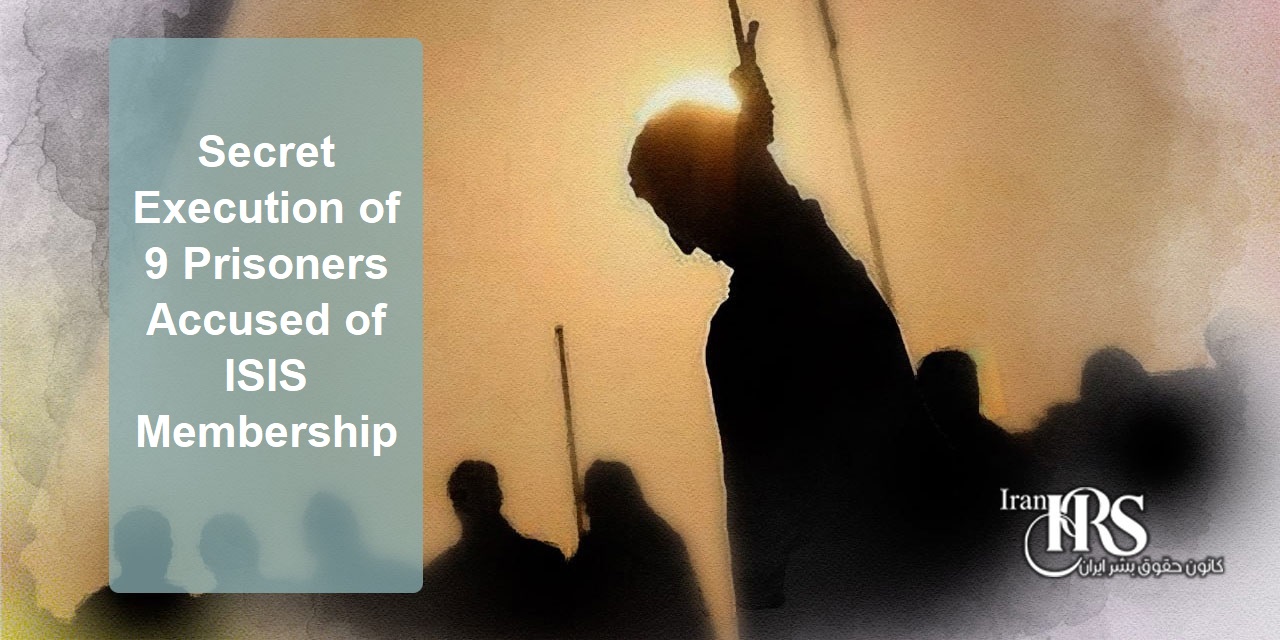
The Mizan News Agency, affiliated with the judiciary, reported that 9 individuals were executed for charges of “moharebeh (enmity against God) through rebellion and armed uprising” and “possession of military weapons,” without providing their names or personal details. The sentences were confirmed by the Supreme Court.
In the latest wave of executions in Iran, the judiciary’s official news agency, Mizan, reported on Monday, June 9, 2025, the execution of 9 individuals accused of “membership in ISIS.” However, the report was shrouded in significant ambiguity. Neither the identities of those executed nor the location of the executions were disclosed. This lack of transparency violates international standards, which require executions to adhere to principles of transparency, fair trial, and respect for defendants’ rights.
According to available reports, eight of the executed prisoners were men, and one was a woman named Hafiza Baloch-Zehi, a 25-year-old from Saravan, Sistan and Baluchestan. All the male prisoners were either Kurdish or Baloch. The executions reportedly took place on May 4, 2025, but Mizan published the news over a month later.
Opaque Executions: No Names, No Location
Mizan, affiliated with the judiciary, provided no names or personal details of the executed individuals, stating only that they were convicted of “moharebeh (enmity against God) through rebellion and armed uprising” and “possession of military weapons.” The sentences were confirmed by the Supreme Court. The failure to disclose names, case details, or the execution location points to a pattern of systematic secrecy, which has become standard in handling security-related cases in recent years.
Closed-Door Trials: No Independent Lawyers, No Public Hearings
Mizan claimed that hearings were held with the presence of the defendants’ lawyers. However, independent sources have repeatedly reported that most security and ideological defendants in Iran are denied access to independent legal representation. Human rights organizations note that defendants in such cases are typically restricted to a list of judiciary-approved lawyers, who are often tied to security institutions and fail to effectively defend their clients’ rights.
Systemic Violation of Fair Trial Rights in Iran
Under Article 14 of the International Covenant on Civil and Political Rights, which Iran has signed, every individual is entitled to a fair and public trial by an impartial and independent court. Additionally, fundamental human rights principles prohibit the use of coerced or tortured confessions for convictions. The report’s emphasis on “defendants’ confessions” during the trial process raises concerns that forced confessions, as seen in similar cases, played a central role in securing the death sentences.
Ambiguity Surrounding the Case and Victims’ Identities: A Threat to Judicial Transparency
The lack of information about the executed individuals has left many families in Iran’s western and southern provinces—where mass arrests for alleged ties to extremist groups have occurred—fearful for their loved ones’ fates. This secrecy also poses a significant barrier to judicial transparency and oversight by independent domestic and international bodies.
Systematic Human Rights Violations in Iran: Global Silence
While Iran’s government claims to uphold justice and the rule of law, reports from organizations like Amnesty International and Human Rights Watch have repeatedly highlighted the systematic violation of human rights in Iran’s judicial processes. These violations include torture, denial of legal representation, pressure on families, lack of meaningful appeals, and the secret execution of death sentences.
Coinciding with the “Tuesdays Against Execution” Campaign
Notably, these executions occurred during the 72nd week of the grassroots “Tuesdays Against Execution” campaign, held weekly across various Iranian cities to demand an end to the use of the death penalty as a tool of repression. Despite security crackdowns and efforts to suppress this civil movement, the protests continue to grow each week.
Execution as a Tool of Repression, Not Justice
The secret execution of 9 prisoners without public trials, identified identities, independent lawyers, or oversight by human rights organizations once again demonstrates that in Iran, the death penalty is used not as a judicial measure but as a tool of political and security repression. Silence in the face of these actions paves the way for the continued violation of human rights.
Follow Iran Human Rights Society on social networks:
Telegram /Twitter /Instagram / YouTube / Facebook
Join Iran Human Rights Society on Twitter







Discussion about this post