
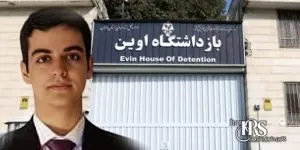
On the evening of Wednesday, June 18, 2025, Ali Younesi, a political prisoner and elite student at Sharif University of Technology, was abruptly and violently removed from Ward 4 of Evin Prison and transferred to an unknown location.
Iran Human Rights Society, June 21, 2025 – The sudden and forced transfer of Ali Younesi, an elite student and political prisoner, has sparked a wave of protests in Evin Prison, drawing renewed attention from the public and human rights organizations to the alarming situation of political prisoners in Iran. Amid escalating regional tensions, reports indicate intensified pressure on political prisoners.
Widespread Protests by Political Prisoners Against Younesi’s Forced Transfer
On June 18, 2025, dozens of political prisoners in Ward 4 of Evin Prison staged a protest in response to Ali Younesi’s forced transfer. The protesters gathered in the ward’s courtyard, sang the anthem “Blood of the Irises,” and repeatedly chanted Younesi’s name.
They voiced their dissent with slogans such as:
- “Threats and abductions no longer work.”
- “The execution regime has no escape.”
- “Down with the execution regime!”
- “Dictatorship of crime, death to this regime!”
The prisoners also sang “Burn the Cage” and “O Iran, O Jeweled Land” as symbols of resistance and national solidarity.
Violent Transfer of Ali Younesi to an Unknown Location

According to reliable reports, on the evening of June 18, Ali Younesi, a political prisoner and elite student at Sharif University, was forcibly removed from Ward 4 of Evin Prison with physical violence and transferred to an undisclosed location. Sources indicate the transfer was pre-planned and carried out with the knowledge of Evin Prison’s warden, Hedayatollah Farzadi.
Reports confirm that prison authorities used physical force to remove Younesi, transferring him without notifying his family or lawyer, raising serious concerns about his safety and well-being.
Ali Younesi: From Unlawful Arrest to Forced Transfer
Ali Younesi, a computer engineering student and one of Iran’s brightest academic talents, was arrested alongside Amirhossein Moradi, a physics student, on April 10, 2020, by Intelligence Ministry agents. The arrest occurred without a judicial warrant, with security forces entering their homes, brutally assaulting them, and transferring them to solitary confinement in Ward 209 of Evin Prison.
Younesi’s case has been marked by gross violations of legal rights from the outset. He was held in solitary confinement for months, denied access to a lawyer, and subjected to severe physical and psychological pressure during his detention.
Increased Pressure Amid Regional Tensions
With the onset of regional tensions and heightened security concerns, pressure on political prisoners in Iran has significantly intensified. Informed sources report that security agencies, citing the volatile regional situation, have escalated their repressive policies. The sudden transfer of Ali Younesi, a prominent figure among students, is seen as part of this strategy.
Human rights activists believe that, fearing potential public protests, Iranian authorities are intensifying arrests and fostering an atmosphere of fear in prisons to suppress any emerging protest movements. The pressure on prisoners like Younesi is part of this broader repressive approach.
Human Rights Community Demands Younesi’s Release
Following these developments, Younesi’s family and human rights activists have called for transparent information about his status. They assert that his violent and unnotified transfer is a clear violation of human rights and have urged international organizations to take immediate action to address his situation.
The academic community has also issued statements expressing concern over Younesi’s situation and demanding his unconditional release.
Ongoing Repression Amid Regional Tensions
The increase in arrests, security pressures, and forced transfers of political prisoners like Younesi reflects the regime’s consistent use of regional crises to justify domestic repression. By instilling fear and escalating threats, Iranian authorities aim to prevent nationwide protests.
In this context, continuous monitoring by human rights organizations and international responses to Iran’s systematic human rights violations are more critical than ever. Ali Younesi’s situation has become a symbol of injustice and intensified pressure on political prisoners amid regional tensions.
Human Rights Violations: Forced Transfer and Systematic Torture
The abrupt and violent transfer of Ali Younesi to an unknown location is a clear example of human rights violations and systematic torture in Iranian prisons. Such actions constitute physical and psychological torture and violate international human rights covenants, including the right to access a lawyer, the right to inform family of a prisoner’s status, and the right to a fair trial. The forced transfer of prisoners without notification, coupled with physical assault, underscores the regime’s ongoing policy of repression, intimidation, and disregard for human dignity. This situation highlights the urgent need for international oversight of Iran’s prisons and detention centers.
Specific Human Rights Violations in Ali Younesi’s Forced Transfer:
Violation of Article 5 of the Universal Declaration of Human Rights: Prohibition of torture and cruel, inhuman, or degrading treatment or punishment.
Violation of Article 9 of the Universal Declaration of Human Rights: Prohibition of arbitrary arrest, detention, or exile.
Violation of Article 10 of the Universal Declaration of Human Rights: Right to a fair and public hearing by an independent and impartial tribunal.
Violation of Article 14 of the International Covenant on Civil and Political Rights: Right to access a lawyer, right to defense, and right to be informed of judicial proceedings.
Violation of Article 7 of the International Covenant on Civil and Political Rights: Prohibition of torture and cruel, inhuman, or degrading treatment.
Violation of Principles 1 and 6 of the Body of Principles for the Protection of All Persons under Any Form of Detention or Imprisonment: Respect for human dignity and the obligation to promptly inform families of a detainee’s status and location.
Violation of Article 3 of the International Convention for the Protection of All Persons from Enforced Disappearance: Prohibition of enforced disappearance and secretive transfers without notifying family or judicial authorities.
Follow Iran Human Rights Society on social networks:
Telegram /Twitter /Instagram / YouTube / Facebook
Join Iran Human Rights Society on Twitter







Discussion about this post