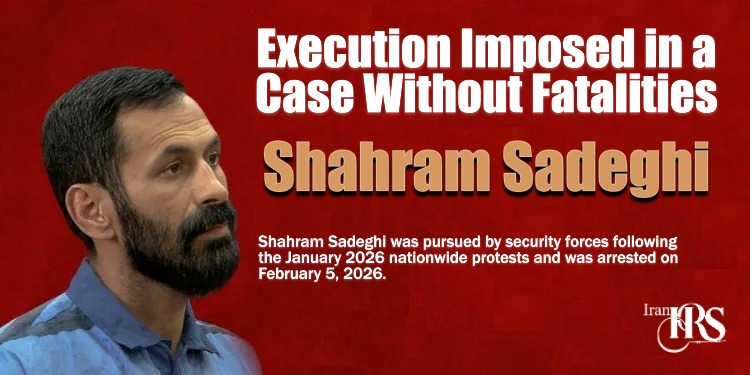
Shahram Sadeghi, a detainee from the January 2026 protests, was executed on the morning of August 16, 2026. Key details regarding his interrogations, the conditions under which confessions were extracted, independent case evidence, and trial procedures resulting in the death penalty remain shrouded in opacity.

Iran Human Rights Society, Sunday, August 16, 2026 – Shahram Sadeghi, a political prisoner and detainee of the January 2026 nationwide protests, was executed on Sunday morning, August 16. The judiciary accused him of driving a Pride automobile into law enforcement officers near the Golzar Intersection in Karaj on the evening of January 8, injuring seven officers. Despite the execution of the death sentence, published information regarding the interrogation phases, confession conditions, independent evidentiary documents, and court session details remains extremely limited. Notably, official accounts record no fatalities among law enforcement personnel during the incident.
Arrest of Shahram Sadeghi Following January Protests
According to available details, Shahram Sadeghi was pursued by security forces following the January 2026 nationwide protests and was arrested on February 5, 2026.
Mizan News Agency, the official organ of the Islamic Republic’s Judiciary, claimed that on the evening of January 8, Sadeghi drove his vehicle toward officers present at the Golzar Intersection in Karaj, injuring seven Faraja (Law Enforcement Command) officers. Official claims further asserted that one officer remained in a coma for three months.
The state news agency also claimed that Sadeghi burned his vehicle after the event and fled the scene.
These assertions constitute the state’s official narrative; independent information detailing post-arrest investigations, interrogations, and procedural mechanics has not been made available.
Confessions: A Critical and Opaque Aspect of the Case
A central component of the Judiciary’s narrative relies upon “confessions” attributed to Shahram Sadeghi.
Mizan reported that during initial investigative stages, Sadeghi claimed his vehicle had been stolen on the night of the incident. According to the same account, the interrogating judge reviewed phone records and 110 police logs, concluding that no stolen vehicle report had been filed.
State media subsequently claimed that Sadeghi admitted to driving the vehicle at high speed into the officers. Official accounts state that he declared in both the prosecutor’s office and the courtroom that his intention was to cause “death or severe injury” to the officers.
However, the publication of a confession does not clarify the conditions or interrogation methods under which these statements were secured.
Published information fails to reveal whether Shahram Sadeghi had access to independent legal counsel during interrogations, the duration of his interrogation period, his holding location during this timeframe, or what procedural safeguards existed to verify that his statements were voluntary.
In a legal proceeding that concludes with capital punishment, resolving these questions is of paramount importance.
Ambiguities Surrounding Torture and Coerced Confessions
A major concern in Shahram Sadeghi’s case is the lack of transparent information regarding interrogation conditions and the inability to independently verify whether confessions were voluntary.
Official texts provide no explanations regarding interrogation methods, duration, detention conditions, or mechanisms to investigate potential coercion. Conversely, information provided for this report indicates the use of torture to extract coerced confessions.
Trial Details Kept Opaque
Mizan announced that following the conclusion of preliminary investigations, an indictment was issued against Shahram Sadeghi, and the case was tried before the Karaj Revolutionary Court with defense counsel present.
However, the mere assertion of legal representation does not satisfy fair trial guarantees.
It remains unverified when legal counsel gained access to the file, whether counsel was granted full access to case files and private consultation with the client, what evidence was presented in court, what defense arguments were made, or how the court evaluated conflicting statements from various investigative stages.
The complete text of the court judgment and detailed transcripts of trial sessions have not been released.
Execution Imposed in a Case Without Fatalities
Crucially, official statements confirm that while seven officers were injured during the cited incident, no fatalities occurred.
Despite this, the Karaj Revolutionary Court sentenced Shahram Sadeghi to death and ordered the confiscation of all his property.
According to Mizan, the legal charge leading to the sentence was “operational action in favor of the Zionist regime, the United States, and hostile groups under Article 1 of the Law on Intensifying Punishment for Espionage and Cooperation with the Zionist Regime and Hostile States Against National Security and Interests.”
This charge introduces another major legal question: published reports provide no details or evidence establishing how the actions attributed to Shahram Sadeghi were linked to “hostile states.”
The Judiciary declared that the sentence was upheld upon appeal by the Supreme Court and executed on the morning of August 16, 2026.
Legal Review of Shahram Sadeghi’s Case Based on Domestic Laws
The laws governing Iran have repeatedly drawn international criticism for failing to align with fair trial standards, opacity in security cases, and reliance on coerced confessions. Reviewing Shahram Sadeghi’s case under domestic legal statutes does not imply endorsement of these laws; the objective is to examine whether safeguards established within domestic law were observed during proceedings leading to his execution.
Legal Ambiguities of the Case
The primary legal ambiguity centers on the conditions under which confessions were extracted. It remains unconfirmed whether statements attributed to Shahram Sadeghi were obtained under duress or whether he had effective access to legal counsel during interrogations.
Furthermore, specific evidence relied upon by the court to prove links between his actions and the United States, Israel, or “hostile groups” has not been disclosed.
Relevant Legal Articles
- Article 32 of the Constitution: Mandates that arrests must strictly follow legal procedures.
- Article 35 of the Constitution: Explicitly recognizes the right of the accused to retain legal representation.
- Article 37 of the Constitution: Upholds the presumption of innocence until guilt is proven in a competent court.
- Article 38 of the Constitution: Strictly prohibits torture for extracting confessions or obtaining information, declaring coerced confessions null and void.
- Article 39 of the Constitution: Forbids any affront to the dignity and honor of detainees and prisoners.
Human Rights Analysis and International Standard Violations
In capital cases resulting in execution, fair trial standards must be upheld at the highest level. Any ambiguity regarding torture, coerced confessions, access to legal representation, or evidentiary sufficiency carries heightened significance.
Relevant International Instruments
- Article 3 of the Universal Declaration of Human Rights: The right to life, liberty, and security of person.
- Article 5 of the Universal Declaration of Human Rights: Absolute prohibition of torture or cruel, inhuman, or degrading treatment or punishment.
- Article 10 of the Universal Declaration of Human Rights: The right to a fair and public hearing by an independent and impartial tribunal.
- Article 6 of the International Covenant on Civil and Political Rights (ICCPR): Right to life and strict limitations on capital punishment.
- Article 7 of the International Covenant on Civil and Political Rights (ICCPR): Absolute prohibition of torture and inhuman treatment.
- Article 14 of the International Covenant on Civil and Political Rights (ICCPR): Right to a fair trial, adequate facilities for defense, and protection against forced self-incrimination.
The execution of Shahram Sadeghi was carried out while critical elements of his interrogation and judicial process remained concealed from public scrutiny. In a proceeding resulting in irreversible capital punishment, lingering doubts regarding confession extraction methods, effective access to counsel, and supporting evidence underscore severe violations of fair trial guarantees.
See also the below articles:
- 3 Prisoners Executed in Ardabil Central Prison Amid Rising Capital Punishment
- Morteza Arab-Khorasani Held Over 6 Months Without Trial in Mashhad
Follow Iran Human Rights Society on social networks:
Telegram /Twitter /Instagram / YouTube / Facebook
Join Iran Human Rights Society on Twitter