
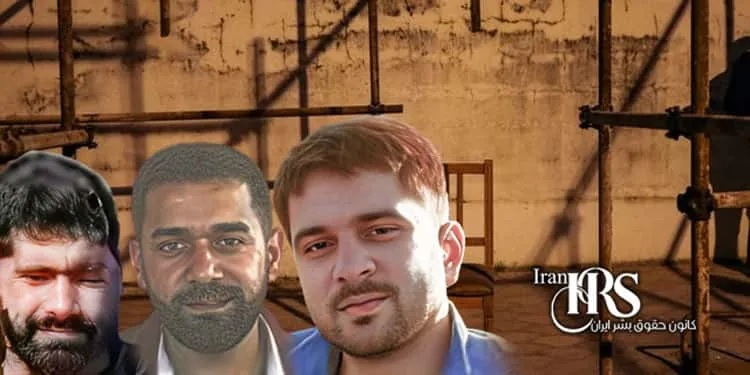
The number of prisoners executed in Khordad, the Persian month has reached at least 140, meaning more than 4 executions per day on average.

Iran Human Rights Center, Sunday, June 22, 2025 – Five prisoners were executed in the prisons of Shiraz, Ahvaz, and Qom. The ruling dictatorship is carrying out executions amid escalating regional tensions, aiming to create an atmosphere of fear and prevent public protests.
The number of prisoners executed in Khordad the Persian month has reached at least 140.
Execution of 3 Prisoners in Shiraz Prison
On the morning of Tuesday, June 17, 2025, three prisoners named Ali Akbar Younesi, Nezam Moradi, and Teymour Pouladvand were executed in Shiraz Prison.
- Nezam Moradi, from Mashhad, married and a father of one, was arrested five years ago on murder charges and sentenced to death.
- Teymour Pouladvand, from Aligudarz, was arrested three years ago on drug-related charges and sentenced to death.
- Ali Akbar Younesi, 30, from Jahrom, was arrested four years ago on rape charges and sentenced to death.
Execution of Ahmad Nazemi in Sepidar Prison, Ahvaz
On the morning of Monday, June 16, 2025, a prisoner named Ahmad Nazemi was executed in Sepidar Prison, Ahvaz. He was 37 years old and from Dezful, charged with drug-related offenses.
Execution of Hossein Haghverdi in Qom Central Prison
On the morning of Wednesday, June 18, 2025, Hossein Haghverdi was executed in Qom Central Prison. He was 33 years old, from Shahr-e Rey, and had been arrested four years ago on murder charges and sentenced to death.
Violation of Human Rights Commitments Regarding the Death Penalty
Article 3 of the Universal Declaration of Human Rights explicitly states: “Everyone has the right to life, liberty, and security of person.” This right cannot be deprived except pursuant to a lawful sentence issued by a competent court for a crime recognized by law.
The death penalty, as the ultimate punishment, directly contradicts this article because:
- Right to Life: The right to life is a fundamental and inalienable right, which the death penalty violates.
- Irreversibility: Once executed, judicial errors cannot be rectified.
- Torture and Inhuman Treatment: Some execution methods are considered torture or inhuman treatment, violating the principles of the Universal Declaration of Human Rights.
According to Article 6 of the International Covenant on Civil and Political Rights, to which Iran is a signatory, the issuance and execution of the death penalty are permissible only with full guarantees of a fair trial and for the most serious crimes. In many similar cases, lack of transparency, restrictions on the defendant’s legal rights, and rulings issued by courts lacking independence violate this fundamental human rights principle.
Follow Iran Human Rights Society on social networks:
Telegram /Twitter /Instagram / YouTube / Facebook
Join Iran Human Rights Society on Twitter








Discussion about this post