
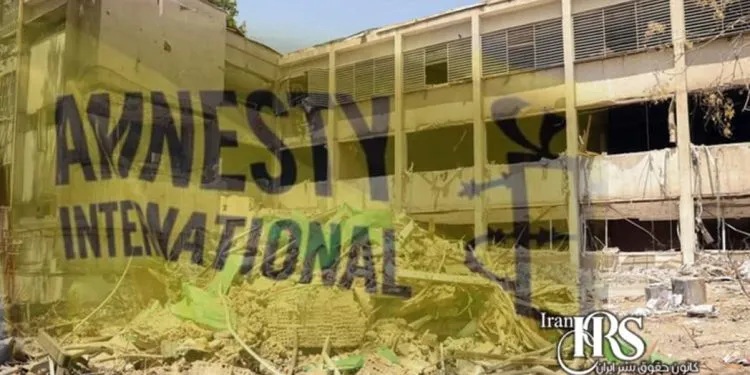
Amnesty International condemns the Evin Prison bombing as a war crime, highlighting civilian targeting and inhumane prisoner transfers. Learn more.
Iran Human Rights Society, Tuesday, July 22, 2025 – Amnesty International strongly denounces the bombing of Evin Prison as a war crime. This attack deliberately targeted a civilian facility, violating international humanitarian law. Evin Prison, located in Tehran, houses nearly 2,000 inmates, including human rights defenders, political dissidents, and persecuted minorities. Such actions demand accountability. The organization calls for justice and protection for civilians caught in conflict. This article explores the incident, its aftermath, and the legal implications under international law.
Evin Prison Attack: A Violation of International Law
The bombing of Evin Prison on July 22, 2025, shocked the global community. Amnesty International confirms that the attack caused significant harm to civilians. The prison holds a diverse group of prisoners, including protesters, dual nationals, and religious minorities, often detained for political reasons. International humanitarian law strictly prohibits targeting civilian facilities. Erika Guevara-Rosas, Senior Director for Research, Advocacy, and Campaigns, stated, “Knowingly and deliberately carrying out such attacks constitutes a war crime.” The attacking forces failed to distinguish between military and civilian targets, ignoring their obligation to protect non-combatants.
Heroic Efforts by Political Prisoners
Despite the chaos, political prisoners showed remarkable courage. Saideh Makarem, a doctor volunteering at Evin Prison, suffered burns and injuries during the bombing. In her Instagram posts from July 2025, she described how fellow prisoners saved her life: “They dragged me to safety when I was half-conscious. They brought water, a blanket, and splinted my leg. They could have escaped, but they stayed to help.” These acts of bravery highlight the resilience of prisoners under dire circumstances. However, the lack of immediate medical care worsened their plight.
Neglect and Loss: Failure to Provide Medical Care
Amnesty International’s investigation revealed a tragic failure to provide medical care. Masoud Behbahani, a 71-year-old prisoner in Ward 4, died after the attack. During the explosion, he was thrown against a chair, and other prisoners fell on him, triggering a heart attack. Instead of hospital care, authorities transferred him to Tehran’s Greater Prison, where he suffered a second fatal heart attack two days later. Additionally, an image from the women’s ward showed severe damage to the ceiling and electrical systems, further endangering prisoners. Such neglect violates basic human rights standards.
Legal Implications of Targeting Civilian Facilities
International humanitarian law clearly outlines protections for civilians. Attacks must target only military personnel or objectives that contribute to military operations. Evin Prison, a civilian facility, does not meet this criterion. Attackers must verify targets, minimize civilian harm, and issue warnings when feasible. The deliberate bombing of Evin Prison disregarded these obligations. Consequently, Amnesty International labels this act a war crime. Furthermore, the failure to provide medical care and the forced transfer of prisoners amplify the violations.
Forced Transfers to Tehran’s Greater Prison
After the bombing, Hedayatollah Farzadi, Evin Prison’s director, ordered armed guards to forcibly transfer political prisoners to Tehran’s Greater Prison, also known as Fashafouyeh. Prisoners resisted, refusing to leave without their belongings. However, guards used threats and violence to enforce the transfer. Reports describe inhumane conditions at Fashafouyeh, including overcrowding and lack of basic necessities. These conditions threaten prisoners’ physical and mental health, violating their dignity and rights. Amnesty International demands immediate action to address these abuses.
Follow Iran Human Rights Society on social networks:
Telegram /Twitter /Instagram / YouTube / Facebook
Join Iran Human Rights Society on Twitter







Discussion about this post