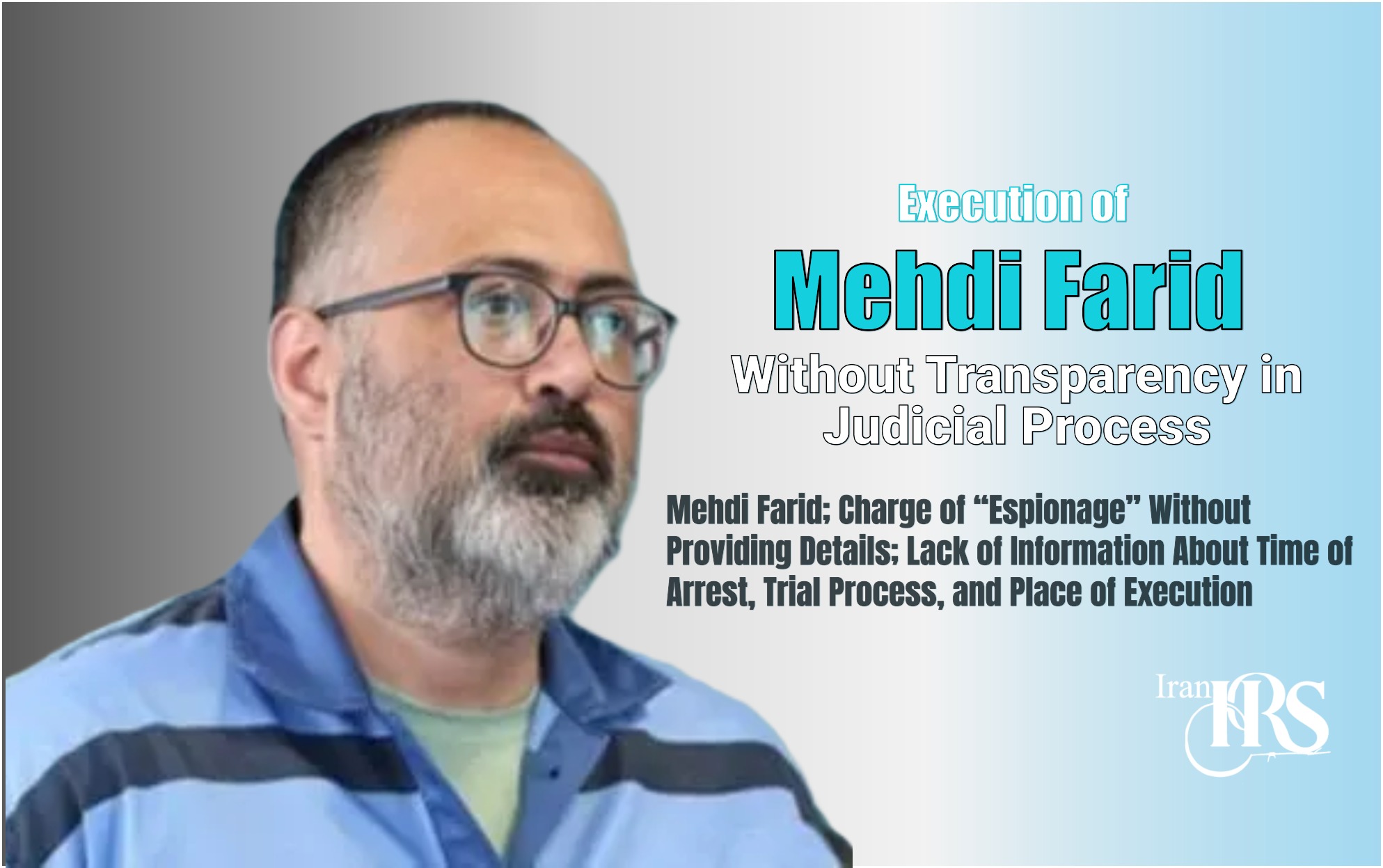
Mehdi Farid; Charge of “Espionage” Without Providing Details; Lack of Information About Time of Arrest, Trial Process, and Place of Execution
Iran Human Rights Society, Wednesday, April 22, 2026 – Based on the report of Mizan News Agency affiliated with the Judiciary, Mehdi Farid was executed this morning; however, no information has been published about the court proceedings, time of arrest, and details of his case, and this issue has created serious ambiguities about how the sentence was issued.
Execution of Mehdi Farid Without Transparency in Judicial Process
Mizan News Agency has reported the execution of Mehdi Farid and has stated his charge as “espionage.” However, in this report, no information whatsoever has been provided about the time of arrest, the judicial trial process, or the details of the case.

Also, the location of the execution of the sentence has not been specified, and this issue has added to the existing ambiguities. The lack of information about these stages makes it difficult to examine the correctness of the judicial process.
Ambiguity in the Court Process and Issuance of the Sentence
While the execution of Mehdi Farid has been announced, no explanation has been provided about how the court was held, his access to a lawyer, or the defense stages. This lack of transparency raises serious questions about the observance of due process principles.
In cases with heavy charges, providing details about the judicial process is of high importance. However, in this case, the available information is limited to announcing the charge and carrying out the sentence, and the other stages remain ambiguous.
Limited Information About Identity and Occupational Position
Based on the published report, before his arrest, Mehdi Farid was the head of the management section of the passive defense committee of one of the sensitive organizations. However, no further details have been provided about his activities or their connection with the raised charges.
This limitation in providing information has made independent evaluation of the case difficult and has added to the concerns about the trial process.
Contradiction of the Death Sentence with the Universal Declaration of Human Rights
Article Three of this declaration explicitly states: Everyone has the right to life. This right shall not be subject to any deprivation except by the sentence of a competent court for a crime that is considered a crime according to law.
The death sentence as the highest punishment is directly in conflict with this article of the Universal Declaration of Human Rights. Because:
Right to Life: The right to life is presented as a fundamental and inalienable right. The death sentence deprives this right.
Irreversibility: In case of carrying out the death sentence, there is no possibility of remedying a judicial mistake.
Torture and Inhuman Treatment: Some methods of carrying out the death sentence are considered torture and inhuman treatment, which itself contradicts the provisions of the Universal Declaration of Human Rights.
Violation of Human Rights Commitments Regarding the Death Penalty
According to Article 6 of the International Covenant on Civil and Political Rights, which Iran is one of its signatories, issuing and carrying out the death sentence is only permitted in the case of the existence of complete guarantees for a fair trial and in very serious crimes. In many similar cases, lack of transparency, legal restrictions on the accused, and issuing sentences in courts lacking the necessary independence are considered contrary to this fundamental principle of human rights.
See also the below articles:
- Execution of Amirali Mirjafari from those arrested in the nationwide protests of 2025-2026
- Mohseni Eje’i and the order for “extraordinary proceedings”; Intensification of repression and hasty executions in the judicial system
Follow Iran Human Rights Society on social networks:
Telegram /Twitter /Instagram / YouTube / Facebook
Join Iran Human Rights Society on Twitter