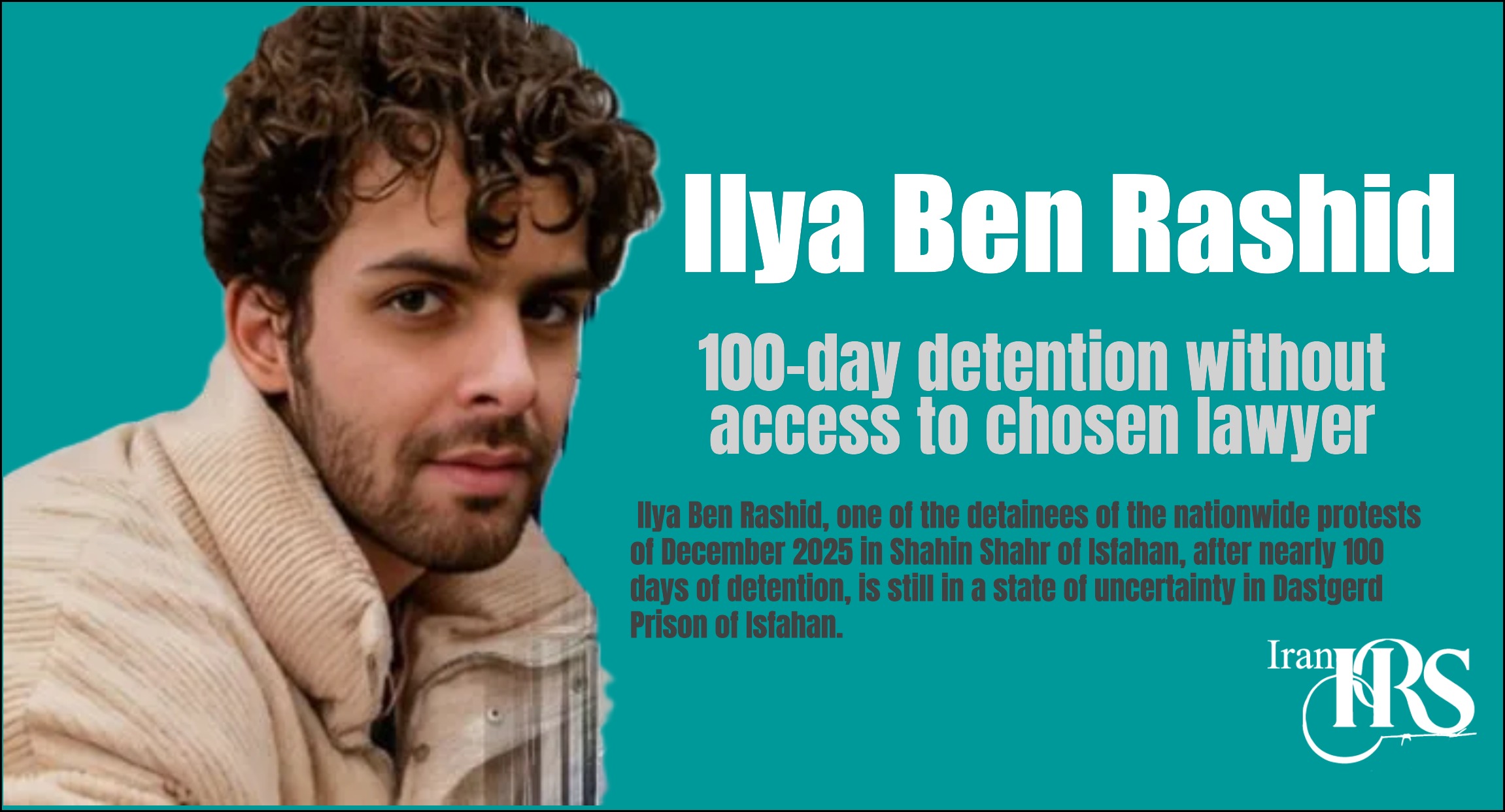
Ilya Ben Rashid, one of the detainees of the protests of December 2025 in Shahin Shahr, faces heavy charges including moharebeh; sources say he has been deprived of access to a chosen lawyer in all stages of the case.
Iran Human Rights Society, Tuesday, 28 April 2026 – Ilya Ben Rashid, one of the detainees of the nationwide protests of December 2025 in Shahin Shahr of Isfahan, after nearly 100 days of detention, is still in a state of uncertainty in Dastgerd Prison of Isfahan. This 22-year-old young man faces heavy charges including “moharebeh”, while according to informed sources, since the time of his arrest until now he has been deprived of access to a chosen lawyer and the process of handling his case is accompanied by serious legal ambiguities.
Continuation of Ilya Ben Rashid’s detention in Dastgerd Prison of Isfahan

According to published reports, Ilya Ben Rashid who was arrested during the December 2025 protests in Shahin Shahr, is still being held in Dastgerd Prison of Isfahan. He is now nearly 100 days in detention and despite the holding of a court session, the final status of his case has not yet been determined and he is in complete uncertainty.
Charge of moharebeh and trial in the Revolutionary Court
According to an informed source, the session for handling Ilya Ben Rashid’s case was held in mid-April 2026 in Branch 5 of the Revolutionary Court of Isfahan. This session was held via videoconference and he faced charges including: – moharebeh through participation in the destruction of public property – assembly and collusion to commit a crime against national security – propaganda activity against the regime Informed sources say he defended himself in this session, but no more details of the handling process and the way his defenses were evaluated have been published.
Deprivation of chosen lawyer in a case with heavy charges
One of the most important concerns raised about Ilya Ben Rashid’s case is his deprivation of the right to access a chosen lawyer. According to the informed source, Ilya has so far been deprived of having a chosen lawyer in all stages of the case and the possibility of benefiting from independent legal defense has not been provided for him. This is while the charge of “moharebeh” is considered one of the heaviest charges in Iran’s criminal system and can result in punishments including execution. Human rights activists emphasize that deprivation of a lawyer in such cases severely makes the trial process unfair.
Difficult family situation and limitations in following up the case
Sources close to the case say Ilya Ben Rashid has lost his father and mother and before the arrest he was living with his elderly grandfather and grandmother. Due to the age conditions and physical limitations of family members, following up on his legal status has been accompanied by many difficulties and this has made the situation of defending him even more complicated.
Arrest during the Shahin Shahr protests

Ilya Ben Rashid was arrested on 22 January 2026 in connection with the nationwide protests in Shahin Shahr of Isfahan. He was then charged on 21 February 2026 in Branch 2 of the Public and Revolutionary Prosecutor’s Office of Shahin Shahr. Since then until now, he has remained in detention and has been transferred to Dastgerd Prison of Isfahan.
Continuation of heavy-handed treatment with protest detainees
Ilya Ben Rashid’s case is being handled at a time when in recent months a large number of detainees of nationwide protests have faced heavy security charges, including moharebeh and corruption on earth. Legal observers say the widespread use of these criminal titles in cases related to protests has increased concerns about the judicial security of detainees.
Long-term uncertainty; double pressure on political defendants
The continuation of Ilya Ben Rashid’s long-term detention without determining the final status of the case is considered by human rights activists as an example of double pressure on political and security defendants. Long-term uncertainty in detention, in addition to psychological pressure on the prisoner, can also be a tool to exert pressure for obtaining confession or weakening the defendant’s defensive ability.
Ilya Ben Rashid’s case; concern about violation of fair trial in the arrest of protesters
The process of arrest and handling of Ilya Ben Rashid’s case has raised serious questions about the observance of fair trial standards in cases related to protests.
Violated articles:
Violation of the right to liberty and personal security – Article 9 of the Universal Declaration of Human Rights: Long-term detention and continued uncertainty can be an example of arbitrary detention
Violation of the right to fair trial – Article 10 of the Universal Declaration of Human Rights: Deprivation of a chosen lawyer and independent defense violates a fair trial
Violation of the presumption of innocence – Article 11 of the Universal Declaration of Human Rights: Exerting judicial pressure before the definitive proof of the crime distorts the presumption of innocence
Violation of the right to effective defense – Basic principles of fair trial: In cases with heavy punishments, access to an independent lawyer is one of the most basic rights of the defendant
See also the below articles:
- Supreme Court Confirms Death Sentence for Mohammad Abbasi Amid Torture Claims
- Maryam Hedavand Receives Death Sentence as Third Woman in Iran Protests Case
Follow Iran Human Rights Society on social networks:
Telegram /Twitter /Instagram / YouTube / Facebook
Join Iran Human Rights Society on Twitter