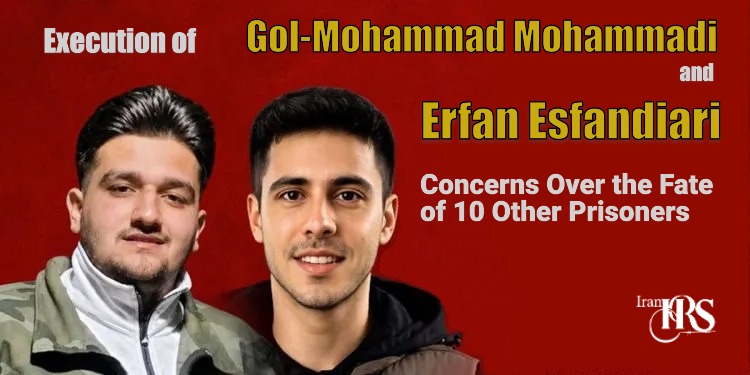
This morning, Erfan Esfandiari, one of the detainees of the 2025-2026 nationwide protests, and Gol-Mohammad Mohammadi, an Afghan citizen, were executed in connection with the case known as the “Ali-Khani Square” of Isfahan. Concurrently, there is still no information available regarding the fate of 10 other prisoners who were previously transferred to solitary confinement cells.

Iran Human Rights Society, Sunday, July 19, 2026 – This morning, two of the detainees of the 2025-2026 nationwide protests, named Erfan Esfandiari and Gol-Mohammad Mohammadi, were executed in connection with the case known as the “Ali-Khani Square” of Isfahan. These two prisoners were tried and sentenced to death on charges of participation in the killing of four members of the Basij during the protests on January 8, 2026.
Erfan Esfandiari was 18 years old at the time of his arrest, and Gol-Mohammad Mohammadi, a 23-year-old Afghan national, was also among the defendants in this case. Reports indicate that both prisoners were executed this morning. Simultaneously, concerns over the fate of 10 other prisoners in this case, who had been transferred to solitary confinement cells yesterday, have intensified. No official information regarding the status of these prisoners has been published so far.
Transfer of Condemned Inmates to Solitary Confinement Before Execution
Prior to the implementation of the sentences, the “Nafas dar Ghafas” (Breath in Cage) association had reported that 12 death-row convicts in the Ali-Khani Square case, along with two other political prisoners, had been transferred to solitary confinement cells; an action that usually takes place on the eve of the execution of death sentences.
Now, with the execution of the death sentences of Erfan Esfandiari and Gol-Mohammad Mohammadi, families and human rights activists have expressed deep anxiety regarding the potential execution of the other convicts in this case.
How the Ali-Khani Square Case Formed
The case known as the Ali-Khani Square dates back to the events of January 8, 2026, during the nationwide protests in the city of Isfahan. On that day, according to official announcements, four members of the Basij and law enforcement forces were killed during clashes.
Following this event, security forces arrested at least 59 individuals. The detainees faced various charges, including Moharebeh (enmity against God) and participation in murder, and their judicial proceedings began in the Revolutionary Court of Isfahan.
According to reports, in addition to those sentenced to death, 23 other defendants in this case have been sentenced to prison terms ranging from five to 10 years, despite statements that they played no role in the killing of the aforementioned individuals.
Confirmation of Death Sentences by the Supreme Court
The judicial review of this case was conducted in Branch 1 of the Revolutionary Court of Isfahan, presided over by Mohammad Barati Dorcheh and with the presence of Judge Mohammad Tavakoli.
At the conclusion of this process, death sentences were issued for 12 of the detainees. Subsequently, the Supreme Court confirmed these sentences on July 9, 2026, and the files were sent to the sentence implementation unit for execution.
The execution of the death sentences of Erfan Esfandiari and Gol-Mohammad Mohammadi marks the first implementation of death sentences in this case and has increased concerns regarding the execution of the other convicts.
Reports of Torture and Forced Confessions
Based on published information, Erfan Esfandiari was subjected to intense physical and psychological pressure following his arrest and was also tortured during interrogations. Informed sources say these conditions led to the extraction of forced confessions from him.
Reports also indicate that the judicial process of his case was accompanied by serious criticisms regarding the adherence to fair trial principles. Among the issues raised were the lack of effective access to a chosen lawyer, restrictions on the right to defense, and a lack of transparency in the judicial review process.
Regarding Gol-Mohammad Mohammadi, it is reported that he had been sentenced to death twice on the charge of Moharebeh through his presence during the events of Ali-Khani Square.
Given the published reports, the reliance on confessions obtained under pressure or torture can bring the validity of the judicial proceedings into serious question.
Concerns Over the Fate of Other Convicts
With the implementation of the sentences of two of the convicts in the case, anxiety regarding the status of the 10 other prisoners who were previously transferred to solitary confinement has escalated.
Human rights activists have demanded a halt to the implementation of the remaining sentences and an independent review of the case. They have emphasized the necessity of examining allegations related to torture, forced confessions, and the compliance with the right to a fair trial.
At the time of publication of this report, judicial authorities have not released any announcement regarding the status of the other convicts in the Ali-Khani Square case.
Legal Review of the Case Based on Domestic Laws
Introduction
The laws of the Islamic Republic of Iran have been repeatedly criticized in recent years by international bodies, including the United Nations Human Rights Council, special rapporteurs, the UN General Assembly, and human rights organizations, for contradicting fair trial standards and international human rights norms. Nevertheless, even based on the domestic laws of the Islamic Republic, defendants possess specified rights, and judicial authorities are obligated to observe fair trial principles, the right to defense, access to counsel, and legal formalities. Therefore, the performance of judicial officials in any case must be evaluated based on domestic laws in addition to international criteria.
Legal Ambiguities
In the present case, published reports concerning the extraction of forced confessions, the application of torture, restrictions on access to a chosen lawyer, and ambiguities in the review process stand in contradiction with multiple articles of the Constitution and the Code of Criminal Procedure. Article 38 of the Constitution prohibits any form of torture for the purpose of extracting confessions and renders confessions obtained under coercion legally invalid. Furthermore, the Code of Criminal Procedure emphasizes the defendant’s right to a lawyer, the right to defense, and a fair trial.
Potential Violations of Law
The following instances can constitute potential violations of domestic laws:
- The application of torture or pressure to extract confessions;
- Relying on confessions obtained under coercion during the trial process;
- Restricting the defendants’ access to a chosen lawyer;
- Violation of the right to an effective defense and an impartial trial;
- Issuing and implementing death sentences despite the allegations raised regarding torture and violations of a fair trial;
- Failing to effectively investigate complaints related to the conduct of agents and the interrogation process.
Human Rights Violations Regarding the Execution of Erfan Esfandiari and Gol-Mohammad Mohammadi
The implementation of the death sentences of two of the convicts in the Ali-Khani Square case, under conditions where reports concerning torture, forced confessions, and the violation of fair trial principles have been published, raises serious concerns regarding the right to life, the right to a fair trial, and the prohibition of torture. Furthermore, the lack of information regarding the status of the other convicts transferred to solitary confinement has added to anxieties over the potential for more executions.
Related Human Rights Articles
- Article 3 of the Universal Declaration of Human Rights: The right to life, liberty, and security of person;
- Article 5 of the Universal Declaration of Human Rights: Prohibition of torture and cruel, inhuman, or degrading treatment or punishment;
- Articles 10 and 11 of the Universal Declaration of Human Rights: The right to a fair trial and the presumption of innocence;
- Article 6 of the International Covenant on Civil and Political Rights: Protection of the right to life;
- Article 7 of the International Covenant on Civil and Political Rights: Prohibition of torture and forced confessions;
- Article 14 of the International Covenant on Civil and Political Rights: The right to a fair trial, counsel, and an effective defense;
- The Mandela Rules: Prohibition of torture, preservation of the dignity of prisoners, and the requirement of humane treatment toward individuals deprived of their liberty.
See also the below articles:
- Ghezel Hesar Hunger Strike Enters Fifth Day of Protests
- Masoud Jamei: Political Prisoner Faces Torture and Solitary Confinement
Follow Iran Human Rights Society on social networks:
Telegram /Twitter /Instagram / YouTube / Facebook
Join Iran Human Rights Society on Twitter