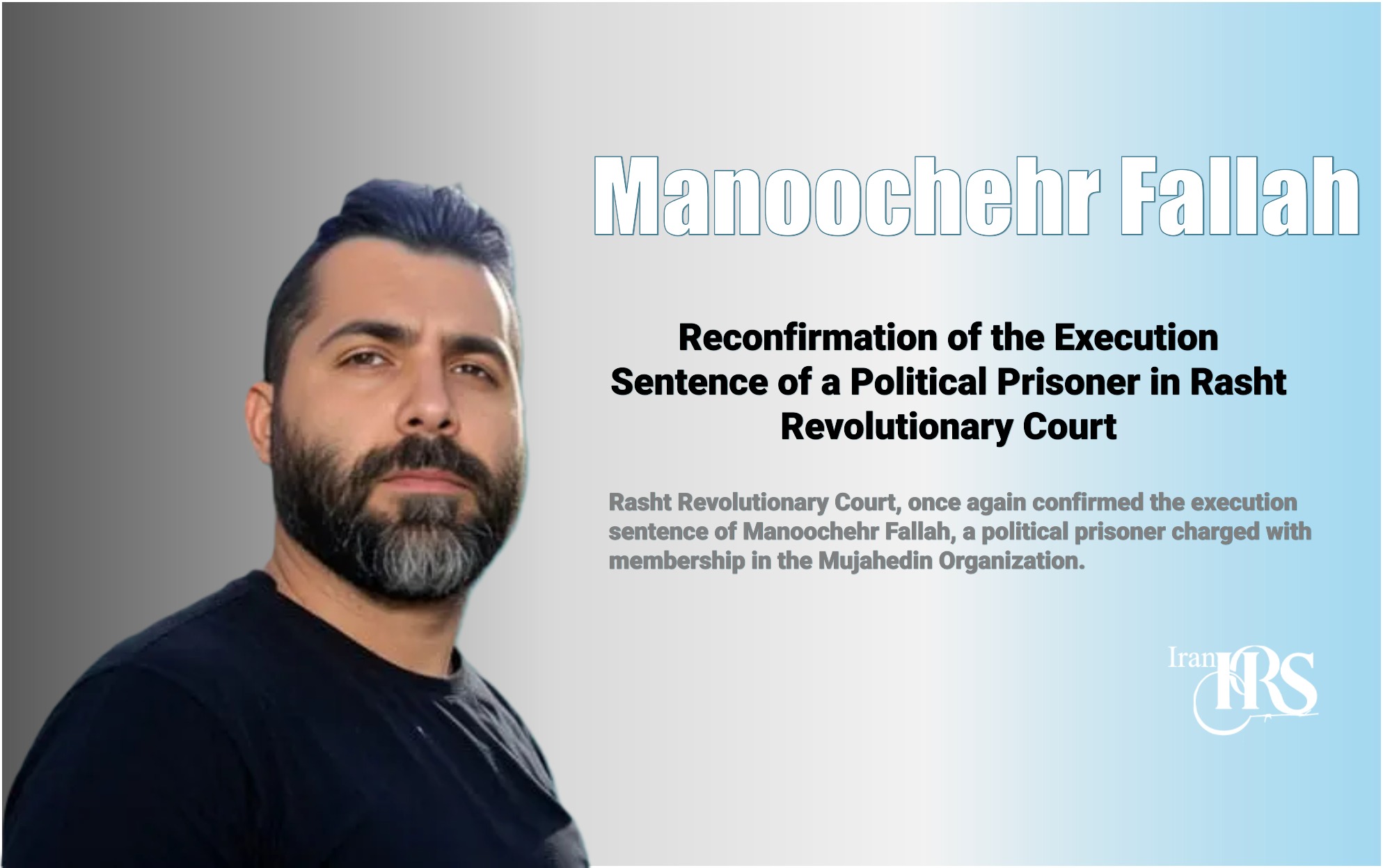
Rasht Revolutionary Court once again confirmed the execution sentence of Manoochehr Fallah, a political prisoner held in Lakan Prison; a sentence that remains in effect after multiple rejections of retrial requests.
Iran Human Rights Society, Wednesday, May 21, 2026 – Rasht Revolutionary Court, presided over by Ahmad Darvish-Goftar, in May once again confirmed the execution sentence of Manoochehr Fallah, a political prisoner charged with membership in the Mujahedin Organization. This decision was made after the Supreme Court referred his case back to Rasht Revolutionary Court for re-examination. Manoochehr Fallah, 36 years old, one of those arrested in the nationwide protests, has been imprisoned in Lakan Prison in Rasht since June 18, 2023.
Reconfirmation of the Execution Sentence in Rasht Revolutionary Court

According to published reports, Rasht Revolutionary Court, presided over by Ahmad Darvish-Goftar, has once again confirmed the execution sentence of this political prisoner.
This is while previously the Supreme Court had also rejected his retrial and cassation requests. On October 25, 2025, Branch Nine of the Supreme Court rejected Manoochehr Fallah’s retrial request, and about two weeks before that, Branch 39 of the Supreme Court had not accepted his cassation appeal.
Sources close to the case say that during the retrial examination, the presiding judge told the case lawyer: “We have executed people for less than this.”
These statements have faced reactions from human rights activists, and they have considered it a sign of the security-oriented and non-independent approach of the judiciary in dealing with political cases.
Who is Manoochehr Fallah?
Manoochehr Fallah, born in 1983, from and resident of Rasht and father of a 16-year-old daughter named “Asal”. Before his arrest, he worked as a sales visitor.
He is one of those arrested in the nationwide protests of 2022 and has been held in Lakan Prison in Rasht since June 18, 2023.
His initial charge was titled “propaganda against the regime” and in this regard he was sentenced to 11 months in prison. With the end of the sentence period and the setting of a 400 million toman bail, it was expected that he would be released, but judicial authorities prevented his release and opened a new case against him.
Subsequently, the charge of “moharebeh through action against national security” was added to his case; a charge that ultimately paved the way for the issuance of an execution sentence.
Details of the Case and the Charge of Explosion in Front of the Judiciary
In the indictment issued against Manoochehr Fallah, it is claimed that in June 2023 he exploded a “sound bomb” in front of the entrance door of the Gilan Judiciary.
However, based on the official expert opinion present in the case, this explosion only caused minor damage to the iron door and stone facade of the building, and the amount of damage is estimated at about 15 million tomans.
After the complaint by the Human Resources and Finance Deputy of the Judiciary, other charges such as “propaganda against the regime”, “insulting Khamenei” and “destruction” were also added to the case.
Human rights activists say that the use of general and security charges along with the charge of “moharebeh” in recent years has become one of the tools of the judiciary for issuing heavy sentences against protesters and political prisoners.
Continuation of Judicial Pressure on Political Prisoners
Manoochehr Fallah’s case continues in conditions where in recent months pressure on political prisoners and those arrested in protests has increased.
Human rights organizations have repeatedly warned that the judiciary, under the influence of security institutions, especially the IRGC and the Ministry of Intelligence, does not have the necessary independence in many political cases and fair trial procedures are not fully observed.
Civil activists say that in many security cases, defendants are deprived of effective access to an independent lawyer, public trial, and the possibility of free defense, and heavy sentences are issued in a security atmosphere.
Human Rights Violation; Issuance of Execution Sentence in a Security Case
Manoochehr Fallah’s case is an example of the widespread use of security charges and heavy sentences against those arrested in protests in Iran.
Violated Articles:
- Violation of the right to a fair trial – Article 10 of the Universal Declaration of Human Rights: Repeated rejection of retrial and the statements of the case judge about the implementation of execution sentences have increased concerns about the independence and impartiality of the judicial process.
- Violation of the principle of proportionality of crime and punishment – Fundamental principles of criminal law: Issuing an execution sentence in a case where, according to the expert report, only limited damage was caused to the building, is in conflict with the principle of proportionality of crime and punishment.
- Violation of the right to freedom of expression and belief – Article 19 of the Universal Declaration of Human Rights: Adding charges such as “propaganda against the regime” and “insult” to political cases is considered part of restricting freedom of expression and suppressing critics.
- Violation of the right to freedom and personal security – Article 9 of the Universal Declaration of Human Rights: Preventing the release of the prisoner after the end of the initial sentence and opening a new security case is an example of judicial pressure and violation of personal security.
See also the below articles:
- Global Reflection of Reports by the Iran Human Rights Society in Mezopotamya
- Concerns Mount for Political Prisoner Mohammad Ali Omouri Nejad After Secret Transfer
Follow Iran Human Rights Society on social networks:
Telegram /Twitter /Instagram / YouTube / Facebook
Join Iran Human Rights Society on Twitter