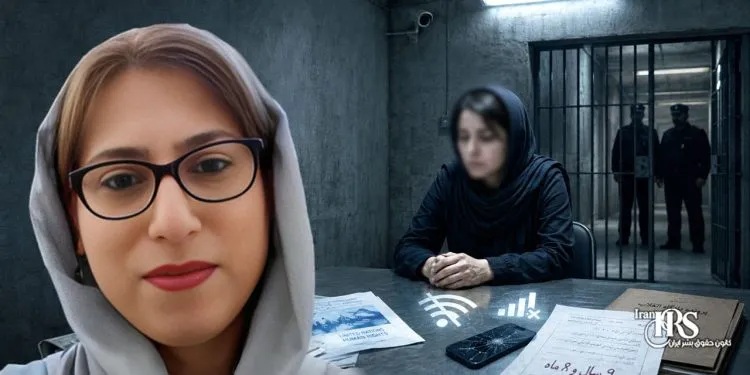
Ghazal Marzban, charged with sending human rights violation reports to the United Nations, was sentenced by Branch 26 of Tehran Revolutionary Court to 9 years and 8 months in prison.
Iran Human Rights Society, Thursday, May 21, 2026 – Ghazal Marzban, a 37-year-old human rights activist, was sentenced by Branch 26 of Tehran Revolutionary Court presided over by Judge Iman Afshari to 9 years and 8 months in prison. This sentence was issued while she was subjected to pressure for forced confessions after her arrest by IRGC Intelligence forces, and security agents have threatened her with non-merging of sentences and serving the full prison term.
Issuance of Heavy Sentence Against Ghazal Marzban
According to published reports, Ghazal Marzban was sentenced to five years in prison on the charge of “assembly and collusion”, to four years in prison on the charge of “promoting killing”, and to eight months in prison on the charge of “propaganda against the regime”.

This sentence was issued by Branch 26 of Tehran Revolutionary Court presided over by Judge Iman Afshari and notified to her.
Informed sources say that security agents have threatened this prisoner that they will not allow the merging of sentences and she must spend her entire sentence period in prison.
According to these sources, these threats have been made in order to put pressure on Ghazal Marzban to cooperate with intelligence institutions and express remorse.
Arrest by IRGC Intelligence and Transfer to an Unknown Location
Ghazal Marzban was arrested at midnight on Thursday, January 15, 2026 during an attack by plainclothes IRGC Intelligence agents on her home in Tehran.
According to reports, after entering the home, security agents transferred her to an unknown location and her family was uninformed about her place of detention and condition for some time.
Human rights sources say that after her arrest she was subjected to severe pressure for forced confessions.
According to these sources, security agents threatened Ghazal Marzban that if she does not cooperate, “they will take her somewhere where no Arab has thrown” [literal]; a threat that human rights activists consider a sign of security pressures and efforts to create fear among detainees.
Pressure on Information Dissemination in the Context of Internet Shutdown
Ghazal Marzban’s case has been raised in conditions where simultaneously with the intensification of the security atmosphere and widespread internet shutdown in Iran, the government has tried to limit the flow of information about arrests, the situation of prisoners, and cases of human rights violations.
Human rights activists say that security institutions are even sensitive to the publication of the smallest information about political and security cases and heavy punishments are considered for independent information dissemination.
In the opinion of these activists, charging individuals who transfer news or reports of human rights violations to international institutions is part of the government’s policy to prevent breaking the information blockade and preventing the connection of society with the outside world.
In recent months, numerous reports have also been published about the arrest of civil activists, journalists, and citizens who have published news of suppression and human rights violations.
History of Arrest and Hunger Strike
Ghazal Marzban had previously faced a judicial case as well. She was sentenced in January 2025 by Branch 26 of Tehran Revolutionary Court to six months in prison and 74 lashes.
After her arrest and serving some time in Evin Prison, she went on a hunger strike and was eventually released on bail.
Human rights activists say that the repetition of case-building and issuance of heavy sentences against civil and human rights activists is part of the policy of intensifying suppression in recent months.
Human Rights Violation; Security Pressure to Silence Information Dissemination
Ghazal Marzban’s case is an example of security confrontation with human rights activists and efforts to prevent the publication of reports on human rights violations in Iran.
Violated Articles:
- Violation of the right to freedom of expression – Article 19 of the Universal Declaration of Human Rights: Sentencing due to sending human rights reports and informing about the situation of prisoners and suppressions violates the right to freedom of expression and free access to information.
- Violation of the right to a fair trial – Article 10 of the Universal Declaration of Human Rights: Applying security pressure, threatening the defendant, and lack of independent trial conditions violate the principles of fair trial.
- Violation of the prohibition of torture and forced confession – Article 5 of the Universal Declaration of Human Rights: Pressure for obtaining forced confessions and security threats against the prisoner are examples of inhuman and degrading treatment.
- Violation of the right to freedom and personal security – Article 9 of the Universal Declaration of Human Rights: Arrest by security forces and transfer to an unknown location without transparent notification to the family violates the right to freedom and personal security.
See also the below articles:
- Manoochehr Fallah Execution Sentence Confirmed in Rasht Court
- Global Reflection of Reports by the Iran Human Rights Society in Mezopotamya
Follow Iran Human Rights Society on social networks:
Telegram /Twitter /Instagram / YouTube / Facebook
Join Iran Human Rights Society on Twitter